
Defense Industrial Base: DOD Efforts to Develop Domestic Biomanufacturing
Fast Facts
Biomanufacturing uses biological materials to create new materials. For example, bioengineered spider silk is lighter than carbon fiber and stronger than Kevlar—making it well-suited for many Department of Defense uses. Biomanufacturing can help address supply chain issues and lessen reliance on foreign sources.
This Q&A reviews DOD's efforts to support domestic biomanufacturing.
Since 2020, DOD has invested about $965 million in this area. DOD worked with industry partners to build biomanufacturing facilities. It's also supported labs to bring projects to large-scale production.
DOD expects to complete a roadmap of future plans in 2026.
Racks of test tubes, sample vials, and stacks of petri dishes with bright red liquid or gel in them on a white countertop.
Highlights
What GAO Found
The Department of Defense (DOD) works to ensure a healthy, resilient defense industrial base. DOD has identified risks to the industrial base, including an overreliance on foreign suppliers. Biomanufacturing is potentially key to mitigating such risks.
Biomanufacturing is a type of production that uses biologically derived components, such as living cells or microorganisms to create and produce new materials. According to DOD officials biomanufacturing has the potential to create material for a wide range of applications, such as explosives, body armor, and solvents to maintain weapon systems. Biomaterials can also expand or create new defense capabilities or replace other products and components that are critical to DOD with materials that are domestically sourced, cheaper, and safer.
Notional Biomanufacturing Process
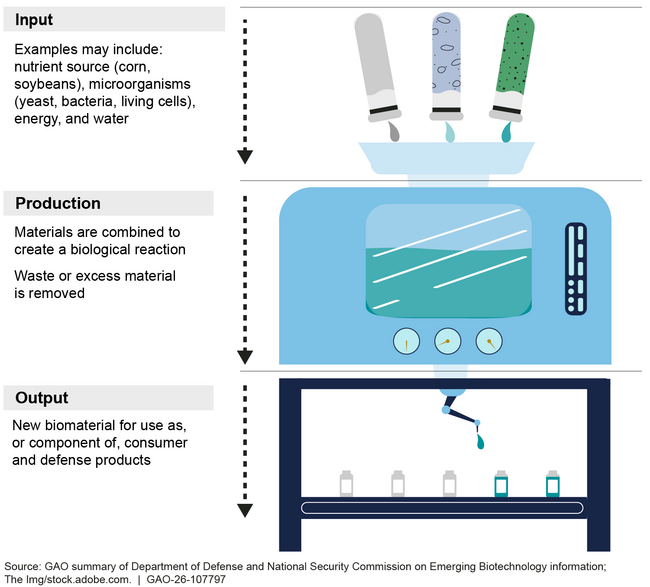
Biomanufacturing development evolves over a multi-stage process. It starts with producing small quantities of materials through work in laboratories and advances to commercial-scale production through testing and demonstration. As projects scale up, researchers need appropriately sized and equipped facilities for each stage.
Notional Biomanufacturing Development Stages and Production Quantities
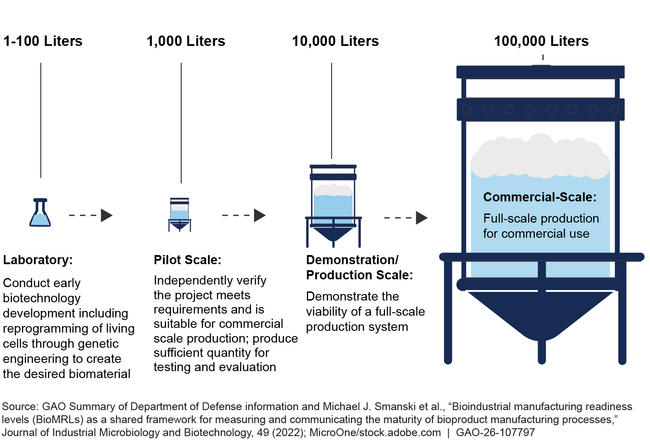
DOD’s Office of Industrial Base Policy and the Office of the Under Secretary of Defense for Research and Engineering (OUSD (R&E)) identified that the U.S. does not have sufficient infrastructure necessary to support the advancement of promising biotechnology projects from the laboratory to commercial production and to establish new supply chains, particularly pilot-scale facilities.
Since 2021, DOD has invested $965.2 million across three initiatives designed to support promising biotechnology projects and establish domestic biomanufacturing supply chains. These efforts include:
- investing in biomanufacturing projects developed in military department laboratories to further mature into products that the warfighter can use,
- collaborating with industry and other partners to build a network of biomanufacturing facilities across the U.S.,
- and providing support for industry partners to plan and construct commercial-scale production facilities in the U.S. for biomaterials with both defense and commercial applications.
DOD’s plans for supporting biomanufacturing in the future are pending but DOD’s forthcoming biotechnology roadmap will provide more insights. In the meantime, DOD plans to end two of the three initiatives after fiscal years 2027 and 2028, respectively. In addition, other efforts are many years away from being operational. Congress required DOD to develop the roadmap and include general strategic investment priorities, goals, funding requirements, and milestones for its biotechnology efforts. OUSD (R&E) expects to complete this roadmap by September 2026, which should provide more insight into its future investments. GAO will continue to monitor DOD’s progress toward completing this roadmap.
Why GAO Did This Study
A House Report accompanying a bill for the Servicemember Quality of Life Improvement and National Defense Authorization Act for Fiscal Year 2025 includes a provision for GAO to review DOD’s investments in biotechnology and biomanufacturing. In addition, the final bill includes a provision for GAO to evaluate a roadmap of DOD’s biotechnology efforts once DOD has completed it. This report describes DOD’s recent efforts to accelerate its use of biotechnology and strengthen the domestic biomanufacturing industrial base.
To do this work, GAO reviewed DOD documents and data, conducted a site visit to an Army biomanufacturing facility that was constructed with support from one of the biomanufacturing initiatives, and interviewed agency officials.
For more information, contact William Russell at russellw@gao.gov.