
Military Installations: DOD Should Improve Natural Disaster Cost Tracking and Planning for Resilience Improvements
Fast Facts
Natural disasters have caused billions of dollars in damage to military installations over the past decade.
Military installations we reviewed have taken steps to improve resilience to prevent or minimize future damages, such as elevating buildings or designing roofs to withstand high speed winds. But DOD's data collection doesn't include all natural disasters—for example, earthquakes—which makes it harder to track recovery costs and effects of extreme weather.
In some cases, installations hadn't planned for the data and resources they would need to pursue certain resilience improvements.
Our recommendations address these issues.
Damage from Hurricane Michael at Tyndall Air Force Base, 2018
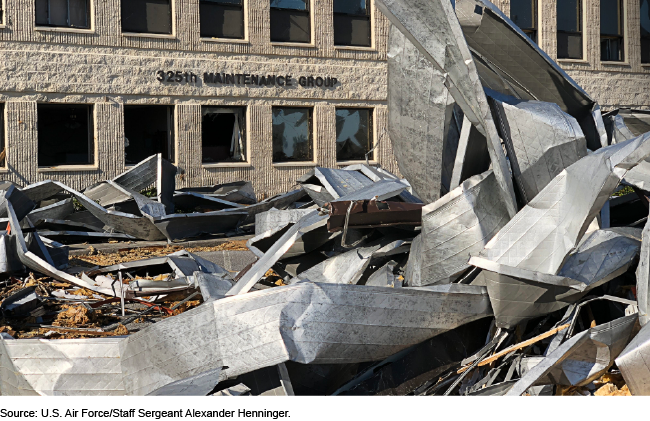
Piles of rubble and twisted metal sit in front of a building with broken windows. A sign on the building says 325th Maintenance Group.
Highlights
What GAO Found
Natural disasters at military installations have resulted in significant costs and damages since 2015, but the Department of Defense (DOD) has not comprehensively tracked data related to those costs. In 2024, DOD began an effort to track the effects of extreme weather at military installations. However, GAO identified gaps in the scope of DOD’s data collection and its ability to collect complete and accurate data on disaster recovery costs. Specifically, DOD’s data collection is limited to the effects of extreme weather, which does not include the full scope of natural disasters, including seismic events such as earthquakes. Also, data DOD collects on the cost of extreme weather at installations may be inaccurate or incomplete in some cases, in part due to the timing of when installations are expected to report the information. Expanding the scope of its data collection to include all types of natural disasters and establishing a process to ensure cost data are complete and accurate can improve DOD’s ability to anticipate future disaster recovery needs.
Figure: Examples of Natural Disasters at Military Installations
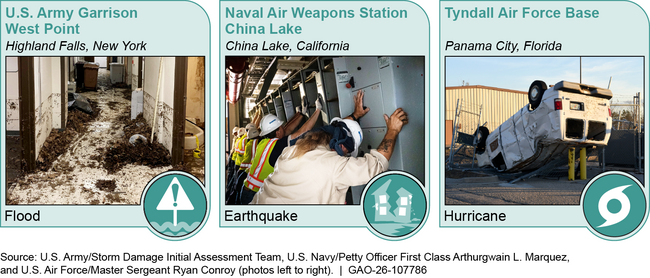
DOD has taken steps to increase installations’ disaster resilience—including implementing resilience improvements at the 12 installations GAO examined—but gaps in planning may limit these efforts. GAO identified some instances when installations were unable to pursue resilience improvements due to not having necessary data or sufficient funding. Installations are working to implement a statutory requirement to include resilience information as part of their master plans. This includes the identification of current and future risks and ongoing or planned projects to mitigate those risks. DOD policy reflects this requirement and addresses how resilience should be incorporated into construction projects, such as by adhering to Unified Facilities Criteria (DOD’s standards for design and construction of facilities). However, existing DOD and military department guidance does not address how installations should use the master plan resilience information when recovering from a disaster. By including such information in guidance, the military departments can help ensure that installations affected by disasters are better able to incorporate resilience improvements while quickly restoring essential capabilities.
Why GAO Did This Study
Extreme weather and natural disasters have resulted in billions of dollars of damages to military installations over the past decade. Such damages can affect DOD’s ability to execute its mission and disrupt installation resources that support service members and their families.
Senate Report 118-58, accompanying a bill for the National Defense Authorization Act for Fiscal Year 2024, includes a provision for GAO to assess DOD’s recovery from natural disasters at military installations. GAO examined the extent to which DOD has (1) tracked costs and damages associated with natural disasters since 2015 and (2) increased resilience of selected installations affected by natural disasters.
GAO reviewed documentation and interviewed officials from a non-generalizable sample of 12 installations on disaster damages and resilience improvement efforts and conducted in-person site visits at three of these installations. GAO analyzed annual and supplemental appropriations to identify funds designated for disaster recovery. GAO also reviewed documentation and interviewed DOD and military department officials related to installations’ recovery efforts and collection of related data.
Recommendations
GAO is making five recommendations, including that DOD improve its efforts to collect data on the effects of extreme weather at installations and that the military departments issue guidance to enhance the use of resilience information in installation master plans. DOD concurred with GAO’s recommendations.
Recommendations for Executive Action
| Agency Affected | Recommendation | Status |
|---|---|---|
| Department of Defense | The Secretary of Defense should ensure that the Under Secretary of Defense for Acquisition and Sustainment expands the scope of data collection on the costs and effects of extreme weather and incremental change at military installations to include all types of natural disasters affecting military installations. (Recommendation 1) |
The Department of Defense concurred with this recommendation and cited plans to expand the scope of its data collection to include all types of natural disasters. In June 2026, DOD stated it will update the list of natural hazards to be included within the scope of its data collection for fiscal year 2027. The agency estimated these actions will be completed in October 2026. When we confirm what actions the agency has taken in response to this recommendation, we will provide updated information.
|
| Department of Defense | The Secretary of Defense should ensure that the Under Secretary of Defense for Acquisition and Sustainment establishes a process to ensure the collection of complete disaster recovery cost data from installations and that installations update the data as more accurate information and estimates become available. (Recommendation 2) |
The Department of Defense concurred with this recommendation and cited plans to strengthen the methodology for its data collection to ensure complete and accurate disaster recovery cost information is obtained. In August 2026, DOD stated its web-based data call format implemented for fiscal year 2026 allows installations to update previously submitted information, including for disaster costs. DOD officials stated additional updates to the data call web-based form and associated instructions will be made for fiscal year 2027 to fully address this recommendation. When we confirm what actions the agency has taken in response to this recommendation, we will provide updated information.
|
| Department of the Army | The Secretary of the Army should issue guidance that clearly identifies how installations should use installation master plan resilience information when recovering from a natural disaster. (Recommendation 3) |
The Department of the Army concurred with this recommendation. In June 2026, DOD cited ongoing efforts to coordinate a memorandum with the military departments to address how installation master plan resilience information should be used for natural disaster recovery. According to DOD, once it issues this memorandum, the Army will update its policy directive in accordance with DOD's memo. The Army estimates these actions will be completed in December 2026. When we confirm what actions the agency has taken in response to this recommendation, we will provide updated information.
|
| Department of the Navy | The Secretary of the Navy should issue guidance that clearly identifies how installations should use installation master plan resilience information when recovering from a natural disaster. (Recommendation 4) |
The Department of the Navy concurred with this recommendation. In June 2026, DOD cited ongoing efforts to coordinate a memorandum with the military departments to address how installation master plan resilience information should be used for natural disaster recovery. According to DOD, once it issues this memorandum, the Navy will issue policy guidance consistent with DOD's memo. The Navy estimates these actions will be completed in April 2028. When we confirm what actions the agency has taken in response to this recommendation, we will provide updated information.
|
| Department of the Air Force | The Secretary of the Air Force should issue guidance that clearly identifies how installations should use installation master plan resilience information when recovering from a natural disaster. (Recommendation 5) |
The Department of the Air Force concurred with this recommendation. In June 2026, DOD cited ongoing efforts to coordinate a memorandum with the military departments to address how installation master plan resilience information should be used for natural disaster recovery. According to DOD, once it issues this memorandum, the Air Force will update its policy directive to reflect the language of DOD's memo. The Air Force estimates these actions will be completed in April 2028. When we confirm what actions the agency has taken in response to this recommendation, we will provide updated information.
|