
Head Start: Office of Head Start Could Improve Communication with Tribal Programs
Fast Facts
Tribal Head Start programs help children in poverty get ready for school while incorporating Native language, culture, and traditions. But some Tribal Head Start programs reported challenges with enrollment, such as trouble hiring and retaining the staff needed to support the children.
Health and Human Service's Office of Head Start helps Tribal Head Start programs comply with federal requirements and navigate such challenges. However, some Tribal Head Start program officials told us they struggled with slow, conflicting, or no response when communicating with the agency.
Our recommendation addresses these issues.
A Playground with Native Elements at a Tribal Head Start Program
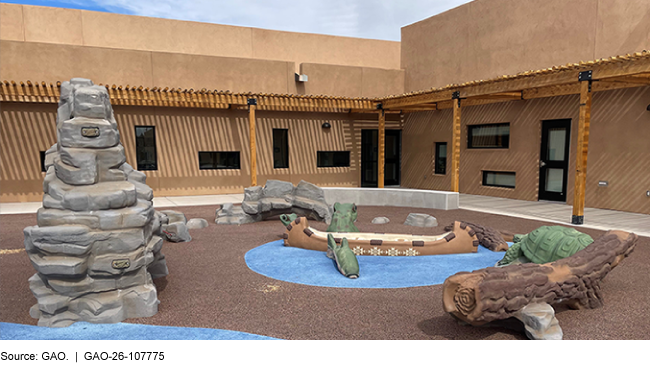
A courtyard in a pueblo-style building with playground climbing structures shaped like rocks, turtles, logs, and a canoe
Highlights
What GAO Found
The Office of Head Start (OHS) provides funding and technical assistance to support Tribal Head Start programs in teaching Native languages and culture. In fiscal year 2024, OHS provided $345 million for Tribal Head Start programs. OHS also provided training to 141 Tribal Head Start programs related to incorporating Native language, culture, and traditions in recent years. Each of the 10 selected Tribal Head Start programs GAO interviewed used immersion, dual language classrooms, or short language lessons to teach Native languages, as allowed by the Head Start Program Performance Standards.
Indigenous Cultural Themes Incorporated into a Tribal Head Start Playground
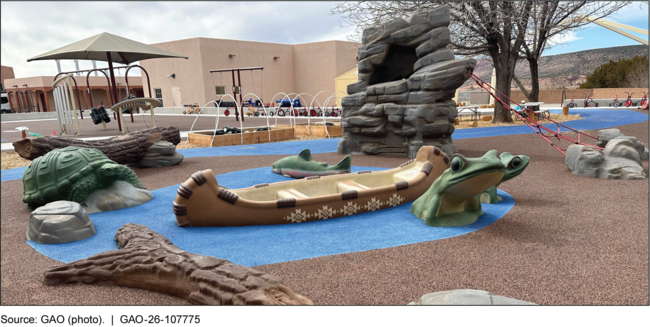
OHS offers Tribal Head Start programs flexibilities, training, and technical assistance to help address enrollment concerns. Officials from selected Tribal Head Start programs spoke positively of support from OHS but reported communication challenges with OHS involving timeliness that impacted their use of the flexibilities. For example, to address challenges with hiring or retaining qualified staff, Head Start programs can apply for approval to reduce the number of program seats they are required to fill and may use funds from leftover seats to raise staff wages. In fiscal year 2024, OHS took an average of 199 days to communicate approval decisions to Tribal Head Start programs.
OHS reported a new intake process in August 2024. This reduced the average time to 91 days for the nine requests that were submitted after the new process began and were completed as of July 2025. However, 35 requests that were also submitted after the new process began were pending as of September 2025, with time frames ranging from 15 to 308 days. Five of 10 selected Tribal Head Start programs GAO interviewed in 2025 also said they did not receive timely communication from OHS about such requests, and one reported the lack of communication limited its ability to increase teacher compensation. OHS has not identified and addressed the causes of timeliness challenges, reported by selected Tribal Head Start programs, in its communication with the programs related to increasing enrollment. By doing so, OHS could help tribal programs avoid delays in their efforts to improve their enrollment numbers.
Why GAO Did This Study
According to OHS, Tribal Head Start programs are key to preserving and promoting Native language, culture, and traditions. They also help fulfill the federal government’s trust responsibility to protect the interests of Tribal Nations. Yet, enrollment in Tribal Head Start programs has declined in recent years, from about 26,000 in school year 2018-2019, to about 18,000 children in school year 2023-2024.
GAO was asked to review the role of Tribal Head Start programs in promoting Native language and culture as well as their declining enrollment. Among other things, this report examines OHS’s support for tribal programs in teaching Native language and culture and the extent to which OHS helps programs address their enrollment challenges.
GAO interviewed a nongeneralizable sample of 10 Tribal Head Start programs. Tribal programs were selected to reflect a variety of regions, experience operating Head Start programs, and enrollment. GAO conducted site visits to eight of the selected programs. GAO also analyzed the most recent OHS data, reviewed relevant federal laws, regulations, and guidance, and interviewed OHS officials.
Recommendations
GAO is recommending that OHS identify and address the causes of timeliness challenges in its communication with Tribal Head Start programs related to improving enrollment. OHS concurred with our recommendation.
Recommendations for Executive Action
| Agency Affected | Recommendation | Status |
|---|---|---|
| Department of Health and Human Services | The Secretary of HHS should ensure OHS identifies and addresses the causes of challenges in the timeliness and consistency of its communication with Tribal Head Start programs related to improving enrollment. (Recommendation 1) |
HHS agreed with this recommendation. HHS said OHS would assess current communication practices and implement standardized procedures to improve timeliness, consistency, and clarity in its engagement with Tribal Head Start programs. OHS recognizes that enrollment remains an ongoing challenge for Tribal Head Start programs, with factors including workforce shortages and transportation limitations, and would incorporate these considerations into its efforts. We will monitor the agency's progress to address this recommendation.
|