
Commercial Shipbuilding: Selected Offshore Wind Projects Used a Mix of U.S. and Foreign Vessels, Spurring Some Shipbuilding Investments
Fast Facts
By law, some of the ships used to build offshore wind farms must be U.S. flag—i.e., built and registered in the U.S. and largely crewed by domestic mariners. Such projects may help increase investment in the U.S. maritime industry, which plays a vital role in national security.
We reviewed the extent to which U.S. ships and crews carried out offshore wind projects.
For the 3 projects we reviewed, 80% of the ships were U.S. flag. The other 20% were large, specialized foreign vessels. Since the foreign vessels were larger and required more crew, a similar number of foreign and domestic mariners worked on these projects.
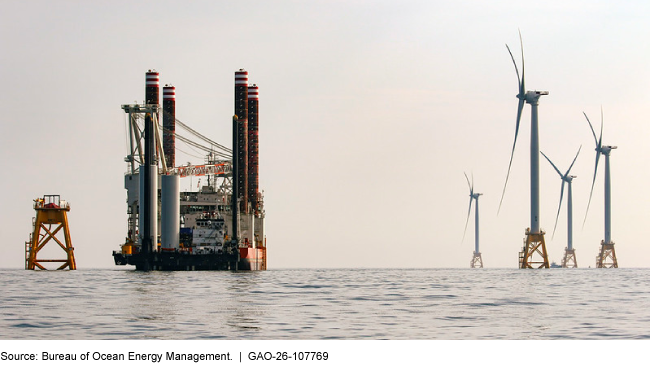
An installation vessel installing turbines in the water at a U.S. offshore wind project.
Highlights
What GAO Found
Constructing offshore wind projects requires numerous oceangoing vessels (offshore wind vessels). Under the Jones Act and other coastwise laws, vessels used for some U.S. offshore wind activities must be U.S. flag—built and registered in the U.S. and largely crewed by domestic mariners. GAO identified more than 300 unique vessels involved in the construction of three selected U.S. offshore wind projects in the Atlantic Ocean. About 80 percent were U.S.-flag. These U.S.-flag vessels were generally smaller and conducted support activities like ferrying workers and surveying cable routes. About 20 percent of the vessels were foreign-flag; many were large, specialized vessels for which there were no U.S.-flag counterparts. GAO estimated that a similar number of foreign and domestic mariners worked across the vessels for the three selected projects, since the larger, more complex foreign-flag vessels required more mariners.
A Foreign Vessel Installing Turbines at a U.S. Offshore Wind Project
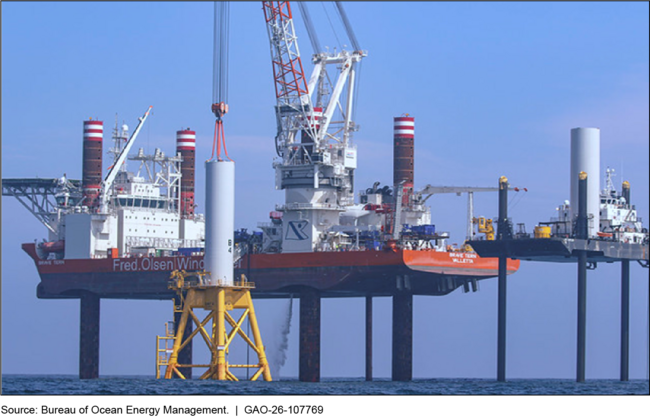
Note: Wind turbine installation vessels often have “legs” capable of extending to the seafloor, allowing the vessel to become a fixed platform.
Fifty new offshore wind vessels, according to the American Clean Power Association, had been delivered, were under construction, or were on order at U.S. shipyards. Constructing all these vessels could generate revenue at almost 20 shipyards across a dozen states. Most are for support vessels, but U.S. vessel owners also invested in two larger, specialized U.S.-built installation vessels. None of the vessel construction was financed using Maritime Administration assistance programs. According to vessel owners GAO interviewed, that was, in part because the application process took too long. Maritime Administration officials said their review process takes, at best, 6 to 9 months. The vessel owners said it often takes much longer. They also said additional vessel construction was unlikely given a lack of future projects.
Why GAO Did This Study
Concerns over the state of U.S. commercial shipbuilding have grown in recent years. Proponents of offshore wind suggest the demands of the industry may provide opportunities to invest in new vessels at U.S. shipyards. Since 2010, the Department of Interior (Interior) has granted about 40 offshore wind leases to commercial developers. Five projects were under construction, as of December 2025. In 2025, the White House took steps to suspend offshore wind development pending review.
GAO was asked to review the extent to which the U.S. maritime industry is constructing U.S. offshore wind projects. This report discusses (1) the extent to which U.S.-flag vessels and domestic mariners were used at selected offshore wind projects and (2) investments in U.S.-built offshore wind vessels, including any use of Maritime Administration financial assistance programs.
GAO selected three offshore wind projects under construction as of August 2025 and analyzed developer-provided data on the vessels used as of November 2025. GAO estimated the range in number of mariners on these vessels based on vessel specifications and discussions with the U.S. Coast Guard and a mariners’ union. GAO reviewed an August 2025 study on investments in offshore wind vessels by the American Clean Power Association; spoke with 11 vessel owners and 11 stakeholders identified based on their expertise; reviewed relevant laws; and interviewed officials from the Maritime Administration, Interior, Department of Energy, and Department of Homeland Security.
For more information, contact Andrew Von Ah at VonAha@gao.gov.