
Border Security: Additional Information Could Inform Enforcement Decisions for Noncitizens Paroled at the Southwest Border
Fast Facts
Customs and Border Protection can grant parole to noncitizens, giving them temporary permission to stay in the United States. CBP granted roughly 2.4 million paroles at the southwest border from late 2018 through May 2025.
Once parole is granted, Immigration and Customs Enforcement is supposed to monitor them to make sure they follow release requirements, like attending immigration court proceedings.
But ICE doesn’t readily have information to identify people who were paroled at the southwest border and doesn’t monitor them as required.
Our recommendation addresses this issue.
U.S. Customs and Border Protection Port of Entry in San Diego, California
A concrete building wall that says San Ysidro Land Port of Entry, West Pedestrian Facility
Highlights
What GAO Found
From October 2018 through May 2025, U.S. Customs and Border Protection (CBP) granted about 2.4 million paroles—temporary permission for a noncitizen to stay in the U.S.—out of its nearly 10.4 million encounters at the southwest border (see figure). Over half were to Mexicans, Cubans, and Venezuelans.
CBP Paroles and Encounters at the Southwest Border, October 2018–May 2025
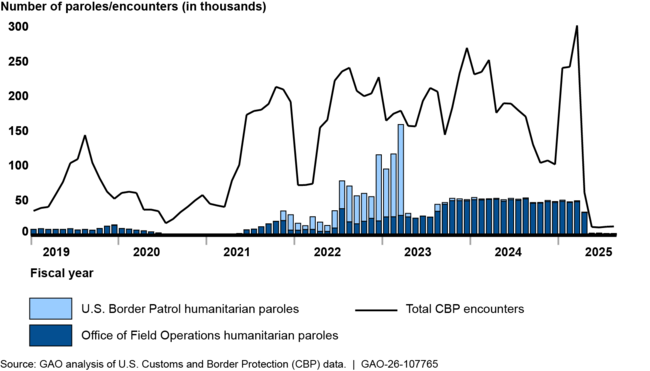
CBP implemented policies in 2021 expanding the use of humanitarian parole to help manage increasing encounters at the southwest border. In July 2021, CBP’s U.S. Border Patrol authorized agents to parole apprehended noncitizens on a case-by-case basis under certain conditions, such as limited immigration detention space. Further, in May 2023, CBP expanded access for noncitizens to use the CBP One mobile application to schedule appointments for CBP Office of Field Operations (OFO) officers to inspect them. Almost all (97 percent) appointments in fiscal years 2023 and 2024 resulted in paroles. Noncitizens paroled under the policies were generally placed in removal proceedings. Since January 2025, Border Patrol and OFO implemented guidance and policies restricting the use of parole and the number of paroles decreased substantially.
Once noncitizens are paroled at the southwest border, U.S. Immigration and Customs Enforcement (ICE) is responsible for monitoring them to ensure they adhere to the conditions of their release. For example, ICE may require assurances that they attend their removal proceedings. In January 2025, the Department of Homeland Security (DHS) and ICE issued guidance that emphasized the importance of ICE reviewing these cases to determine whether further enforcement action is appropriate. However, ICE does not have the information it needs to readily identify noncitizens CBP paroled at the southwest border and does not monitor them as required. By obtaining this information from CBP, ICE would be better positioned to monitor these noncitizens, review their cases, and take enforcement action, in accordance with DHS and ICE guidance.
Why GAO Did This Study
Within DHS, CBP is responsible for securing U.S. borders while facilitating legitimate travel and trade. CBP encounters noncitizens at the southwest border at and between ports of entry. CBP has discretion to grant parole—temporary permission to stay in the U.S.—to noncitizens it encounters for urgent humanitarian reasons or significant public benefit. CBP’s OFO and Border Patrol are responsible for securing the border at and between ports of entry. ICE, also within DHS, is responsible for monitoring paroled noncitizens to ensure they adhere to the conditions of their release.
GAO was asked to review CBP’s use of humanitarian parole at the southwest border and ICE’s enforcement efforts for paroled noncitizens. This report examines (1) what CBP data show about the number and characteristics of humanitarian paroles at the southwest border since fiscal year 2019; (2) how CBP has used humanitarian parole in processing noncitizens encountered at the southwest border; and (3) ICE’s monitoring and enforcement efforts related to those noncitizens. GAO analyzed CBP and ICE documents, and CBP data on paroles granted at the southwest border from October 2018 through May 2025. GAO also interviewed officials from (1) CBP and ICE headquarters, (2) selected CBP field locations that collectively granted more than half of paroles over the time period, and (3) selected ICE field offices responsible for monitoring noncitizens.
Recommendations
GAO is recommending ICE obtain information from CBP on the parole status of noncitizens CBP paroled at the southwest border and make that information accessible to relevant ICE officials, to inform ICE’s monitoring and enforcement decisions. DHS concurred with the recommendation.
Recommendations for Executive Action
| Agency Affected | Recommendation | Status |
|---|---|---|
| United States Immigration and Customs Enforcement | The Director of ICE should obtain information from CBP on the parole status of noncitizens CBP paroled at the southwest border and make that information accessible to relevant ICE officials to inform ICE's monitoring and enforcement decisions. (Recommendation 1) |
DHS concurred with our recommendation. DHS stated that ICE's Enforcement and Removal Operations (ERO) is modernizing its systems to improve visibility into a noncitizen's full immigration history, and as part of this effort, ERO plans to work with CBP as appropriate to obtain any additional data needed on paroled noncitizens. If these modernization efforts result in ERO obtaining and sharing readily accessible data on the parole status of noncitizens CBP paroled at the southwest border, these actions should address our recommendation.
|