
K-12 Education: Lessons Learned from Implementing COVID-19 Relief Funding Provisions Could Improve Future Grant Monitoring
Fast Facts
Billions of dollars in federal grants were provided to schools during COVID-19. There are longstanding concerns that when federal grants end, states bridge the gap by cutting funding for disadvantaged students. To mitigate this, Congress designed COVID-19 grant provisions to protect low-income schools from bearing the brunt of such cuts.
The Department of Education oversaw states' efforts to meet grant requirements. But we found that Education could have improved their efforts. For example, unreliable and incomplete data prevented Education from knowing if states identified their poorest districts.
Our recommendations address this and more.

Multiple children with their hand raised looking towards an adult pointing in a classroom setting.
Highlights
What GAO Found
Statutory Maintenance of Equity (MOEquity) requirements generally prohibited states and districts from disproportionately cutting funds from districts or schools serving high percentages of low-income students. Beginning in July 2021, the Department of Education provided guidance and technical assistance to help states and districts meet these requirements as part of receiving certain COVID-19 relief funding. Education officials said they developed and refined this guidance in real time. As a result, the agency did not develop internal written procedures for its staff to use when providing related technical assistance. Federal oversight and performance principles and practices note the importance of internal guidance and written documentation to ensure consistency. Without these, Education could not ensure states received consistent information on implementing MOEquity. Moreover, the risk of inconsistently applying guidance may increase with staff turnover, which Education said occurred during MOEquity implementation.
Selected State and District Maintenance of Equity Requirements
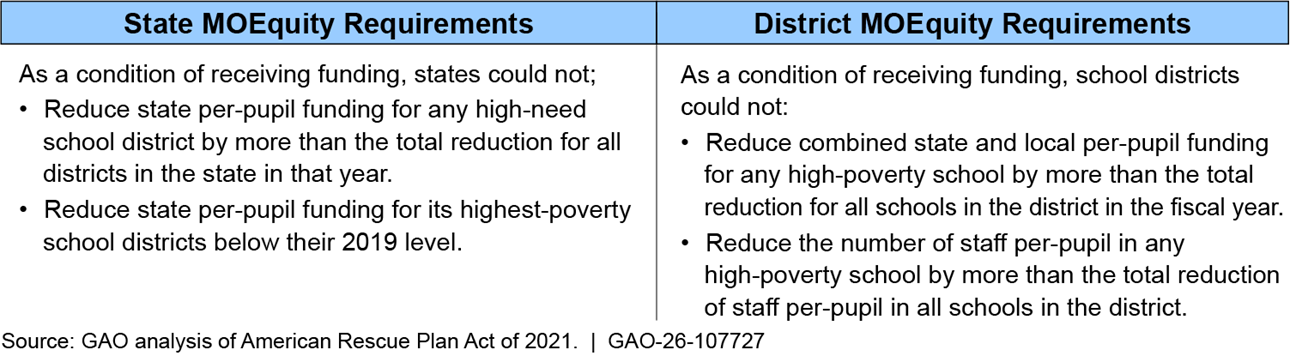
GAO's analysis of six states' data found that districts generally identified their poorest schools; however, Education lacked reliable data on how states implemented the state MOEquity requirements to identify their poorest districts. On average, high-poverty schools had more factors associated with need—for example, free or reduced-price lunch eligibility and students with disabilities—than other schools. However, because MOEquity required schools to be identified by district rather than statewide, MOEquity-identified high-poverty schools in a district were not always the poorest schools in the state. GAO could not determine if states paid appropriate districts or the total amounts paid in supplemental payments because of data reliability issues, such as duplicative or missing data. Education could not explain the data issues or provide documentation of data reliability procedures. Without reliable data, neither GAO nor Education could assess whether MOEquity requirements fully achieved their intended results.
Selected states and districts described challenges implementing MOEquity—e.g., staff capacity issues and limited access to data—and expressed interest in lessons learned, but Education officials said they did not document and share them because the agency does not have procedures ensuring it does so and it was not a priority at the time. Yet, Education officials noted that MOEquity provided an opportunity to inform how they may handle similar situations going forward. Key practices for effectively managing federal efforts include identifying and applying lessons learned for future decision making. Doing so limits the chance of recurrence of failures or difficulties. Absent a way to ensure Education identifies, documents, and shares lessons learned, insights from such efforts may be limited or lost.
Why GAO Did This Study
To receive certain funds under the American Rescue Plan Act of 2021, states and districts generally agreed to not make certain cuts. These include disproportionately cutting funds from districts or schools serving high percentages of economically disadvantaged students for fiscal years 2022 and 2023. GAO was asked to examine MOEquity implementation. This report addresses (1) how Education assisted states and districts in complying with MOEquity requirements; (2) what data show about state and district implementation of MOEquity; and (3) what challenges states and districts faced in implementing MOEquity and what lessons Education learned. GAO reviewed relevant federal laws and analyzed Education's MOEquity guidance and data. GAO also interviewed Education officials, as well as officials from seven states. GAO selected states for varied approaches to implementing MOEquity. In three of these states, GAO interviewed officials from districts that received the most supplemental funding. GAO also analyzed school-level data from six of these states that had reliable data for this analysis.
Recommendations
GAO is making three recommendations to Education: (1) develop internal written procedures for engaging in technical assistance for its grants; (2) establish procedures to ensure the reliability of data collected for grants oversight; and (3) develop a way to document and share key lessons learned from implementing major grant efforts, as appropriate. Education disagreed with the first two recommendations and partially agreed with the third. GAO maintains all three are warranted.
Recommendations for Executive Action
| Agency Affected | Recommendation | Status |
|---|---|---|
| Department of Education | The Secretary of Education should develop internal written procedures to use when engaging in technical assistance to ensure staff have a common understanding of the information program managers provide to grantees when overseeing grants. (Recommendation 1) |
Education disagreed with this recommendation. Education noted that for some programs such as Title I, Title II, or Title V of the Elementary and Secondary Education Act (ESEA), Education program offices retain internal banks of grantee questions and answers that are continually refreshed and vetted by attorneys and senior leadership to ensure consistent technical assistance to grantees. However, as our report noted, Education officials told us they did not document procedures-such as a MOEquity technical assistance plan-for how program managers would ensure they delivered consistent information to grantees. We continue to believe that all technical assistance efforts should be guided by internal written procedures to ensure guidance is applied consistently-in line with federal oversight and performance management principles and practices that stress the importance of doing so.
|
| Department of Education | The Secretary of Education should establish procedures to ensure the quality and reliability of data collected for grants oversight and technical assistance. (Recommendation 2) |
Education disagreed with this recommendation. Education stated noted that the agency has procedures in place to ensure the quality and reliability of data collected for grant oversight, as well as a Data Governance Board and data stewards in each office. However, during the course of our review, Education did not provide us with data reliability procedures or information about procedures used to review MOEquity data. In addition, Education officials stated that they could not answer questions about what steps they took or if they followed data reliability procedures to ensure the data submitted by states were complete and accurate. Education also did not address why there were inconsistences in its MOEquity data-inconsistencies that prevent Education and us from determining whether the application of state MOEquity requirements had the intended effect of targeting the highest need school districts. Education stressed that the MOEquity data collection was particularly challenging for the department and states-as we discuss in the report-because it was an entirely new requirement. We will need to obtain the procedures Education mentions to determine if the agency addressed this recommendation.
|
| Department of Education | The Secretary of Education should develop a way to ensure that, as appropriate, staff timely identify, document, and share any lessons learned from implementing new and ongoing initiatives that may inform future grants oversight. (Recommendation 3) |
Education partially agreed with this recommendation. Education noted that the agency has procedures in place to document lessons learned over time. However, Education officials told us during our review that they do not have such procedures and generally have not identified a need for them. Education stated that it would consider setting up a site on an internal website for maintaining and sharing internal lessons learned. The agency noted that if lessons learned include information useful to external parties, it could share the lessons through conferences, webinars, or through other means of distribution. We encourage such efforts and will monitor any progress the agency makes on these and other relevant efforts.
|