
Navy Ship Maintenance: Fire Prevention Improvements Hinge on Stronger Contractor Oversight
Fast Facts
Welding and other "hot work" involved in U.S. Navy ship maintenance means a significant risk of fire. In 2020, a Navy ship caught fire, suffering over $3 billion in damage. This spurred Navy action to improve fire safety in ship maintenance.
Still, two key factors undercut the Navy's progress. Staffing shortages across key organizations mean more reliance on sailors, who have other duties, to prevent fires. The Navy also uses contract oversight tools to ensure ship maintenance contractors follow safety standards. But these tools do not effectively enforce penalties for safety violations.
Our recommendations address these issues and more.
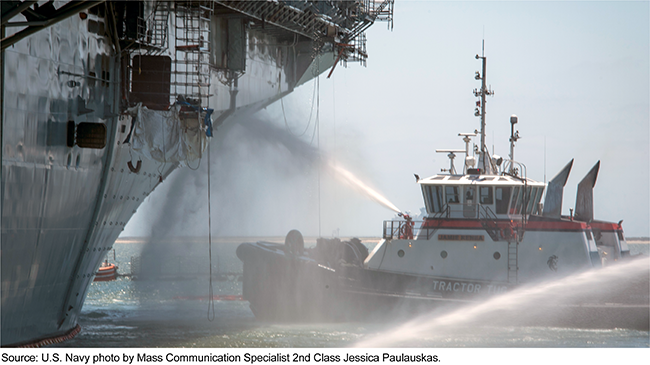
Highlights
What GAO Found
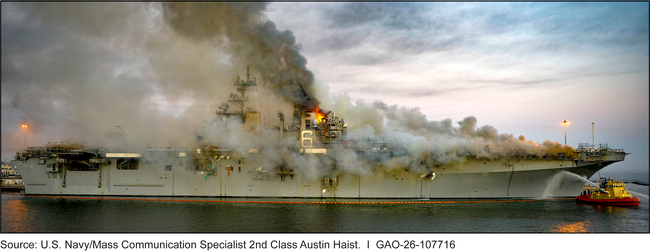
The Navy has suffered significant losses from 13 fires on ships undergoing maintenance since 2008. The Navy investigated these fires, including one on board the USS Bonhomme Richard in 2020. Based on actions taken since that fire, the Navy has improved fire safety and culture in the Navy and among contractors—contributing to no major fires since 2020.
However, staffing shortages threaten progress and oversight. GAO found that key organizations responsible for fire safety oversight have personnel shortages. Such shortages limit the Navy’s oversight of fire safety standards and add a burden for sailors who are balancing other duties.
Image of the July 2020 Major Fire Aboard the USS Bonhomme Richard
Further, the Navy did not fully assess challenges with contractor oversight. In reviewing the Navy’s key oversight tools, GAO found that these tools do not effectively address contractor compliance with fire safety standards during ship maintenance periods:
Corrective Action Requests. The Navy uses these requests to bring contractors into compliance with contract requirements. But this process does not incorporate monetary penalties to address persistent issues. As a result, the Navy issued many requests related to fire safety, including a severe warning prior to the USS Bonhomme Richard fire, but fire safety issues continued.
Quality Assurance Surveillance Plans. These plans are a tool through which the Navy assesses monetary penalties. The Navy’s guidance and its quality assurance surveillance plans for the six ships GAO reviewed did not assess penalties for noncompliance with contractual safety standards.
Progress Payment Retention Rates. The Navy generally pays contractors as maintenance work is completed, retaining some payment until the work is done. The Navy’s continued use of a reduced retention rate implemented in response to the COVID-19 pandemic reduces the effectiveness of this tool.
Liability. The Navy has not adjusted its limitation on ship repair contractor liability for major losses since 2003. Inflation and the increased complexity and cost of ship maintenance mean that the limit is proportionally less than when established, placing increase financial risk on the government in the event of a loss, such as a major fire.
Why GAO Did This Study
Fire is a significant risk for Navy ships undergoing maintenance. A 2020 fire found to be caused by arson on board the USS Bonhomme Richard resulted in the ship’s decommissioning, decades earlier than planned.
This report assesses (1) the extent to which Navy actions taken following the USS Bonhomme Richard fire addressed contractor compliance with fire safety standards, and (2) the Navy’s use of various contracting tools for ensuring contractor accountability and compliance with fire safety standards.
GAO reviewed Navy actions based on lessons learned from the USS Bonhomme Richard fire. GAO also selected six nonnuclear surface ships undergoing major repair by four different contractors at four domestic maintenance centers, and analyzed Navy documentation of contractor compliance with fire safety standards. Additionally, GAO visited three regional maintenance centers and toured five ships.
Recommendations
GAO is making six recommendations to the Navy, including for the Navy to develop a mechanism to address resources across organizations responsible for fire safety oversight; review contractor compliance with fire safety standards when developing actions to address any future major fires during ship maintenance periods; assess how to improve the Corrective Action Request process; ensure Quality Assurance Surveillance Plans and guidance include safety standards; reassess the progress payment retention rate; and reassess the limitation of liability clause for ship repair contractors. The Navy concurred with all six recommendations.
Recommendations for Executive Action
| Agency Affected | Recommendation | Status |
|---|---|---|
| Department of the Navy | The Secretary of the Navy should develop a mechanism to maximize available resources across organizations responsible for fire safety oversight to better ensure contractor fire safety oversight and alleviate the burden on sailors. (Recommendation 1) |
The Navy concurred with this recommendation and stated that it will take actions to reduce the burden of fire safety oversight on sailors, such as evaluating the effectiveness of hot work site thresholds and deploying automated fire watch systems. The Navy plans to complete these actions by January 2027.
|
| Department of the Navy | The Secretary of the Navy should ensure that the Learning to Action Board takes contractor compliance with fire safety standards into account, such as reviewing corrective action requests, when developing actions to address any future major fires during ship maintenance periods. (Recommendation 2) |
The Navy concurred with this recommendation and stated that it will develop metrics and assess contractor compliance of contractual fire safety requirements during routine assessments. The Navy plans to complete these actions by January 2027.
|
| Department of the Navy | The Secretary of the Navy should task the Learning to Action Board to assess how to improve the corrective action request process to increase contractor accountability, including whether monetary penalties for serious fire safety issues may improve contractor compliance with fire safety standards. (Recommendation 3) |
The Navy concurred with this recommendation and stated that it will take actions to enhance the corrective action request process, such as establishing a review committee to assess the corrective action request process and develop actions to improve the process. The Navy plans to complete these actions by January 2027.
|
| Department of the Navy | The Secretary of the Navy should ensure that the Commander of Naval Sea Systems Command updates the Navy's Quality Assurance Surveillance Plan guidance to include safety performance standards. (Recommendation 4) |
The Navy concurred with this recommendation and stated that it will take update the Navy's Quality Assurance Surveillance Plan guidance to mandate safety performance standards as a core evaluation metric. The Navy plans to complete this action by January 2027.
|
| Department of the Navy | The Secretary of the Navy should reassess the progress payment retention rate for surface ship maintenance contracts based on an assessment of the government's risk and health of the ship repair industrial base. (Recommendation 5) |
The Navy concurred with this recommendation and stated that it will develop a memorandum detailing a new risk-informed progress payment retention rate. The Navy plans to complete this action by January 2027.
|
| Department of the Navy | The Secretary of the Navy should reassess the ship repair limitation of liability clause, as outlined in the Defense Federal Acquisition Regulation Supplement, including whether adjustments to the contractor's liability ceiling, such as to reflect inflation, are warranted and make a recommendation to the Under Secretary of Defense for Acquisition and Sustainment to update the Defense Federal Acquisition Regulation Supplement clause. (Recommendation 6) |
The Navy concurred with this recommendation and stated that it will submit a recommendation that the Under Secretary of Defense for Acquisition and Sustainment update the ship repair limitation of liability clause to account for current inflation and modern ship repair costs. The Navy plans to complete this action by January 2027.
|