
Carbon Capture Tax Credit: Actions Needed to Improve Federal Administration and Evaluation of Tax Expenditure
Fast Facts
Carbon capture technology can reduce carbon in the atmosphere by storing it underground or using it to make products like concrete or jet fuel.
The 45Q tax credit was created to incentivize development of this technology. But some taxpayers have difficulty claiming it. Those who use captured carbon to make products face the biggest hurdles—long delays for approval and a high rejection rate, for example.
No agency is tasked with measuring results and the law didn't set clear goals, so it's hard to know if the 45Q tax credit is working.
We made recommendations to Congress and agencies to improve oversight and administration of the tax credit.

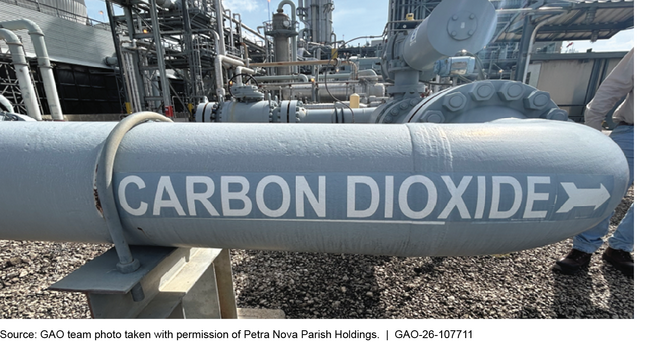
Industrial carbon capture and storage facility with tall metal towers, and pipes.
Highlights
What GAO Found
The Carbon Oxide Sequestration Credit (45Q) is a tax credit provided for certain carbon oxides that are captured at emission sources or directly from the air and either stored underground or used to produce products. The credit has been amended multiple times, including by the 2022 Inflation Reduction Act (IRA), which added new credit features. More recently, the One Big Beautiful Bill Act created parity in credit values across uses of captured carbon. As of March 2026, there were 33 carbon capture facilities in the U.S., with additional facilities planned. The number of 45Q credit claims more than tripled from 2019 to 2023, according to IRS data.
The Internal Revenue Service (IRS) has taken several actions to administer the 45Q credit and mitigate potential noncompliance. However, taxpayers using carbon to produce products face compliance burdens, delays, and uncertainty in claiming the credit. GAO identified areas in the approval process for carbon utilization where IRS and the Department of Energy (DOE) could potentially minimize compliance burden and improve certainty for taxpayers. Pursuing such opportunities—for example, streamlining certain processes, or clarifying acceptable datasets that can be used to calculate carbon displaced—could improve the process and help minimize delays for both agencies and taxpayers.
Multiple potential goals, the lack of a designated agency to evaluate the effectiveness of the credit, and data limitations complicate Congress’s ability to understand the performance of the 45Q credit. Even so, periodic reviews of tax expenditures are crucial for informed oversight. GAO has previously recommended various actions Congress and agencies could take to improve oversight for other tax expenditures, such as identifying what should be analyzed and by whom. In this report, GAO identified key questions for Congress to consider directing agencies to analyze to help determine the performance of the credit. These key questions are: (1) how well the credit is working to achieve its goals, (2) how efficiently the credit is performing and (3) how the credit compares to other policy tools.
Why GAO Did This Study
The 45Q credit was created in 2008 to incentivize the development of carbon capture technology and reduce carbon emissions. Carbon capture involves complex and novel technology, and the 45Q credit could result in potentially substantial revenue expenditures.
The IRA includes a provision for GAO to review the distribution and use of IRA funds. This report assesses (1) IRS’s administration of the 45Q credit, and (2) the challenges in evaluating the effectiveness of the credit. GAO reviewed agency policies and procedures and interviewed officials from IRS, DOE, and the Environmental Protection Agency. GAO also interviewed selected external stakeholders knowledgeable about the 45Q credit, representing advocacy, research, and industry. GAO also conducted two site visits to carbon capture sites in Houston, Texas.
Recommendations
GAO is recommending that Congress consider directing agencies to collect and analyze data to answer key questions about the performance of the 45Q credit, such as how well it is working to achieve its goals, how efficiently it is performing, and how it compares to other policy tools.
GAO is making four recommendations to IRS and two recommendations to DOE to improve the review process for carbon utilization, by reducing taxpayers’ burden while still mitigating potential noncompliance. These include determining a time period of carbon capture data needed to begin claiming the credit, and clarifying datasets acceptable for calculating carbon displaced. IRS partially agreed with one recommendation; IRS and DOE disagreed with the remaining five. GAO maintains the recommendations are warranted as discussed in the report.
Matter for Congressional Consideration
| Matter | Status | Comments |
|---|---|---|
| Congress should consider directing agencies to collect and analyze data to answer key questions about the performance of the 45Q credit, such as how well it is working to achieve specific goals, how efficiently it is performing, and how it compares to other policy tools. (Matter for Congressional Consideration 1) | When we confirm what actions the agency has taken in response to this recommendation, we will provide updated information. |
Recommendations for Executive Action
| Agency Affected | Recommendation | Status |
|---|---|---|
| Internal Revenue Service | The Commissioner of Internal Revenue, in coordination with DOE, should determine the minimum time period of production system direct data needed to determine the displacement factor in the LCA pre-approval, and update guidance to allow for taxpayers that meet that minimum to submit an LCA for pre-approval prior to the end of the tax year. (Recommendation 1) |
When we confirm what actions the agency has taken in response to this recommendation, we will provide updated information.
|
| Internal Revenue Service | The Commissioner of Internal Revenue, in coordination with DOE, should continue creating additional comparison product system technology baselines, including by implementing a process for taxpayers to request specific technology baselines, similar to the process for requesting provisional emissions rates for the 45V and 45Z credits. (Recommendation 2) |
When we confirm what actions the agency has taken in response to this recommendation, we will provide updated information.
|
| Internal Revenue Service | The Commissioner of Internal Revenue, in coordination with DOE, should determine the feasibility, including the costs and benefits, of developing a Greenhouse gases, Regulated Emissions, and Energy use in Technologies (GREET) model for common 45Q utilization pathways, allowing an LCA process that can be submitted upon tax return filing without prior review, similar to the 45V and 45Z credits. (Recommendation 3) |
When we confirm what actions the agency has taken in response to this recommendation, we will provide updated information.
|
| Department of Energy | The Secretary of Energy, in coordination with IRS, should adjust the 45Q credit guidance on LCAs to clarify which GREET model data are acceptable for use with a 45Q credit LCA and how and when they can be used. (Recommendation 4) |
When we confirm what actions the agency has taken in response to this recommendation, we will provide updated information.
|
| Internal Revenue Service | The Commissioner of Internal Revenue, in coordination with DOE, should modify the IRS/DOE memorandum of understanding (MOU) to provide taxpayers, with appropriate limitations, an opportunity to modify elements of their LCAs prior to rejection, rather than having to resubmit their LCAs and restart the process. (Recommendation 5) |
When we confirm what actions the agency has taken in response to this recommendation, we will provide updated information.
|
| Department of Energy | The Secretary of Energy, in coordination with IRS, should modify the IRS/DOE MOU to provide taxpayers, with appropriate limitations, an opportunity to modify elements of their LCA prior to rejection, rather than having to resubmit their LCAs and restart the DOE review process. (Recommendation 6) |
When we confirm what actions the agency has taken in response to this recommendation, we will provide updated information.
|