
Federal Custody: Bureau of Prisons and ICE Should Take Actions to Improve Access to Menstrual Products
Fast Facts
The Bureau of Prisons and U.S. Immigration and Customs Enforcement are responsible for making menstrual products accessible to the individuals they incarcerate or detain.
We found that both agencies generally made some menstrual products available in fiscal year 2024. But the Bureau has not systematically and routinely assessed whether its prisons are fully adhering to the policy--and in some cases, they aren't.
We also found that ICE oversight mechanisms have limited ability to identify problems with access to menstrual products because it does not have clear, specific standards.
We made recommendations to address these issues.
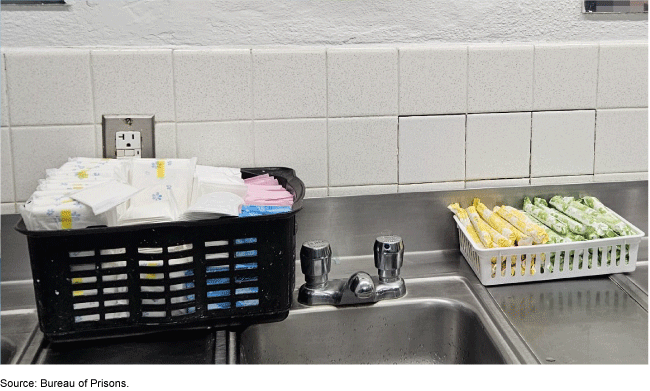
Pads, panty liners, and tampons provided to individuals at one Bureau of Prisons institution.
Highlights
What GAO Found
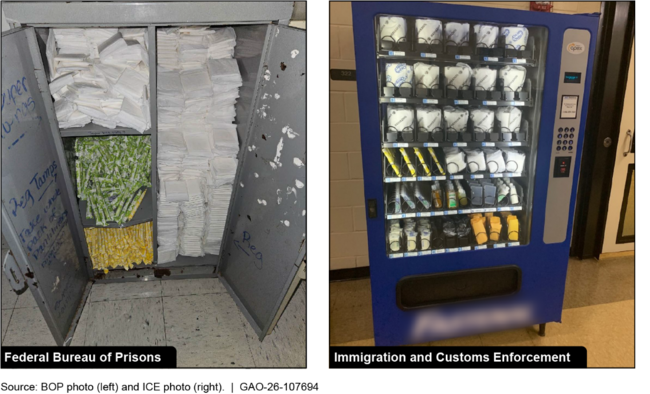
Federal Bureau of Prisons (BOP) institutions generally make menstrual products available to incarcerated and detained individuals; however, a few of the 29 institutions that housed women in fiscal year 2024 do not fully adhere to all required elements of BOP’s policy. For example, based on site visits and questionnaire responses, GAO found that not all institutions provide the five required types of products in common areas or replenish menstrual products within 24 hours. BOP has two oversight mechanisms to monitor whether institutions adhere to its policy. However, neither mechanism has systematically assessed, detected, and rectified all deficiencies across BOP institutions related to providing menstrual products. By conducting routine, systematic oversight, BOP could better ensure that menstrual products are consistently, appropriately, and equitably available and accessible to incarcerated and detained individuals.
Of the 31 Immigration and Customs Enforcement (ICE) facilities GAO visited or whose officials responded to GAO’s questionnaire, facilities generally make at least some menstrual products available to detained individuals. However, ICE’s detention standards do not have specific detail to allow its oversight mechanism to detect variation in access to menstrual products. ICE conducts inspections of facilities against their assigned detention standards, which outline how facilities are to provide safe, secure, and humane confinement. Without more detailed language in these standards, inspections cannot detect deficiencies related to access to menstrual products. GAO found variation in (1) the types of menstrual products facilities provide, (2) how facilities provide products, and (3) the quantity limits that facilities apply. By revising the detention standards to clarify requirements, ICE could better ensure menstrual products are consistently, appropriately, and equitably available and accessible to detained individuals.
Examples of the Provision of Menstrual Products at Bureau of Prisons (BOP) Institutions and Immigration and Customs Enforcement (ICE) Facilities
Why GAO Did This Study
BOP and ICE incarcerated and detained tens of thousands of women in fiscal year 2024. These agencies are responsible for caring for the individuals in their custody. This includes providing hygiene items like menstrual products.
GAO was asked to review the availability and accessibility of menstrual products for vulnerable populations, including incarcerated and detained individuals. This report examines the extent to which (1) BOP provides access to menstrual products for incarcerated and detained individuals and (2) ICE provides access to menstrual products for detained individuals. GAO visited a nongeneralizable sample of five BOP institutions and three ICE facilities. These locations were selected based on the number of individuals housed and security level or facility type, among other criteria. During these visits, GAO observed the provision of menstrual products and interviewed facility staff and incarcerated and detained individuals. GAO also reviewed agency documents and conducted a web-based survey of 29 BOP institutions and 52 ICE facilities. GAO analyzed the responses received from officials from 100 percent of BOP institutions and 58 percent of ICE facilities (30).
Recommendations
GAO is making one recommendation to BOP and one to ICE. GAO recommends that (1) BOP ensure its oversight activities monitor adherence to its policy on providing menstrual products, and (2) ICE clarify requirements related to providing menstrual products in its detention standards. BOP concurred. ICE did not, stating that its standards are intended to provide guidance and flexibility. GAO continues to maintain that the recommendation is warranted, as discussed in the report.
Recommendations for Executive Action
| Agency Affected | Recommendation | Status |
|---|---|---|
| Bureau of Prisons | The Director of BOP should ensure the Bureau's oversight activities systematically and routinely monitor adherence to BOP policy on the provision of menstrual products. (Recommendation 1) |
The BOP concurred with this recommendation and said it would take steps to implement it. When we confirm what actions the BOP has taken in response to this recommendation, we will provide updated information.
|
| United States Immigration and Customs Enforcement | The Director of ICE should revise each set of detention standards to clarify requirements related to the provision of menstrual products. (Recommendation 2) |
ICE did not concur with this recommendation stating that its standards are intended to provide guidance and flexibility. GAO maintains that the recommendation is valid because while it is important to provide flexibility in operations, it is equally important to ensure that standards and policy are clear and adhered to. ICE's detention standards lack the specificity to adequately assess the provision of menstrual products to detained individuals. Further, inspection teams are limited in questions they ask about the provision of menstrual products because the detention standards lack specificity in this area. As such, inspection teams cannot adequately assess how and when menstrual products are provided and the type provided. Moreover, because the standards lack specificity, officials are unable to adequately monitor the extent to which facilities provide sufficient menstrual products to individuals and should revise the detention standards to clarify requirements related to the provision of menstrual products. This would improve DHS and ICE's ability to monitor variation and ensure consistent and equitable access to menstrual products.
|