
Defense Research and Engineering: Action Needed to Improve Management and Oversight of Technology Investments
Fast Facts
DOD's Office of Research and Engineering helps DOD quickly adopt innovative tech. The office has developed a national strategy to guide DOD's science and tech efforts and investments. But the military services' tech strategies don't always line up with DOD's, which might lead to competing or conflicting efforts.
Also, the office doesn't receive detailed and timely budget information. So, it can't determine whether the military services' tech budget priorities align with DOD's.
We recommended that DOD and Congress address these issues so DOD can keep pace with foreign adversaries in adopting innovative tech.

Close up of a circuit board of an electronic device.
Highlights
What GAO Found
The Department of Defense (DOD) seeks to outpace foreign adversaries’ capabilities by quickly adopting innovative technologies. The Office of the Under Secretary of Defense for Research and Engineering (OUSD(R&E)) helps DOD reach that goal.
OUSD(R&E) is generally implementing processes and programs, consistent with its authorities to manage and oversee innovation-related investments. For example, it developed a National Defense Science & Technology Strategy in accordance with the 2022 National Defense Strategy. The military departments have department-focused strategies, but the extent to which those strategies are updated and aligned with DOD’s strategy varies. Consequently, DOD risks the military departments pursuing technologies that do not match its vision.
Further, OUSD(R&E) faces several challenges ensuring that the military departments are well-positioned to quickly deliver technologies to the warfighter. For example, OUSD(R&E):
- has not, according to officials, issued guidance for the development of Critical Technology Area roadmaps, including identifying stakeholders who should be involved or identifying the content to include in those roadmaps.
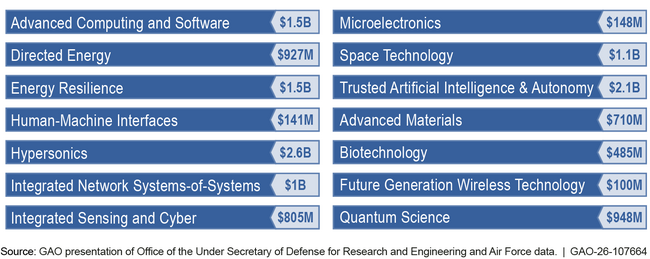
- has not determined how the military departments should balance investments in critical technologies between the joint force and military department priorities. This is because it has not provided guidance to the military departments on the amount of investment in each critical technology area to align with corresponding roadmaps, despite military department investments in those critical technologies, as shown below.
- is limited in its ability to influence military departments’ budgets to ensure they align with DOD-wide priorities through the annual budgeting process. This is because OUSD(R&E) does not have statutory authority to certify the military departments’ budget. Having this authority would better position DOD to ensure priorities align.
Without addressing these challenges, OUSD(R&E) risks being unable to effectively execute its responsiblities to manage and oversee technology efforts.
Military Department Science and Technology Investments in Critical Technology Areas for Fiscal Year 2025
Why GAO Did This Study
DOD requested nearly $180 billion in the President’s Fiscal Year 2026 budget for managing, overseeing, and improving technology. Members of Congress have raised questions about OUSD(R&E)’s ability to oversee this technology as a counter to the rising threat of adversaries such as China and Russia.
The House report accompanying the National Defense Authorization Act for Fiscal Year 2024 includes a provision for GAO to review how OUSD(R&E) manages, oversees, and improves DOD’s innovation investments and outcomes. This report evaluates (1) the extent to which OUSD(R&E) has taken steps to implement its authorities, and (2) the extent to which these authorities position it to effectively manage these investments.
GAO reviewed DOD documentation and data as well as selected legislative provisions. GAO also interviewed officials from OUSD(R&E) and the military departments.
Recommendations
GAO recommends that Congress consider granting OUSD(R&E) budget certification authority. GAO is also making three recommendations to DOD, including that it direct each military department to develop science and technology strategies that align with OUSD(R&E)’s DOD-wide science and technology strategy to the maximum extent practicable; issue guidance for developing Critical Technology Area roadmaps; and provide guidance to the military departments on the amount of investment in each critical technology area needed to ensure alignment to the maximum extent practicable with corresponding roadmaps. DOD agreed with GAO’s recommendations.
Matter for Congressional Consideration
| Matter | Status | Comments |
|---|---|---|
| Congress should consider providing OUSD(R&E) with budget certification authority for research, development, test and evaluation activities. This would require (1) the secretary of each military department and the head of each defense agency to transmit their department's or agency's proposed budget for research, development, test and evaluation activities for a fiscal year and for the period covered by a future-years defense program to the Under Secretary of Defense for Research and Engineering by January 31 of the year preceding the proposed budget's fiscal year; (2) the Under Secretary of Defense for Research and Engineering to review each proposed budget and determine whether it is adequate; and (3) an appropriate DOD official to report to the congressional defense committees on each proposed budget that the Under Secretary of Defense for Research and Engineering determines to not be adequate. (Matter for Consideration 1) | When we confirm what actions have been taken in response to this matter, we will provide updated information. |
Recommendations for Executive Action
| Agency Affected | Recommendation | Status |
|---|---|---|
| Department of Defense | The Secretary of Defense should direct the Secretaries of the Air Force, Army, and Navy to each develop and issue a science and technology strategy that aligns with the National Defense Science and Technology Strategy to the maximum extent practicable, and to update their strategies as needed to ensure continued alignment. (Recommendation 1) |
When we confirm what actions the agency has taken in response to this recommendation, we will provide updated information.
|
| Department of Defense | The Secretary of Defense should ensure the Under Secretary of Defense for Research and Engineering issues guidance for the development of the Critical Technology Area roadmaps. This guidance should identify stakeholders—including from the military departments—to involve when the roadmaps are developed, as well as identify the content to include in the roadmaps. (Recommendation 2) |
When we confirm what actions the agency has taken in response to this recommendation, we will provide updated information.
|
| Department of Defense | The Secretary of Defense should direct the Under Secretary of Defense for Research and Engineering to provide annual guidance to the Secretaries of the Air Force, Army, and Navy on the amount of military department investment that OUSD(R&E) considers necessary to ensure alignment to the maximum extent practicable with each Critical Technology Area roadmap. (Recommendation 3) |
When we confirm what actions the agency has taken in response to this recommendation, we will provide updated information.
|