
Junior Reserve Officers’ Training Corps: Additional Actions Needed to Improve Oversight and Prevent Instructor Sexual Misconduct
Fast Facts
The military services partner with thousands of high schools to provide students with leadership training through the Junior Reserve Officers' Training Corps. DOD oversees the program. Protecting JROTC students against sexual misconduct from instructors is a priority.
DOD has policies to prevent and respond to sexual misconduct in JROTC programs, but we found issues that hinder its efforts. For example:
Instructor training doesn’t consistently cover information about Title IX, which prohibits sex-based discrimination in education.
Guidance on how students can report misconduct isn't clear.
Our recommendations address these issues and more.

Instructor and cadets dressed in military attire socialize around a desk in a classroom.
Highlights
Why This Matters
The Department of Defense (DOD) has emphasized the importance of protecting students in the Junior Reserve Officers’ Training Corps (JROTC) from instructor sexual misconduct. DOD reported more than 100 misconduct allegations from 2013—2023. Legislation established new JROTC requirements in fiscal year 2024, in part to address concerns about sexual misconduct involving instructors and students.
GAO Key Takeaways
The military services partner with high schools to provide leadership training to students through JROTC, which DOD oversees.
In response to statutory requirements, DOD developed policies and procedures to prevent sexual misconduct in JROTC and respond to misconduct allegations. We identified issues that, if addressed, would aid DOD’s efforts:
- The standardized memorandum of agreement (MOA)—which the military services sign with school districts—incorporates seven of 10 required provisions but does not fully incorporate three (see figure). For example, the MOA does not require schools to certify that they provide student training.
- Instructor training does not consistently address Title IX, a law prohibiting sex-based discrimination in education. This makes instructors less likely to be aware of Title IX requirements.
- Information provided to students on how to report misconduct is unclear and could be improved.
Gaps in DOD’s oversight of JROTC programs also exist. For example, DOD guidance does not clearly define how the military services’ regional officials are expected to coordinate and communicate with partner schools. Clarifying these responsibilities would improve program oversight and better ensure students’ safety.
Areas of Misalignment Between Requirements and the Military Services’ Agreement with School Districts
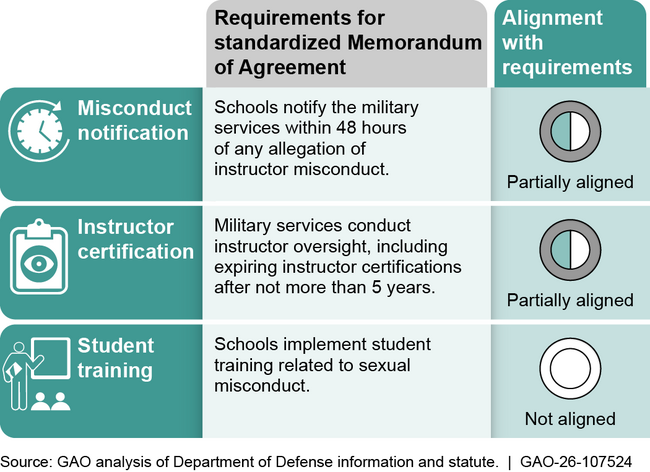
Note: For more details, see figure 2 in GAO-26-107524.
How GAO Did This Study
We analyzed relevant statutes, documents, and policies on DOD’s prevention of and response to sexual misconduct in JROTC; reviewed the most recent 5 years of data on allegations; visited 11 high schools with JROTC programs in four states; and interviewed school officials, instructors, and DOD officials.
Recommendations
We are making 16 recommendations, including for DOD to include all requirements in the MOA; standardize instructor Title IX training; better communicate information about reporting misconduct; and clarify oversight responsibilities. DOD did not provide comments on the report.
Recommendations for Executive Action
| Agency Affected | Recommendation | Status |
|---|---|---|
| Department of Defense | The Secretary of Defense should ensure that the Under Secretary of Defense for Personnel and Readiness, in coordination with the Secretaries of the military departments, revises the standardized MOA with school districts to include all statutory requirements, including (1) a requirement for schools to notify the military service within 48 hours of all allegations of instructor misconduct, regardless of whether investigative or disciplinary actions are taken; (2) a requirement for schools to certify that they annually provide training to students on methods to prevent, respond to, and report sexual misconduct; and (3) a procedure for instructor certifications to expire after not more than 5 years. (Recommendation 1) |
DOD did not provide comments on this report and, as of February 2026, has not provided information on how it intends to address this recommendation. We will monitor DOD's actions to address this recommendation going forward.
|
| Department of Defense | The Secretary of Defense should ensure that the Under Secretary of Defense for Personnel and Readiness, in coordination with the Secretaries of the military departments and the Commandant of the Marine Corps, and in consultation with the Department of Education, develops and publishes standardized Title IX compliance training for JROTC instructors. (Recommendation 2) |
DOD did not provide comments on this report and, as of February 2026, has not provided information on how it intends to address this recommendation. We will monitor DOD's actions to address this recommendation going forward.
|
| Department of the Army | The Secretary of the Army should, once the Under Secretary of Defense for Personnel and Readiness develops and publishes standardized Title IX compliance training for JROTC instructors, implement the standardized training by administering it to new and existing instructors on an annual basis. (Recommendation 3) |
DOD did not provide comments on this report and, as of February 2026, has not provided information on how it intends to address this recommendation. We will monitor DOD's actions to address this recommendation going forward.
|
| Department of the Navy | The Secretary of the Navy should, once the Under Secretary of Defense for Personnel and Readiness develops and publishes standardized Title IX compliance training for JROTC instructors, implement the standardized training by administering it to new and existing instructors on an annual basis. (Recommendation 4) |
DOD did not provide comments on this report and, as of February 2026, has not provided information on how it intends to address this recommendation. We will monitor DOD's actions to address this recommendation going forward.
|
| Department of the Air Force | The Secretary of the Air Force should, once the Under Secretary of Defense for Personnel and Readiness develops and publishes standardized Title IX compliance training for JROTC instructors, implement the standardized training by administering it to new and existing instructors on an annual basis. (Recommendation 5) |
DOD did not provide comments on this report and, as of February 2026, has not provided information on how it intends to address this recommendation. We will monitor DOD's actions to address this recommendation going forward.
|
| Department of the Navy | The Secretary of the Navy should ensure the Commandant of the Marine Corps, once the Under Secretary of Defense for Personnel and Readiness develops and publishes standardized Title IX compliance training for JROTC instructors, implements the standardized training by administering it to new and existing instructors on an annual basis. (Recommendation 6) |
DOD did not provide comments on this report and, as of February 2026, has not provided information on how it intends to address this recommendation. We will monitor DOD's actions to address this recommendation going forward.
|
| Department of Defense | The Secretary of Defense should ensure that the Under Secretary of Defense for Personnel and Readiness, in coordination with the Secretaries of the military departments, develops and implements a mechanism to more effectively communicate information on students' rights to participate in a JROTC program free from sexual misconduct and harassment and how to report allegations of JROTC instructor misconduct. (Recommendation 7) |
DOD did not provide comments on this report and, as of February 2026, has not provided information on how it intends to address this recommendation. We will monitor DOD's actions to address this recommendation going forward.
|
| Department of Defense | The Secretary of Defense should ensure that the Under Secretary of Defense for Personnel and Readiness clearly defines what constitutes sexual misconduct with regard to tracking allegations made against JROTC instructors and communicates that definition to the military services, along with expectations for how the services should report such data. (Recommendation 8) |
DOD did not provide comments on this report and, as of February 2026, has not provided information on how it intends to address this recommendation. We will monitor DOD's actions to address this recommendation going forward.
|
| Department of Defense | The Secretary of Defense should ensure that the Under Secretary of Defense for Personnel and Readiness clarifies guidance for baseline roles and responsibilities of regional oversight officials, including how they are to coordinate and communicate with host schools. (Recommendation 9) |
DOD did not provide comments on this report and, as of February 2026, has not provided information on how it intends to address this recommendation. We will monitor DOD's actions to address this recommendation going forward.
|
| Department of the Army | The Secretary of the Army should, once the Under Secretary of Defense for Personnel and Readiness clarifies guidance on the baseline roles and responsibilities of regional oversight officials, update the Army's guidance to ensure that oversight responsibilities align with DOD guidance and that these roles are properly executed. (Recommendation 10) |
DOD did not provide comments on this report and, as of February 2026, has not provided information on how it intends to address this recommendation. We will monitor DOD's actions to address this recommendation going forward.
|
| Department of the Navy | The Secretary of the Navy should, once the Under Secretary of Defense for Personnel and Readiness clarifies guidance on the baseline roles and responsibilities of regional oversight officials, update the Navy's guidance to ensure that oversight responsibilities align with DOD guidance and that these roles are properly executed. (Recommendation 11) |
DOD did not provide comments on this report and, as of February 2026, has not provided information on how it intends to address this recommendation. We will monitor DOD's actions to address this recommendation going forward.
|
| Department of the Air Force | The Secretary of the Air Force should, once the Under Secretary of Defense for Personnel and Readiness clarifies guidance on the baseline roles and responsibilities of regional oversight officials, update the Air Force's guidance to ensure that oversight responsibilities align with DOD guidance and that these roles are properly executed. (Recommendation 12) |
DOD did not provide comments on this report and, as of February 2026, has not provided information on how it intends to address this recommendation. We will monitor DOD's actions to address this recommendation going forward.
|
| Department of the Navy | The Secretary of the Navy should ensure the Commandant of the Marine Corps, once the Under Secretary of Defense for Personnel and Readiness clarifies guidance on the baseline roles and responsibilities of regional oversight officials, updates the Marine Corps's guidance to ensure that oversight responsibilities align with DOD guidance and that these roles are properly executed. (Recommendation 13) |
DOD did not provide comments on this report and, as of February 2026, has not provided information on how it intends to address this recommendation. We will monitor DOD's actions to address this recommendation going forward.
|
| Department of the Air Force | The Secretary of the Air Force should issue guidance that establishes a process for recertification of JROTC instructors and associated requirements, including a timeline for the expiration of instructor certifications that aligns with statutory requirements. (Recommendation 14) |
DOD did not provide comments on this report and, as of February 2026, has not provided information on how it intends to address this recommendation. We will monitor DOD's actions to address this recommendation going forward.
|
| Department of the Army | The Secretary of the Army should evaluate the Army's JROTC oversight structure and responsibilities to ensure that they are aligned with oversight priorities. As part of the evaluation, the Army may consider the other services' oversight structures and responsibilities. (Recommendation 15) |
DOD did not provide comments on this report and, as of February 2026, has not provided information on how it intends to address this recommendation. We will monitor DOD's actions to address this recommendation going forward.
|
| Department of the Army | The Secretary of the Army should revise its guidance on JROTC unit inspections to ensure that it is inspecting all items required per DOD guidance, including student code of conduct forms and instructor prohibited activities forms. (Recommendation 16) |
DOD did not provide comments on this report and, as of February 2026, has not provided information on how it intends to address this recommendation. We will monitor DOD's actions to address this recommendation going forward.
|