
Public Health Preparedness: Improved Coordination Needed for HHS’s Emergency Preparedness Programs
Fast Facts
The Department of Health and Human Services awarded about $900 million to states and localities in fiscal year 2024 through two emergency preparedness programs. One helps public health departments prepare for threats, and the other helps health care systems—which include hospitals.
Coordination between public health departments and health care systems is vital for responding to public health emergencies. But HHS is missing opportunities to coordinate between these two programs. For example, funding recipients from both programs could be required to conduct joint training and exercises.
Our recommendations address this and other issues we found.

A person with medical surgery clothing on, securing the glove on their hand.
Highlights
What GAO Found
The U.S. Department of Health and Human Services (HHS) leads the federal public health and medical preparedness for, response to, and recovery from public health emergencies. HHS awarded almost $900 million in fiscal year 2024 to states and other jurisdictions to help them prepare for a range of public health threats and emergencies through two programs. First, the Public Health Emergency Preparedness (PHEP) program supports jurisdictions’ public health systems, which includes public health agencies at all government levels. Second, the Hospital Preparedness Program (HPP) supports health care systems, which include a community’s health care organizations such as hospitals. Jurisdictions distribute HPP funds to health care coalitions—made up of health care and other entities to support preparedness. HHS requires jurisdictions and health care coalitions to complete activities. These include exercises to help ensure that jurisdictions are prepared to respond to public health threats, such as infectious diseases and extreme weather events (e.g., hurricanes).
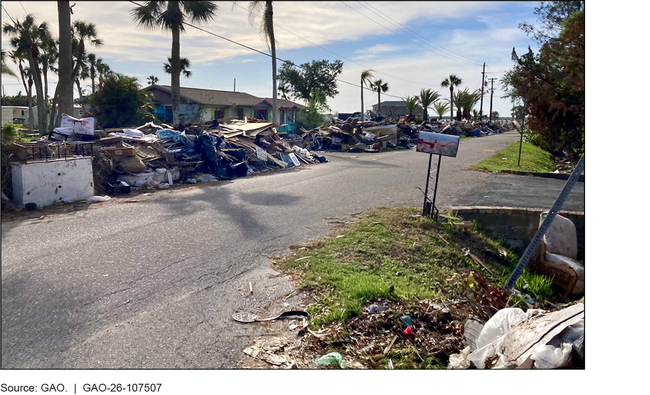
Debris from Damaged Homes Following Hurricanes Helene and Milton, 2024, Florida
The two HHS agencies that administer these programs lack a formal mechanism, such as joint exercises, written agreements, or working groups, to coordinate them. Coordinating these preparedness programs could allow HHS to better manage them and support jurisdictions as they prepare both their public health and health care systems to respond to public health threats and emergencies. Lessons learned from the COVID-19 pandemic have demonstrated the importance of coordination between these systems, such as between state health departments and hospitals, if jurisdictions are to be effectively prepared. Additionally, officials from selected jurisdictions said that greater interagency coordination could help reduce resource inefficiencies associated with implementation of PHEP and HPP.
Further, HHS does not collect or analyze information on jurisdictions’ ability to meet the 15 public health and four health care preparedness capabilities and any related gaps. According to HHS documentation, it identified these capabilities to serve as national guidance. The capabilities describe skills and abilities jurisdictions need to effectively respond to, and recover from, public health threats and emergencies. For example, they include providing mass medical care and laboratory testing at scale for emerging pathogens. Collecting and analyzing such information would help HHS understand the extent to which jurisdictions are prepared to respond to public health threats and emergencies and whether any changes are needed.
Why GAO Did This Study
The United States faces ongoing risks from future public health threats, such as infectious diseases; extreme weather events; and biological, chemical, nuclear, and radiological events. In fiscal year 2024, HHS, through PHEP, provided $654 million, and through HPP, provided $240 million, to jurisdictions to aid preparedness for such threats.
The CARES Act includes a provision for GAO to examine public health preparedness and response efforts related to the COVID-19 pandemic. This report examines, among other objectives, the extent to which HHS agencies (1) coordinate PHEP and HPP and (2) collect and analyze information on jurisdictions’ capabilities.
GAO reviewed HHS documentation, including notices of funding opportunity, templates, and examples of documents submitted by eight selected jurisdictions. GAO also interviewed officials from HHS and the eight selected jurisdictions. GAO selected these jurisdictions to include variation among geographic location, percent of the population living in a rural setting, and public health governance structure.
Recommendations
GAO is making five recommendations, including that HHS establish a mechanism to coordinate PHEP and HPP; and that it collect and analyze information on jurisdictions’ preparedness capabilities and any related gaps. HHS concurred with our recommendations.
Recommendations for Executive Action
| Agency Affected | Recommendation | Status |
|---|---|---|
| Department of Health and Human Services | The Assistant Secretary for Preparedness and Response and the Director of CDC should develop a mechanism, or mechanisms, to coordinate PHEP and HPP by, for example, taking into consideration GAO's Leading Practices to Enhance Interagency Collaboration and Address Crosscutting Challenges. (Recommendation 1) |
We will update the status of this recommendation when HHS provides its 180-day letter (expected in summer 2026)
|
| Department of Health and Human Services | The Director of CDC should provide information to jurisdictions on how the required PHEP activities support the development of the public health preparedness capabilities. (Recommendation 2) |
We will update the status of this recommendation when HHS provides its 180-day letter (expected in summer 2026)
|
| Administration for Strategic Preparedness and Response | The Assistant Secretary for Preparedness and Response should provide information to jurisdictions on how the required HPP activities support the development of the health care preparedness capabilities. (Recommendation 3) |
We will update the status of this recommendation when HHS provides its 180-day letter (expected in summer 2026)
|
| Department of Health and Human Services |
Priority Rec.
The Director of CDC should collect and analyze information on jurisdictions' ability meet the public health preparedness capabilities and identify any related gaps in partnership with jurisdictions. (Recommendation 4) |
We will update the status of this recommendation when HHS provides its 180-day letter (expected in summer 2026)
|
| Administration for Strategic Preparedness and Response |
Priority Rec.
The Assistant Secretary for Preparedness and Response should collect and analyze information on jurisdictions' ability to meet health care preparedness capabilities and identify any related gaps in partnership with jurisdictions. (Recommendation 5) |
We will update the status of this recommendation when HHS provides its 180-day letter (expected in summer 2026)
|