
Coast Guard: Actions Needed to Improve Maritime Interdictions
Fast Facts
In response to the highest maritime migration in over 30 years, the U.S. Coast Guard made tradeoffs to prioritize migrant interdiction that affected its other missions.
During FYs 2015-2024, USCG generally didn't meet its drug or migrant interdiction goals. USCG said these measures don't effectively assess its efforts. It has implemented new drug measures but hasn't yet implemented new migrant measures.
USCG and federal partners generally coordinated well through a DHS task force focused on maritime migration, but the task force didn't fully share information on lessons learned.
We made 2 recommendations to DHS to address these issues.
Coast Guard Interdicts Migrant Vessel
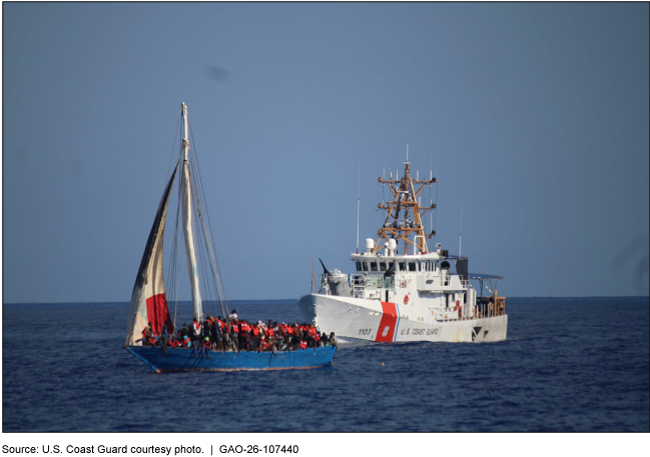
A Coast Guard ship is following closely behind a blue wooden sailboat that is overloaded with migrants about 20 miles off the coast of Haiti. The Coast Guard is preparing to intercept the sailboat and return those on board to Haiti. The photo was taken in January 2023.
Highlights
What GAO Found
The Coast Guard, a multi-mission military service within the Department of Homeland Security (DHS), uses its resources—including assets such as vessels and aircraft—to conduct its drug and migrant interdiction missions. Given limited resources, the Coast Guard made tradeoffs to address a significant increase in maritime migration levels that began in 2021. Specifically, it redirected assets to migrant interdiction that it had originally allocated to other missions, such as drug interdiction. This impacted its ability to conduct those other missions.
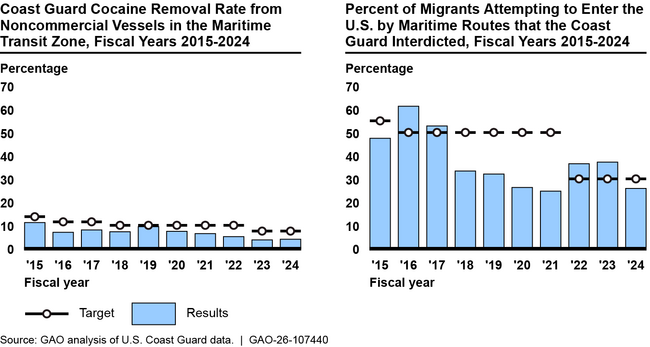
The Coast Guard did not meet its primary drug interdiction performance target in fiscal years 2015 through 2024, and did not meet its primary migrant interdiction target for 6 years during the same period. See figures below. Coast Guard officials said neither primary measure effectively assesses its efforts. Thus, it began to implement new drug interdiction measures in fiscal years 2021 and 2022 to better assess its performance. As of July 2025, the Coast Guard had identified which would be its new primary drug interdiction measures. In addition, the Coast Guard is in the initial stages of developing new migrant interdiction performance measures, but as of July 2025 had not yet implemented them. Doing so would better position the Coast Guard to provide decision makers with relevant information to make future resource decisions.
Coast Guard Annual Drug and Migrant Interdiction Primary Performance Measures
The DHS Operation Vigilant Sentry task force provides a key coordination mechanism for the Coast Guard and about 10 federal partners responsible for maritime migrant interdiction. The Coast Guard and its federal partners generally followed seven of GAO’s eight leading collaboration practices identified in prior work. However, the task force did not fully share information on lessons learned. By implementing a process to identify and address lessons learned from events and sharing related reports with relevant federal partners, the task force would better address areas for improvement. This process could also help better manage fragmentation by ensuring all partners operate with similar information to support the migrant interdiction mission.
Why GAO Did This Study
The Coast Guard is the lead federal maritime agency responsible for interdicting illicit drug traffic and enforcing U.S. immigration laws and policies at sea. In fiscal years 2022 and 2023, it responded to the highest maritime migration levels in over 30 years. It has been conducting a migrant interdiction surge operation since August 2022. As of November 2025, the surge operation was ongoing.
GAO was asked to review the Coast Guard’s drug and migrant interdiction missions. This report examines, among other things: (1) the extent the Coast Guard met its drug and migrant interdiction mission performance targets in fiscal years 2015–2024, (2) how its maritime migration surge operation in fiscal years 2022–2024 affected its ability to perform its other statutory missions, and (3) the extent it coordinated with federal partners to conduct maritime migrant interdiction.
GAO analyzed Coast Guard drug and migrant interdiction performance data, and reviewed relevant policies and documentation. GAO also conducted in-person site visits to Miami, Florida and San Diego, California and interviewed Coast Guard officials and DHS partner agencies to discuss drug and migrant interdiction operations and related coordination efforts.
Recommendations
GAO is making two recommendations to DHS to (1) implement new migrant interdiction performance measures for the Coast Guard and (2) implement a process for the Operation Vigilant Sentry task force to identify lessons learned from events and share related reports with all relevant federal partners. DHS concurred with both recommendations.
Recommendations for Executive Action
| Agency Affected | Recommendation | Status |
|---|---|---|
| Department of Homeland Security | The Secretary of Homeland Security should ensure the Commandant of the Coast Guard implements performance measures for the migrant interdiction mission that effectively measure the service's efforts. (Recommendation 1) |
In its agency comments, DHS agreed with this recommendation and outlined the Coast Guard's plan to propose and implement changes to its migrant interdiction performance measures so that they effectively measure and report on the service's efforts. As of June 2026, DHS officials stated that the Office of Maritime Law Enforcement Policy was working to develop updated metrics. Officials noted that this initiative also includes significant improvements to migrant interdiction data collection and governance across the organization. According to DHS officials, once complete, improved data processes combined with current performance measures and planned revisions to measures will ensure that the Coast Guard effectively captures service efforts. DHS estimates completing these efforts by the end of September 2027. We will continue to monitor the status of this recommendation.
|
| Department of Homeland Security | The Secretary of Homeland Security should ensure the Operation Vigilant Sentry task force implements a process to identify and address lessons learned following real-world events and exercises with all relevant federal partner agencies, and shares relevant information with those partners. (Recommendation 2) |
In its agency comments, DHS agreed with this recommendation and outlined the Coast Guard's plan to work with the Operation Vigilant Sentry task force to consider how best to establish a process that identifies and addresses lessons learned following real-world events and exercises with relevant federal partner agencies, and to share information with those partners, as appropriate. In June 2026, DHS officials requested GAO close this recommendation. They stated that the Operation Vigilant Sentry task force meets daily with operational partners to discuss previous and current interdiction cases. In addition, they said that Unified Command Principal task force officials meet monthly to discuss activities from the previous month, lessons learned, and recommendations. In July 2026, we requested the Coast Guard provide documentation of these meetings, and are awaiting a response. To fully implement this recommendation, DHS needs to demonstrate that it has established and implemented a formal process to identify and address lessons learned and share information with relevant partners, as appropriate. We continue to monitor the status of this recommendation.
|