
Humanitarian Parole: DHS Identified Fraud Risks in Parole Processes for Noncitizens and Should Assess Lessons Learned
Fast Facts
The Department of Homeland Security introduced new processes for humanitarian parole in 2022 and 2023. These allowed some noncitizens to stay in the U.S. temporarily if they had someone there to support them financially.
DHS granted parole under these processes to about 774,000 noncitizens before the processes were suspended in January 2025.
These processes were vulnerable to fraud. Also, DHS faced staffing and other challenges in implementing them.
While the processes have ended, assessing and applying lessons learned could help DHS improve other operations and avoid similar challenges in the future.
Our recommendations address this and more.
Noncitizens Waiting to be Considered for Humanitarian Parole at John F. Kennedy International Airport
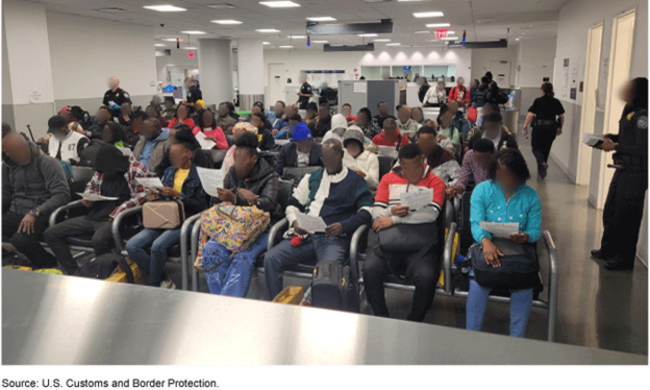
Humanitarian parole beneficiaries await processing at John F. Kennedy International Airport.
Highlights
What GAO Found
The Department of Homeland Security (DHS) began granting parole—temporary permission to stay in the U.S.—to certain eligible noncitizens through its supporter-based parole processes in May 2022. From that time through September 2024, DHS granted parole to about 774,000 noncitizens across three supporter-based processes: Cubans, Haitians, Nicaraguans, and Venezuelans (CHNV), Uniting for Ukraine (U4U), and family reunification parole (see figure).
Grants of Supporter-Based Parole, May 2022–September 2024

Shortly after U4U began, the DHS components responsible for implementing the parole processes—U.S. Citizenship and Immigration Services (USCIS) and U.S. Customs and Border Protection (CBP)—identified fraud risks and other vulnerabilities. Subsequently, a July 2024 USCIS review found that fraud indicators were widespread in U4U and CHNV. USCIS attributed these risks to insufficient internal controls in its supporter vetting process—for example, not having automated processes to prevent or detect possible fraudulent activity. DHS has since suspended or terminated the processes. However, USCIS has not developed an internal control plan for new or changed programs in the future. Such a plan could include basic antifraud controls and mechanisms to help proactively identify and mitigate fraud risks.
In addition, DHS faced other challenges implementing the parole processes, including limited staffing and resources, inconsistent review of the reasons for beneficiaries requesting parole, and supporters not upholding their commitments to beneficiaries. DHS agencies began taking some corrective actions, but DHS has not assessed lessons learned from the parole processes that it could apply to other efforts, such as lessons related to the use of temporarily assigned staff. By assessing and applying lessons learned from the parole processes, even if the processes have ended, DHS could improve other areas of its operations and thus be better positioned to avoid similar challenges in the future.
Prior to January 2025, U.S. Immigration and Customs Enforcement (ICE), which is responsible for enforcing U.S. immigration laws, did not have enforcement guidance focused specifically on parole beneficiaries, according to ICE officials. After January 2025, in alignment with new presidential administration executive orders and DHS policies, ICE instructed its officers to review each noncitizen case they encounter and determine whether any noncitizen’s parole status should be terminated. As of May 2025, ICE officials said that ICE did not have any nationwide enforcement efforts for paroled noncitizens and that its field offices determined any such actions on a case-by-case basis.
Why GAO Did This Study
In 2022 and 2023, DHS introduced new processes for humanitarian parole in response to increases in noncitizens arriving at the southwest border. The processes allowed eligible noncitizens from certain countries to travel to the U.S. to seek a grant of parole. To be eligible, noncitizens had to have a U.S.-based supporter apply to financially support them. DHS briefly suspended some of the processes in summer 2024 before restarting them. Then, in January 2025, following an executive order, DHS suspended all of the processes.
GAO was asked to review DHS’s administration and oversight of these parole processes. This report addresses (1) what DHS data show about supporter-based parole processes; (2) challenges that existed, and the extent to which DHS addressed them; and (3) DHS’s approach for taking enforcement actions against parole beneficiaries, as appropriate. GAO analyzed USCIS, CBP, and ICE documents and data on the parole processes from 2022 to 2025. GAO also (1) visited four U.S. airports where large numbers of noncitizens seeking parole arrived and (2) interviewed USCIS, CBP, and ICE officials from headquarters and field offices.
Recommendations
GAO is making three recommendations, including one to USCIS to develop an internal control plan that can be applied to a new or changed program, and two to DHS to assess and apply lessons learned from the parole processes. DHS concurred with the first recommendation and disagreed with the two to assess and apply lessons learned, noting terminating the processes sufficiently addresses the challenges. GAO believes these recommendations remain valid and could help improve other areas of DHS operations beyond parole.
Recommendations for Executive Action
| Agency Affected | Recommendation | Status |
|---|---|---|
| United States Citizenship and Immigration Services | The Director of USCIS should develop an internal control plan that can be immediately implemented or quickly tailored to mitigate fraud risks in a new program or a change to an existing program, such as a new immigration benefit application. (Recommendation 1) |
USCIS concurred with our recommendation. In July 2026, DHS stated that, since September 2025, USCIS has developed and implemented organizational changes and policies, and initiated rulemaking to improve program integrity and further mitigate fraud risks across the agency. For example, DHS reported that USCIS issued several guidance documents to strengthen security and background checks for immigration benefit requests. Additionally, USCIS initiated rulemaking to require the submission of biometrics by any individual associated with an immigration benefit request. The department said that USCIS's actions strengthened its ability to mitigate fraud risks regardless of the program. DHS also said that these actions serve the same purpose as internal controls that are documented within USCIS policy rather than a separate plan. DHS said that USCIS is in the process of preparing an update for GAO's review that documents the actions USCIS has taken. Upon receipt, we will assess this information to determine whether USCIS's actions meet the intent of an internal control plan that can be applied early in the implementation of a new or existing program to mitigate fraud risks.
|
| Department of Homeland Security | The Secretary of Homeland Security should assess and document lessons learned from the supporter-based parole processes that are relevant to other ongoing operations. (Recommendation 2) |
DHS did not concur with this recommendation. As of July 2026, DHS said that it is constantly evaluating and improving processes based on dynamic border security operations. DHS also acknowledged that certain lessons from the supporter-based processes may be potentially applicable to other ongoing operations but said that it did not plan to take any further action because it believes terminating the supporter-based processes sufficiently addresses the challenges with them. However, the challenges DHS faced implementing the processes, such as those related to staffing, resources, and fragmentation of responsibilities, may offer valuable lessons for ongoing and future operations. For example, USCIS began taking steps to modify the case management system it used to process supporter applications, such as automating address validations and implementing controls to prevent duplicate filings. While we acknowledge that these steps may no longer be relevant to the parole processes because they have ended, USCIS uses the case management system to help adjudicate and process applications for a range of immigration and non-immigration benefits. As of August 2026, we continue believe that by assessing and documenting lessons learned, DHS could improve other areas of its operations beyond parole and avoid similar challenges in the future.
|
| Department of Homeland Security | The Secretary of Homeland Security should apply the lessons learned identified through the assessment to ongoing operations, as appropriate. (Recommendation 3) |
DHS did not concur with our recommendation. As of July 2026, DHS said that it is constantly evaluating and improving processes based on dynamic border security operations. DHS also acknowledged that certain lessons from the supporter-based processes may be potentially applicable to other ongoing operations, but said that it did not plan to take any further action because it believes terminating the supporter-based processes sufficiently addresses the challenges with them. However, by applying lessons learned from these parole processes, DHS could improve other areas of its operations. For example, as discussed in our report, the challenges CBP officials reported with processing large quantities of parole beneficiary arrivals at airports-such as communicating across language barriers, processing children who arrived without a parent or legal guardian, and verifying documentation-may apply to other populations CBP processes. As of August 2026, we believe that by applying lessons learned, DHS could improve other areas of its operations beyond parole and avoid similar challenges in the future.
|