
Combatting Illicit Drugs: DOJ and DHS Must Resolve Uncertainties Around Collaboration to Ensure Effective Counternarcotics Investigations
Fast Facts
Illegal drugs transported across U.S. borders are a serious risk to Americans' health. Within the Departments of Justice and Homeland Security, the Drug Enforcement Administration and Homeland Security Investigations have agreements to collaborate on drug investigations.
The agreements outline requirements—like developing joint training—for the agencies to work together. But a new DOJ memorandum and other developments resulted in uncertainty about which requirements remain in effect.
Without clarity on the status of requirements, the agencies may not collaborate effectively on drug investigations.
Our recommendations address this.
Bundles wrapped in black plastic and brown tape, and some small clear plastic bags with white powder in them.
Highlights
What GAO Found
The Drug Enforcement Administration (DEA) and U.S. Immigration and Customs Enforcement (ICE) have entered into longstanding formal agreements to enhance their collaboration on counternarcotics investigations, including a June 2009 interagency cooperation agreement and a January 2021 joint letter. These agreements describe how DEA and ICE’s Homeland Security Investigations (HSI) are to coordinate on investigations. They establish requirements for DEA to cross-designate (or allow) HSI special agents to engage in counternarcotics investigations under the Controlled Substances Act and for both agencies to deconflict case information and engage in joint training, among other things.
More recently, GAO found that the Department of Justice (DOJ) issued two new documents since 2021 that relate to DEA and HSI collaboration on counternarcotics investigations—a January 2025 DOJ Office of Legal Counsel opinion and a May 2026 memorandum from the Acting Attorney General.
DOJ Documents Issued Since 2021 Related to DEA and ICE Collaboration
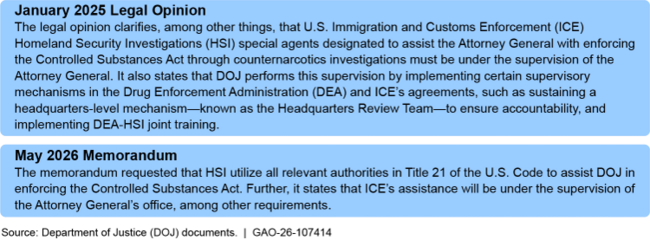
Prior to the issuance of the May 2026 memorandum, GAO found that DEA and ICE’s collaboration generally addressed four out of eight leading collaboration practices, including defining common outcomes and clarifying roles and responsibilities. The four leading practices that DEA and ICE had not fully addressed (ensuring accountability, sustaining leadership, bridging organizational cultures, and updating agreements) involve activities required by the agreements. For example, DEA and ICE never fully sustained a functioning Headquarters Review Team, nor had they fully implemented joint training, which were required by the 2009 and 2021 agreements respectively to address collaboration challenges. As of June 2026, DOJ officials told GAO they were still determining how the May 2026 memorandum will impact existing requirements in the 2009 and 2021 collaboration agreements, including establishing the Headquarters Review Team and implementing the joint training. By clarifying the status of the requirements within DEA and ICE’s agreements, DOJ and DHS would provide DEA and ICE the necessary direction about the activities they should conduct to ensure effective collaboration on counternarcotics investigations.
Why GAO Did This Study
The U.S. faces multiple challenges related to illicit drugs, including the opioid epidemic, which has been a national public health emergency since October 2017. To combat this crisis, the federal government has tasked DEA with leading U.S. efforts against illicit drug trafficking. In this role, DEA works with ICE’s HSI, within the Department of Homeland Security (DHS), to investigate illicit drug activity with a connection to U.S. borders.
GAO was asked to examine how DEA and ICE coordinate on counternarcotics investigations. This report addresses (1) new DOJ and DHS documents since 2021 that address how DEA and ICE collaborate and (2) the extent to which DEA and ICE agreements and activities related to counternarcotics investigations have been aligned with leading practices for collaboration.
To do this work, GAO analyzed DEA and HSI agreements and policies and interviewed relevant headquarters officials. GAO also conducted site visits with a nongeneralizable sample of nine DEA and HSI field offices to interview staff about their collaboration experiences. GAO selected this sample to reflect a variety of geographic regions and quantities of DEA and HSI drug seizures over an 8 ½ -year period. GAO also compared DEA and ICE’s collaboration activities against leading interagency collaboration practices and DOJ legal requirements.
Recommendations
GAO is making five recommendations, including that DOJ and DHS clarify the status of the requirements of the June 2009 agreement and January 2021 joint letter. DOJ agreed and DHS disagreed with the recommendations. GAO maintains its recommendations are valid, as discussed in the report.
Recommendations for Executive Action
| Agency Affected | Recommendation | Status |
|---|---|---|
| Department of Justice | The Attorney General should collaborate with the Secretary of Homeland Security to clarify the status of requirements in DEA and ICE's 2009 agreement and 2021 joint letter, including the Headquarters Review Team, field office notification of investigations and operational plans, and the joint training. (Recommendation 1) |
When we confirm what actions the agency has taken in response to this recommendation, we will provide updated information.
|
| Department of Justice | After clarifying the status of the requirements in DEA and ICE's existing agreements, the Attorney General should direct the Administrator of DEA, in collaboration with the Director of ICE, to update DEA and ICE's 2009 agreement and 2021 joint letter to address changes to the current operating environment or develop a new agreement or framework that addresses these changes. (Recommendation 2) |
When we confirm what actions the agency has taken in response to this recommendation, we will provide updated information.
|
| Department of Justice | The Attorney General should clarify how DOJ will implement key supervisory mechanisms identified in DOJ Office of Legal Counsel's January 2025 opinion in light of any changes to requirements within DEA and ICE's 2009 agreement and 2021 joint letter. (Recommendation 3) |
When we confirm what actions the agency has taken in response to this recommendation, we will provide updated information.
|
| Department of Homeland Security | The Secretary of Homeland Security should collaborate with the Attorney General to clarify the status of requirements in DEA and ICE's 2009 agreement and 2021 joint letter, including the Headquarters Review Team, field office notification of investigations and operational plans, and the joint training. (Recommendation 4) |
When we confirm what actions the agency has taken in response to this recommendation, we will provide updated information.
|
| Department of Homeland Security | After clarifying the status of the requirements in DEA and ICE's existing agreements, the Secretary of Homeland Security should direct the Director of ICE, in collaboration with the Administrator of DEA, to update DEA and ICE's 2009 agreement and 2021 joint letter to address changes to the current operating environment or develop a new agreement or framework that addresses these changes. (Recommendation 5) |
When we confirm what actions the agency has taken in response to this recommendation, we will provide updated information.
|