
Air Traffic Control Workforce: FAA Should Establish Goals and Better Assess Its Hiring Processes
Fast Facts
Air traffic controllers guide more than 80,000 flights to their destinations daily. But as air traffic has increased, the air traffic controller workforce has shrunk. Not having enough controllers can delay or cancel flights and could impact safety.
Ensuring enough controllers are available is difficult. The process for hiring and training them is long and complex and many applicants don't make it to the end. The Federal Aviation Administration has taken steps to increase its hiring.
We recommended FAA set specific goals and make better use of data to further improve its recruiting, hiring, and training processes.

Three air traffic controllers work in an airport control tower.
Highlights
What GAO Found
Federal Aviation Administration (FAA) air traffic controllers help ensure the safety of U.S. air travel. However, lapses in appropriations in the 2010s, and the COVID-19 pandemic, resulted in reduced controller hiring and increased attrition. In response, FAA has increased hiring every year since 2021. Nevertheless, at the end of fiscal year 2025, FAA employed 13,164 controllers, about 6 percent fewer than in 2015. Between fiscal years 2015 and 2024, total flights using the air traffic control system increased by about 10 percent to 30.8 million.
FAA uses a standardized process to hire controllers that begins with evaluating applicants’ performance on an aptitude test or their prior experience as an air traffic controller. Applicants must also meet medical and security standards and succeed at multiple types of training.
However, FAA’s processes for hiring and training controllers result in substantial attrition (see fig.). This occurs due to a limited portion of the population having the required aptitude, and the length and complexity of the processes—which can take 2-6 years. Specifically, the medical clearance process can take some applicants 2 years to complete. In response to these challenges, FAA has taken steps to accelerate the process, including adding resources to the medical clearance process and streamlining application review.
Attrition Across the FAA’s Processes for Hiring Air Traffic Controllers Without Prior Experience, Fiscal Years 2017-2022
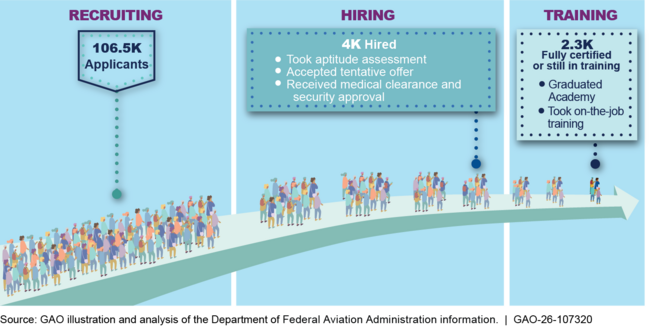
GAO also found that FAA does not consistently assess its processes to recruit, hire, and train air traffic controllers. Specifically, FAA does not have performance goals for these processes and their resulting impact. Such goals help ensure accountability for achieving specific and measurable results. GAO also found that while FAA is taking steps to improve its collection of data on recruiting, hiring, and training, it does not consistently use these data to assess the results of its efforts and inform decision-making. Doing so could help FAA understand the performance of its processes, make the changes that would have the greatest effect on controller staffing, and keep otherwise qualified applicants on the track to becoming certified controllers.
Why GAO Did This Study
FAA, within the Department of Transportation, manages over 80,000 flights daily. FAA air traffic controllers perform this essential job that requires highly specialized skills and training. Over the last 10 years, FAA has faced staffing shortages at critical facilities.
GAO was asked to review FAA’s processes for hiring air traffic controllers. This report (1) describes the size and composition of the air traffic control workforce and changes since fiscal year 2015; (2) describes the processes FAA uses to recruit, hire, and train new controllers; (3) examines the steps FAA has taken to address challenges associated with recruiting, hiring, and training controllers; and (4) evaluates how FAA has assessed its efforts to hire air traffic controllers.
To address these objectives, GAO used FAA data to develop a dataset covering individuals from application through certification and used the data to analyze attrition in the controller hiring process. GAO also reviewed FAA documentation; visited the FAA training academy in Oklahoma City and air traffic control facilities near Chicago; Seattle; and Washington, D.C.; interviewed FAA officials and aviation industry stakeholders; and compared FAA’s efforts to assess its hiring processes with leading practices for evidence-based decision-making.
Recommendations
GAO is making three recommendations, including that FAA (1) establish and document measurable goals for its processes to recruit, hire, and train controllers; and (2) analyze the information it collects to inform decisions about improving those processes. FAA agreed with the recommendations.
Recommendations for Executive Action
| Agency Affected | Recommendation | Status |
|---|---|---|
| Federal Aviation Administration | The Administrator of FAA should ensure that FAA develops a system, such as its planned dashboard for applicants, that provides applicants with the ability to efficiently access information related to their application, including the ability to check their application status and obtain the information they need to complete their next steps. (Recommendation 1) |
On May 28, 2026, DOT sent its 180-day letter concurring with our recommendation. According to FAA, as the agency advances implementation of the government-wide Human Capital Management system, it will utilize dashboards to support Air Traffic Control applicants in navigating the clearance process more effectively. Further, the agency stated that as an interim solution, FAA is developing a candidate-status dashboard prototype. FAA expects to launch the interim candidate status dashboard no later than June 30, 2026. We will continue to monitor agency efforts to implement this recommendation.
|
| Federal Aviation Administration | The Administrator of FAA should establish and document measurable goals for its processes to recruit, hire, and train air traffic controllers. (Recommendation 2) |
On May 28, 2026, DOT sent its 180-day letter concurring with our recommendation. According to FAA, in its Flight Plan 2026, FAA documented measurable activities and goals to improve its hiring and training of air traffic controllers. In addition, the agency stated that it has initiated a data-driven process improvement study to identify constraints and opportunities for added efficiencies in its controller hiring and training processes. They further noted that actions to identify any additional required goals and metrics will be completed by September 30, 2026. We will continue to monitor agency efforts to implement this recommendation.
|
| Federal Aviation Administration |
Priority Rec.
The Administrator of FAA should use the information FAA collects across its databases to assess its processes for recruiting, hiring, and training air traffic controllers and inform decisions about any needed improvements. (Recommendation 3) |
On May 28, 2026, DOT sent its 180-day letter concurring with our recommendation and indicating that the agency had developed a performance dashboard integrating controller hiring and training data from various databases to inform decisions needed to meet controller hiring targets and other metrics. GAO is currently reviewing FAA's documentation of its dashboard efforts to determine if the agency has achieved the recommendation's intend.
|