
While Thousands Applied to Become Air Traffic Controllers, There’s Still a Shortage. We Looked at Why.
The Federal Aviation Administration (FAA) has been trying to hire and train more air traffic controllers, who direct and manage flights. Yet even with about 200,000 applicants over the last several years, FAA remains short staffed.
Today’s WatchBlog post looks at our new report on the shortage of air traffic controllers, its impacts, and why it is so difficult to hire and train more of these critical workers.
Image

A decade of trying to hire more air traffic controllers has fallen short
The number of air traffic controllers in the U.S. has declined by about 6% in the last decade. At the same time, there has been a 10% increase in the number of flights that rely on the air traffic control system. As a result, there have been staffing shortages at critical facilities.
The shortage was especially noticeable this fall, but has been fueled by a number of factors over the years, including:
- Government shutdowns. For example, shutdowns in 2013 and 2018-2019 froze all hiring and training activities.
- The COVID-19 pandemic, which led to suspended training for 4 months. When training resumed, it was at reduced capacity for nearly 2 years.
- Unexpected trends in the workforce and in air traffic. For example, high attrition from 2019-2024 and rapidly recovering travel demand after the pandemic saw the FAA struggling to increase its training capacity and meet demand.
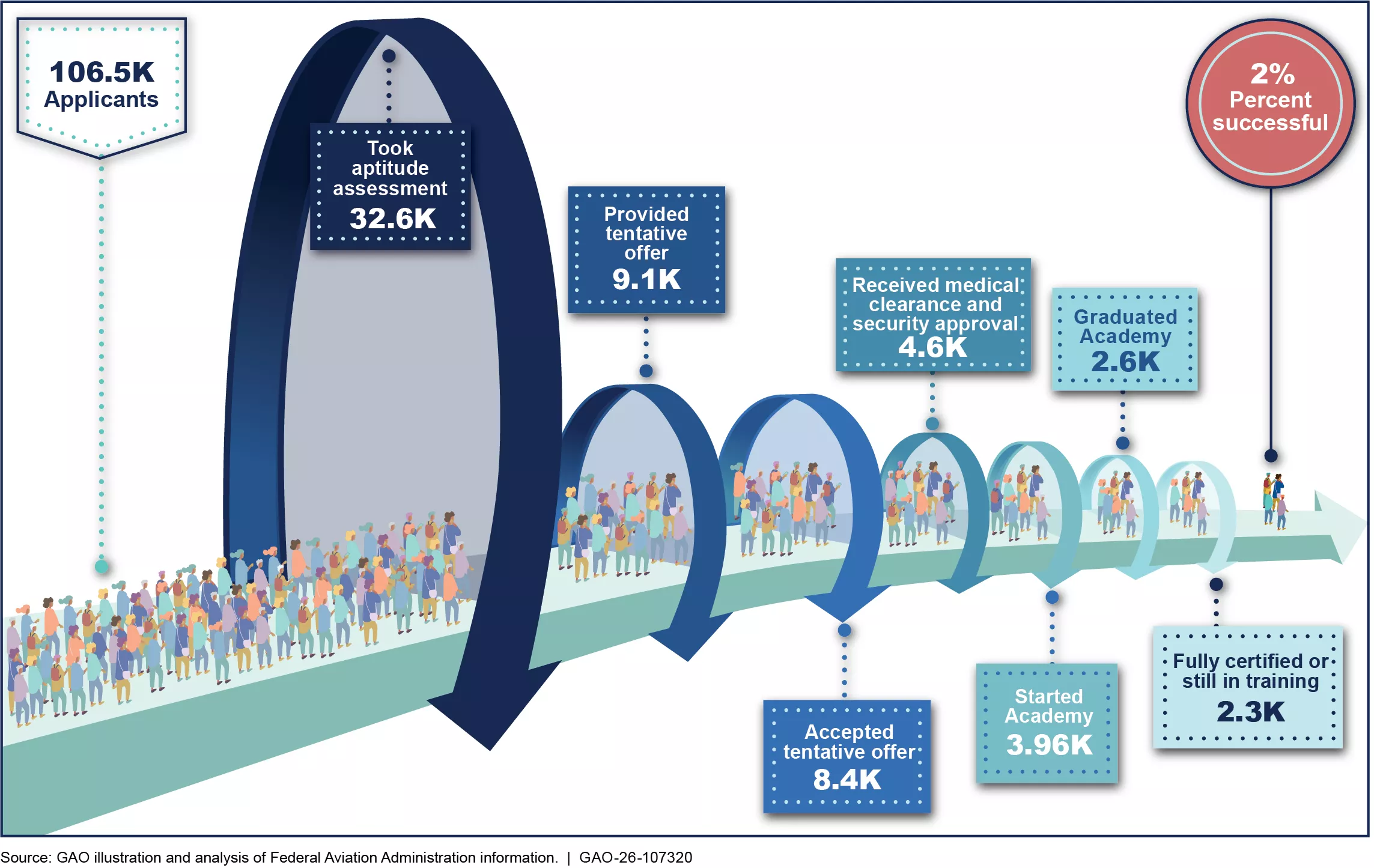
To address shortages, the FAA has been working to hire and train new controllers. But this is no simple task nor is it speedy. For example, all applicants must pass an aptitude assessment and obtain a medical clearance and security approval before they are hired.
Once candidates pass these initial screenings, most must then graduate from a 4-to-6-month training course at the FAA Academy in Oklahoma City, followed by on-the-job training. Becoming certified can take new candidates up to 6 years.
FAA Planned vs. Actual Air Traffic Controller Hiring, 2012-2028
Image
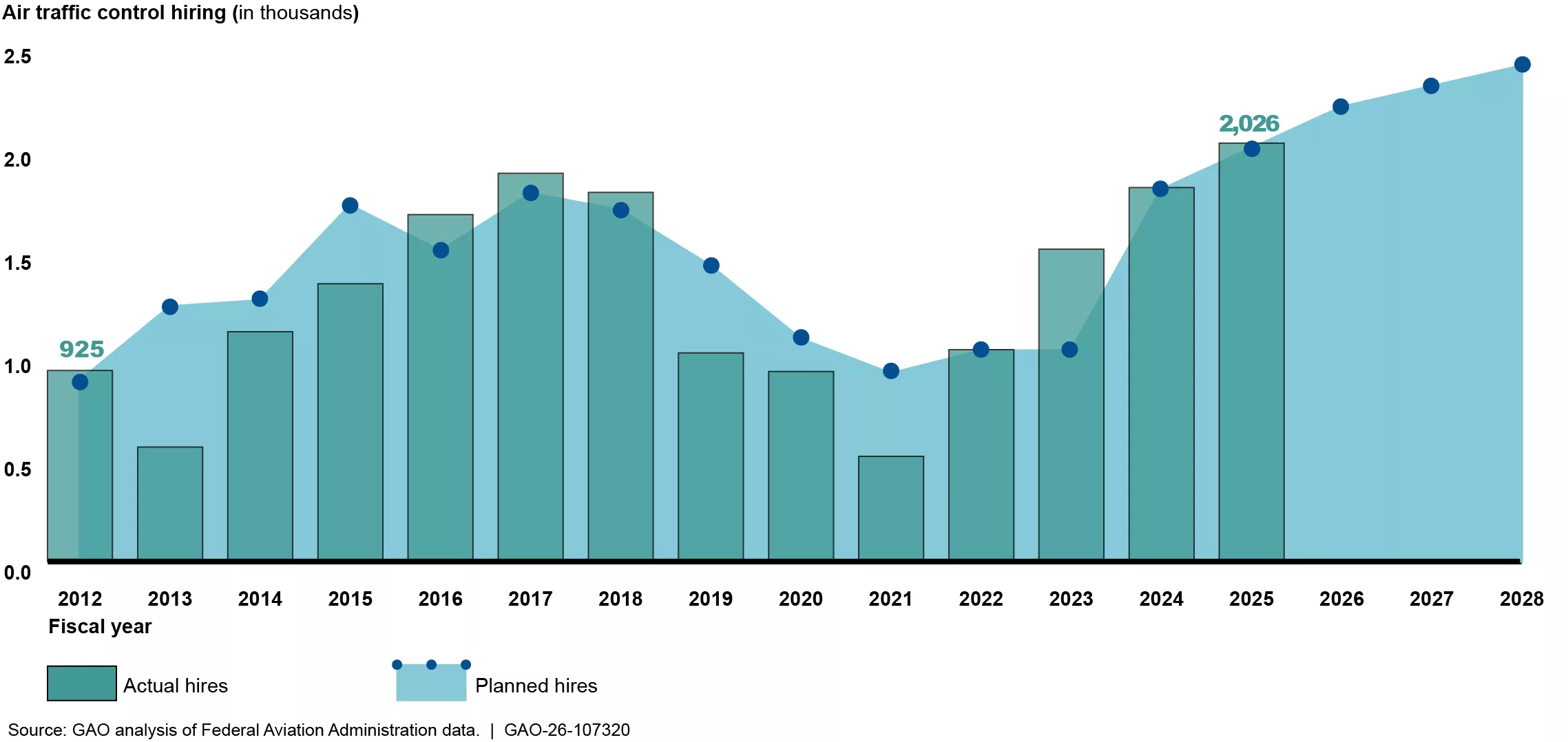
This rigorous hiring and training process is designed to ensure that candidates are well equipped to handle a demanding, high-stakes career as an air traffic controller. Very few applicants—about 2%—qualify for and complete the full training process. So even if many people are interested in the job, it would be nearly impossible for the FAA to quickly hire a lot of new air traffic controllers.
Attrition Across the FAA’s Process for Hiring Air Traffic Controllers
Image
What is FAA trying to do and what more should it do?
While some attrition during the hiring process is unavoidable—some applicants simply do not meet medical standards or do not pass the aptitude test—other attrition may be preventable. For example, the hiring process can be difficult to navigate and require multiple in-person appointments for medical screening, fingerprinting, and more.
And by the time applicants receive an employment offer, they may have already accepted another job or their life circumstances no longer let them relocate for the job.
The FAA has taken some steps to streamline its hiring process by introducing new practices to speed it up and by hosting pre-employment events that allow applicants to complete multiple in-person tasks at one time. Yet many applicants still struggle to figure out where they are in the process and—more importantly—what they need to do next. Our new report suggests that the FAA develop a system to allow applicants to do just that.
The FAA collects data about key steps in the hiring and training process, such as candidate scores on the aptitude exam. But it has not analyzed this data to understand why applicants and trainees do not complete the process to become certified controllers. In our analysis, we found that aptitude test scores might be related to candidates' future success in achieving certification. Additional analysis like this could help the FAA inform decisions about how it could improve recruiting, hiring, and training of new air traffic controllers.
Learn more about the air traffic controller shortage and what more the FAA could do to address it in our new report.
- GAO’s fact-based, nonpartisan information helps Congress and federal agencies improve government. The WatchBlog lets us contextualize GAO’s work a little more for the public. Check out more of our posts at GAO.gov/blog.
- Got a comment, question? Email us at blog@gao.gov.
GAO Contacts
Image




Related Products

GAO's mission is to provide Congress with fact-based, nonpartisan information that can help improve federal government performance and ensure accountability for the benefit of the American people. GAO launched its WatchBlog in January, 2014, as part of its continuing effort to reach its audiences—Congress and the American people—where they are currently looking for information.
The blog format allows GAO to provide a little more context about its work than it can offer on its other social media platforms. Posts will tie GAO work to current events and the news; show how GAO’s work is affecting agencies or legislation; highlight reports, testimonies, and issue areas where GAO does work; and provide information about GAO itself, among other things.
Please send any feedback on GAO's WatchBlog to blog@gao.gov.