
Osprey Aircraft: Additional Oversight and Information Sharing Would Improve Safety Efforts
Fast Facts
The Osprey tiltrotor aircraft combines the capabilities of a helicopter with a turboprop airplane. The Marine Corps, Navy, and Air Force use the Osprey for missions that can require both aircraft types. But the Osprey has had 4 fatal accidents since 2022, resulting in 20 service member deaths and raising concerns about its safety.
We found the services haven't fully resolved safety risks, like not having enough personnel for maintenance. We also found they haven't established:
- Who is responsible for ensuring known safety risks have been addressed
- How to routinely share relevant safety information
Our recommendations address these issues.
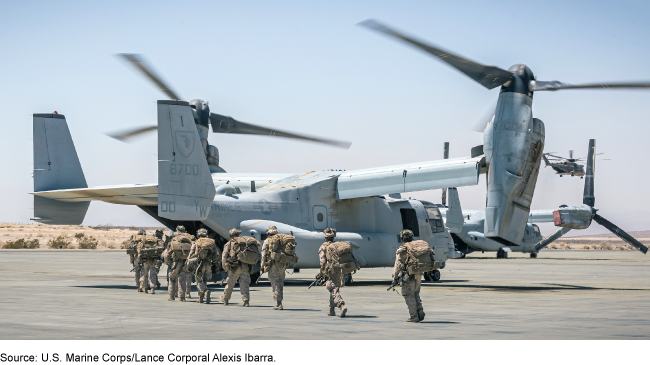
U.S. Marines board an Osprey during a training event at Marine Corps Air-Ground Combat Center, CA
Highlights
What GAO Found
The Marine Corps and Air Force had higher rates of the most serious accidents in the last 2 fiscal years (2023 and 2024) with its Osprey aircraft compared with the average serious accident rate for the previous 8 years, based on available Department of Defense (DOD) data. In fiscal years 2023 and 2024, 18 serious, non-combat accidents occured involving death; permanent disability; extensive hospitalization; property damage of $600,000 or more; or a destroyed aircraft. Rates of serious accidents were between 36 percent and 88 percent higher than each service’s average rate for the prior 8 fiscal years.
Percent Difference of Serious Osprey Accident Rates in Fiscal Years 2023 and 2024 Compared to Service Average for Fiscal Years 2015–2022

Note: The accident rate equals the number of accidents per year divided by the number of flight hours per year and then multiplied by 100,000. Serious accidents refer to combined Class A and B accidents which are those accidents that involved death; permanent disability; extensive hospitalization; property damages of $600,000 or more; or a destroyed aircraft. The Navy had not experienced a Class A or Class B accident with its Osprey variant since it began operational use in fiscal year 2021 through fiscal year 2024.
Rates of serious accidents with the Osprey aircraft generally exceeded those of the Departments of the Navy and Air Force fixed wing and rotary wing aircraft fleets for fiscal year 2015 through fiscal year 2024.
Serious Accident Rate Comparisons for Marine Corps and Air Force Osprey with Departments of the Navy and Air Force Fixed Wing and Rotary Wing Fleets, Fiscal Years 2015–2024
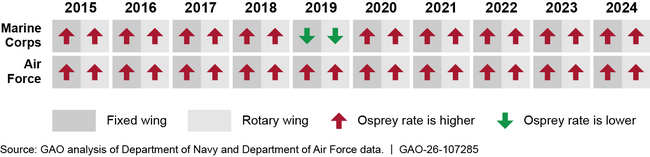
Note: Serious accidents refer to combined Class A and B accidents which are those accidents that involved death; permanent disability; extensive hospitalization; property damages of $600,000 or more; or a destroyed aircraft.
Most reported causes for serious accidents related to materiel failure of airframe or engine components and human error during aircraft operations or maintenance, according to GAO’s analysis of safety data.
Osprey program stakeholders have not fully identified, analyzed, or responded with procedural or materiel mitigations to all safety risks. For example, program stakeholders, which include the Osprey Joint Program Office and military services that operate the aircraft, had closed 45 risk assessments at the time of our review, but had not fully responded to 34 known system-related risks related to the potential failure of airframe and engine components. Stakeholders also had not identified actions to respond to non-system safety risks associated with aircraft maintenance and operations, such as mismatches in maintenance skill levels and limited training time to build aircrew experience. Without refining the joint program’s process for identifying, analyzing, and responding to Osprey safety risks to incorporate and prioritize system and non-system safety risks, program stakeholders cannot adequately mitigate risks that can contribute to death, injury, or loss of mission capability and resources.
Program stakeholders described factors that affected their ability to fully resolve Osprey safety risks, including challenges with how program stakeholders developed priorities and plans for addressing safety issues. These stakeholders identified costly, long-term engineering solutions and safety improvements that were required across a joint program with varied fleet sizes, which created longer risk mitigation timelines. GAO found that the median age for 28 unresolved serious and medium system risks was about 9 years, and over half (17 of 28) had been unresolved for between 6 and 14 years.
Summary and Median Age of Unresolved Osprey System Safety Risk Assessments, by Assessment Type as of June 2025
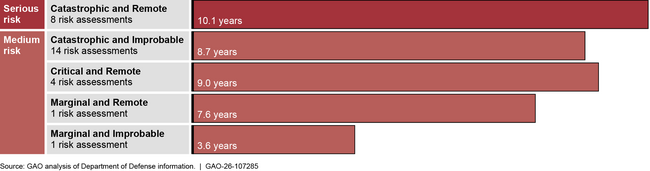
Note: The Department of Defense (DOD) designates risk assessments as serious and medium based on their assessment of the severity (e.g., catatsrophic) and frequency (e.g., remote). The figure does not include six additional risk assessments for general military aviation risks (e.g., bird strikes) that are not specific to the Osprey and have been accepted for the life of the program.
New initiatives established in 2024 are intended to address several of these factors, but these efforts did not comprehensively address non-system safety risks or include information for each service’s Osprey variant. Without determining an oversight structure with clearly defined roles and responsibilities for resolving known safety risks or conducting periodic reviews of efforts to resolve them, DOD cannot have reasonable assurance that program stakeholders will fully resolve the interrelated system and non-system safety risks affecting the Osprey.
GAO found that the Osprey program stakeholders have not routinely shared information in three areas to promote the safe operation of the aircraft.
Hazard and accident reporting. Program stakeholders have not proactively shared hazard and accident reporting information with Osprey units and unit safety personnel in the other services that operate the aircraft. Determining a process to proactively share relevant safety information with these personnel would provide greater assurance that Osprey units have the information needed to update their safety procedures.
Aircraft knowledge and emergency procedures. Program stakeholders did not convene a multi-service conference or other forum to share Osprey aircraft knowledge and emergency procedures for 5 years (from 2020 to 2025). Service-specific changes to operational practices included safety related information, but these changes were not readily shared among the services, according to unit personnel with whom GAO spoke. The military services that operate the aircraft held a conference in May 2025, but they had not formalized plans to continue to do so. Without such a routine method, Osprey units have missed out on opportunities to share information that would enhance the safe operations of the aircraft.
Maintenance data for common aircraft components and parts. Program stakeholders have taken steps to address maintenance data integrity issues for the hundreds of common Osprey aircraft components and parts that are shared across the services, but they have yet to confirm that all implementation steps have been completed. Without conducting a comprehensive review of Osprey maintenance guidance and inspection procedures, program stakeholders do not have assurance that efforts to improve maintenance information sharing have resolved data integrity issues, including for critical life-limited Osprey components, which has hindered their ability to ensure the safe operation of the aircraft.
Why GAO Did This Study
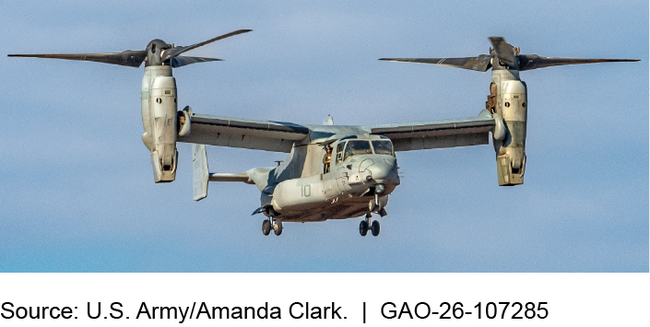
The Marine Corps, Air Force, and Navy use the Osprey tiltrotor aircraft, which combines the capabilities of a helicopter with those of a turboprop aircraft.
The Osprey experienced four fatal accidents since 2022 resulting in the deaths of 20 service members, based on reported DOD data.
GAO was asked to review Osprey accidents. This report (1) describes the trends in reported Osprey accidents; (2) evaluates the extent to which the Program Office and the military services have taken steps to identify and resolve Osprey safety issues; and (3) discusses how the military services share relevant Osprey safety information.
GAO analyzed DOD data on Osprey accidents through fiscal year 2024 and visited a non-generalizable sample of seven Marine Corps, Air Force, and Navy Osprey units to interview officials that GAO selected based on factors such as where accidents occurred.
Recommendations
GAO recommends that DOD
- Refine the joint program’s process for identifying, analyzing, and responding to all safety risks;
- Establish an oversight structure to ensure the timely resolution of known safety risks; and
- Implement processes to routinely share relevant safety data.
DOD agreed with the recommendations.
Recommendations for Executive Action
| Agency Affected | Recommendation | Status |
|---|---|---|
| Department of Defense | The Secretary of Defense should ensure that the Secretary of the Navy and the Secretary of the Air Force, in coordination with the Chief of Naval Operations; the Chief of Staff of the Air Force; the Commandant of the Marine Corps; and the Commander, Air Force Special Operations Command, refine the joint program's process for identifying, analyzing, and responding to all Osprey safety risks—including incorporating and prioritizing system and non-system safety risks. (Recommendation 1) |
DOD concurred with our recommendation. As of July 2026, we are monitoring DOD's actions to implement this recommendation.
|
| Department of Defense | The Secretary of Defense should ensure that the Secretary of the Navy and the Secretary of the Air Force, in coordination with the Chief of Naval Operations; the Chief of Staff of the Air Force; the Commandant of the Marine Corps; and the Commander, Air Force Special Operations Command, determine an oversight structure with clearly defined roles and responsibilities for resolving known system and non-system safety risks in a timely manner and conducting periodic reviews of efforts to resolve them. (Recommendation 2) |
DOD concurred with our recommendation. As of July 2026, we are monitoring DOD's actions to implement this recommendation.
|
| Department of Defense | The Secretary of Defense should ensure that the Secretary of the Navy and the Secretary of the Air Force, in coordination with the Chief of Naval Operations; the Chief of Staff of the Air Force; the Commandant of the Marine Corps; and the Commander, Air Force Special Operations Command, assess safety information sharing agreements and update them as needed to ensure that a process exists to proactively share relevant safety information from hazard and accident reporting with Osprey units and unit safety personnel across the military services. (Recommendation 3) |
DOD concurred with our recommendation. As of July 2026, we are monitoring DOD's actions to implement this recommendation.
|
| Department of Defense | The Secretary of Defense should ensure that the Secretary of the Navy and the Secretary of the Air Force, in coordination with the Chief of Naval Operations; the Chief of Staff of the Air Force; the Commandant of the Marine Corps; and the Commander, Air Force Special Operations Command, establish a routine method, such as a recurring multi-service conference to share information on Osprey aircraft knowledge and emergency procedures. (Recommendation 4) |
DOD concurred with our recommendation. As of July 2026, we are monitoring DOD's actions to implement this recommendation.
|
| Department of Defense | The Secretary of Defense should ensure that the Secretary of the Navy and the Secretary of the Air Force, in coordination with the Chief of Naval Operations; the Chief of Staff of the Air Force; the Commandant of the Marine Corps; and the Commander, Air Force Special Operations Command, conduct a comprehensive review of maintenance guidance and inspection procedures and update them as needed to ensure that Osprey units are using the system for tracking serialized aircraft components. (Recommendation 5) |
DOD concurred with our recommendation. As of July 2026, we are monitoring DOD's actions to implement this recommendation.
|