
Federal Prisons: Improvements Needed to the System Used to Assess and Mitigate Incarcerated People’s Recidivism Risk
Fast Facts
About 45% of people released from federal prison are re-arrested or return within 3 years. The First Step Act of 2018 requires the Bureau of Prisons to assess incarcerated people's:
Risk of recidivism (reoffending)
Needs that, if met, could potentially reduce that risk
Based on these assessments, the Bureau can place people into programs where they may earn credits toward early release.
But the Bureau doesn't maintain accurate data on incarcerated people's participation in these programs. It also doesn't have accurate data to indicate if people are released from prison when eligible.
Our recommendations address these issues and more.
Incarcerated people participating in a program

One person in an orange jumpsuit stands next to a whiteboard on an easel, while two people in orange jumpsuits and one person in a blue shirt sit around a table and applaud.
Highlights
What GAO Found
The First Step Act of 2018 (FSA) required the Federal Bureau of Prisons (BOP) to assess incarcerated people’s risk of recidivism and their needs, that if addressed, may reduce that risk. BOP did not conduct all assessments within required time frames (28 days for initial and 90 or 180 days for reassessments) for various reasons, including technology issues. For example, BOP conducted initial risk assessments within required time frames for about 75 percent of the 57,902 incarcerated people who entered a BOP facility from June 1, 2022, to March 30, 2024. For the needs it is responsible for assessing, BOP conducted 69 to 95 percent of this cohort’s assessments within required time frames. BOP plans to enhance an existing application to ensure assessments are conducted as required, in response to a 2023 GAO recommendation.
BOP officials said they offer FSA programs and activities that address all 13 needs (e.g., substance use). However, BOP does not have accurate program data because, for example, staff used different methods to record when an incarcerated person declined to participate in a recommended program. GAO also found inaccuracies in program participation data, which BOP officials attributed to data entry errors. Without accurate data, BOP cannot determine if it offers sufficient programming to meet the needs of its incarcerated population.
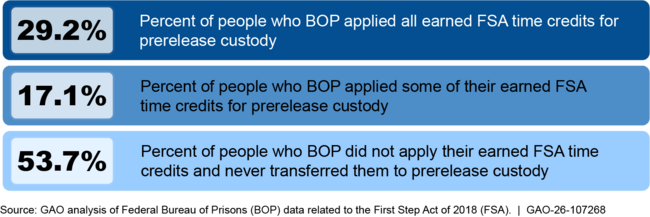
Eligible incarcerated people who agree to participate in programs, among other things, may earn time credits toward early transfer to supervised release and prerelease custody (i.e., home confinement or residential reentry center). GAO found that BOP generally applied all time credits toward supervised release but not for prerelease custody. BOP implemented new planning tools in 2024 and 2025 to help staff anticipate upcoming transfers to prerelease custody and ensure incarcerated people receive their FSA time credits. GAO has ongoing work examining BOP’s efforts to forecast capacity needs and provide sufficient residential reentry center resources.
People Incarcerated in a BOP Facility on March 30, 2024 that Transferred or Could Have Transferred to Prerelease Custody From March 31, 2024–December 31, 2024
The Department of Justice (DOJ) has not been able to fully address all FSA annual reporting requirements because not enough time has passed since the agency implemented FSA to determine certain things, such as recidivism rates. This requirement expired in 2025, and absent congressional actions, DOJ no longer has to submit a report to Congress. Without such information, Congress may be hindered in its decision making regarding the FSA.
Why GAO Did This Study
In 2024, BOP released approximately 42,000 people from federal prisons. Approximately 45 percent of people released from federal prison recidivate (are re-arrested or return within 3 years of their release), according to BOP. Under the FSA, BOP is to help reduce recidivism by assessing a person’s recidivism risk and needs and providing programs and activities to address their needs. The FSA allows eligible people to earn time credits that may reduce their time in prison.
The FSA includes a provision for GAO to assess certain FSA requirements. This report examines the extent to which BOP conducted risk and needs assessments; offered programs and activities; and applied FSA time credits. This report also examines the extent to which DOJ met FSA reporting requirements, among other objectives.
GAO analyzed BOP data from January 2022 through December 2024 for people in BOP custody as of March 30, 2024. GAO analyzed DOJ and BOP policies, guidance, and reports and interviewed officials at BOP’s Central Office and three regional offices. GAO also interviewed staff and incarcerated persons at four facilities. GAO selected facilities based on factors such as geographic location and security level.
Recommendations
GAO recommends that Congress consider extending the reporting requirement for DOJ’s annual FSA report. Additionally, GAO is making six recommendations to BOP, including several recommendations to improve its data collection. BOP concurred with all six recommendations and plans to take action to address them.
Matter for Congressional Consideration
| Matter | Status | Comments |
|---|---|---|
| Congress should consider amending 18 U.S.C. § 3634, to extend the Attorney General's reporting requirement to help Congress gain a full understanding of the effectiveness of FSA programs and the budgetary savings resulting from implementing the FSA. (Matter for Consideration 1) | As of March 2026, Congress has not acted on this matter. |
Recommendations for Executive Action
| Agency Affected | Recommendation | Status |
|---|---|---|
| Bureau of Prisons | The Director of BOP should take steps to ensure it collects and maintains accurate programming data, including codes to indicate program participation and waitlists. (Recommendation 1) |
In January 2026, we reported that BOP does not collect and maintain accurate programming data, including codes to indicate program participation and waitlists. We recommended that BOP collect and maintain such data and BOP concurred. In response, in July 2026, BOP officials stated that they developed and implemented enhancements to its First Step Act Dashboard which will strengthen their ability to collect and monitor program data. In addition, officials stated that they are working on standardizing their education and work data codes. While these actions will help improve these data, our report found inaccuracies in program participation and waitlist data for various programs, including data on when an incarcerated person declines to participate in a recommended program. To address this recommendation, BOP will need ensure that it collects and maintains accurate program data across all programs, including codes to indicate program participation and waitlists.
|
| Bureau of Prisons | The Director of BOP should collect standardized data bureau-wide that are readily accessible on incarcerated people who do not have work assignments, including data on people who are exempt from working for allowable reasons. (Recommendation 2) |
In January 2026, we reported that BOP does not have standardized bureau-wide data that are readily accessible on whether incarcerated people have a work assignment, including if they have an allowable reason for not working. We recommended that BOP collect such data and BOP concurred. In response, in July 2026, BOP officials stated that they are developing a plan to standardize "no work" assignment codes, including codes for people who are exempt from working for allowable reasons. BOP officials stated that they anticipate implementing this standardization plan for work assignments after BOP migrates data to its new case management database, CICLOPS. BOP officials stated that they anticipate completing the migration to CICLOPS in September 2026. To address this recommendation, BOP will need to ensure that it collects standardized data bureau-wide that are readily accessible on incarcerated people who do not have work assignments, including data on people who are exempt from working for allowable reasons.
|
| Bureau of Prisons | The Director of BOP should monitor work assignment data, once collected, and take corrective action as needed to ensure eligible persons have work assignments. (Recommendation 3) |
In January 2026, we reported that BOP does not have standardized bureau-wide data that are readily accessible to be able to monitor whether incarcerated people have a work assignment, including if they have an allowable reason for not working. We recommended that BOP monitor such data, once collected, and BOP concurred. In response, in July 2026, BOP officials stated that they are developing a plan to standardize "no work" assignment codes, including codes for people who are exempt from working for allowable reasons. They stated that this would allow them to monitor work assignments. BOP officials stated that they anticipate implementing this standardization plan for work assignments after BOP migrates data to its new case management database, CICLOPS. BOP officials stated that they anticipate completing the migration to CICLOPS in September 2026. To address this recommendation, BOP will need to ensure that it monitors work assignment data, once collected, and takes corrective action as needed to ensure eligible persons have work assignments.
|
| Bureau of Prisons | The Director of BOP should ensure accurate release data are readily accessible on an individual's release status and associated date. (Recommendation 4) |
In January 2026, we found that BOP did not have accurate release status for approximately 9 percent of incarcerated individuals that was readily accessible. Specifically, BOP's data had conflicting information in case management system (SENTRY) on these individuals that indicated, for example, two separate dates for when the person was released from BOP custody to supervised released. We recommended that BOP ensure it had accurate release data on an individual's release status and associated date that are readily available and BOP concurred. In response, in July 2026, BOP officials stated that they continue their efforts to ensure accuracy and accessibility of release data by regularly reviewing each person's case. While reviewing release data on a case-by-case basis may help with accuracy, it does not ensure these data are readily available. To address this recommendation, BOP will need to take action to ensure these data are accurate and readily accessible.
|
| Bureau of Prisons | The Director of the BOP should develop and implement a process to ensure its FSA policies and procedures are consistently implemented across the bureau and take corrective actions as needed. (Recommendation 5) |
In January 2026, we reported that BOP did not have a process to ensure staff implement FSA policies and procedures consistently across the bureau and recommended that it develop and implement such a process. BOP concurred with this recommendation. In response, in July 2026, BOP officials stated BOP issued a new program statement on FSA assessments, programming, and incentives in May 2026 that requires interdisciplinary FSA committees at all facilities to ensure quality and consistency. In addition, officials stated that they are finalizing an FSA office to oversee all aspects of FSA implementation, training, and monitoring. Officials stated they anticipate this office will be expanded to ensure consistency. To address this recommendation, BOP will need to develop and implement a process to ensure its FSA policies and procedures are consistently implemented across the bureau and take corrective actions as needed.
|
| Bureau of Prisons | The Director of the BOP should develop and implement a process for staff with FSA responsibilities to demonstrate competence in implementing the FSA and take corrective actions as needed. (Recommendation 6) |
In January 2026, we reported that BOP did not have a process for staff with FSA responsibilities to demonstrate competence in implementing the FSA and recommended that it develop and implement such a process. BOP concurred with this recommendation. In response, in July 2026, BOP officials stated effective implementation of the FSA requires a multi-level approach and that they will continue their current training efforts while developing additional training requirements. Officials also stated that they posted a training slide deck, titled Understanding the First Step Act, on its internal website and are in the process of finalizing this into a required training course for all BOP staff. In addition, officials stated that they posted additional training videos on its internal web page and will continue to expand its in-person training sessions. Officials stated that they will provide discipline-specific training that will be tailored to each staff's area of responsibility. To address this recommendation, BOP develop and implement a process for staff with FSA responsibilities to demonstrate competence in implementing the FSA and take corrective actions as needed.
|