
Health Care Accessibility: Further Efforts Needed to Address Barriers for People with Disabilities
Fast Facts
We also published an "Easy Read" version of this report. Easy Read is a way of making written information easier to understand. We published the Easy Read version to make our report more accessible to certain people with intellectual and developmental disabilities.
One in 4 U.S. adults reports having a disability. We spoke to experts and reviewed literature to identify barriers people with disabilities may face in the health care system. We also looked at federal oversight.
Barriers included:
Diagnostic equipment that requires standing
Crowded, brightly lit waiting rooms that can overwhelm some people with autism
Health and Human Services doesn't collect national data from people with disabilities on barriers—which it could use to help improve accessibility.
HHS updated accessibility requirements in 2024 but health care organizations may not know that.
Our recommendations address these and other issues.
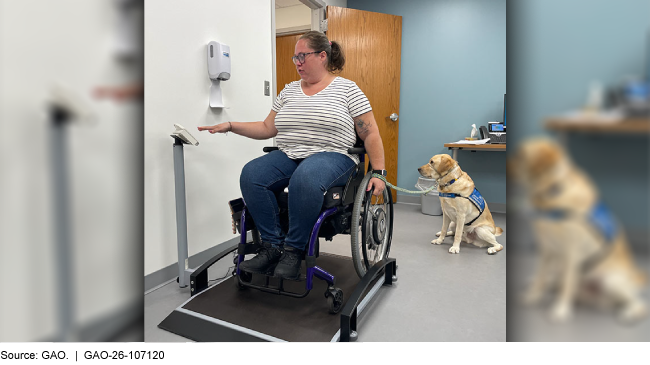
A woman in a wheelchair uses a wheelchair-accessible scale. Her service dog sits next to her.
Highlights
What GAO Found
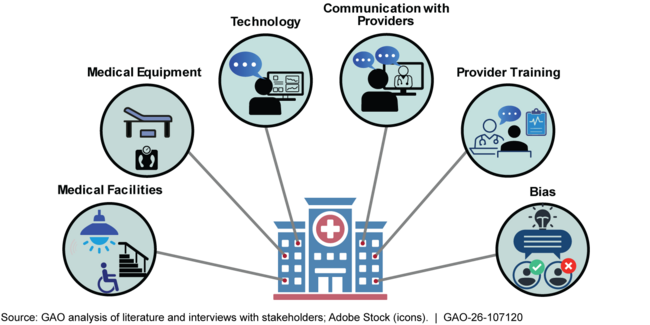
People with disabilities may encounter barriers related to accessibility in the U.S. health care system; these barriers can affect the quality of their care. GAO analyzed research literature on health care accessibility and conducted interviews with stakeholders and identified the following potential barriers.
Types of Potential Barriers to Accessibility in Health Care Described by Literature and Selected Stakeholders
The Department of Health and Human Services (HHS) does not collect national-level data on the accessibility of health care from people with disabilities. GAO analyzed 12 HHS population health surveys. One survey included a question on bias, but none covered other barriers to accessibility. HHS has established goals to increase the accessibility of health care through data collection, but officials stated that they do not have plans to collect related national-level data. Such plans would better position HHS to accurately identify barriers and evaluate the effects of HHS regulations that cover nondiscrimination in health care.
Within HHS, the Centers for Medicare and Medicaid Services (CMS) and Office of Civil Rights (OCR) oversee aspects of health care organizations’ compliance with federal laws, but oversight related to accessibility has been limited. Specifically, CMS (1) uses an on-site inspection process to ensure that organizations participating in Medicare comply with health and safety standards and (2) inspects some aspects of accessibility. OCR investigates some accessibility issues through compliance reviews and from complaints. But it does not routinely share information on the results of its compliance reviews or complaint investigations. Sharing these results could broaden the impact of OCR’s efforts to other health care organizations. In 2024, HHS amended its regulations, adding accessibility requirements, and HHS’s current strategic plans state that accessibility is a priority. However, these plans do not include details or time frames for achieving this priority. As a result, HHS may not take appropriate steps to ensure that health care organizations meet accessibility requirements and some people with disabilities may continue to face barriers to obtaining health care.
Why GAO Did This Study
Millions of adults in the U.S. report having some form of a disability, such as a condition that affects vision, movement, hearing, or mental health. Federally funded programs such as Medicare pay for health services, including for people with disabilities. Although federal laws prohibit these programs from discrimination on the basis of disability, people with disabilities may face barriers to obtaining health care.
GAO was asked to review federal efforts, including data collection and oversight, to ensure the accessibility of health care for people with disabilities. This report examines (1) barriers to accessible health care that people with disabilities may face, (2) HHS data collection efforts on the accessibility of health care, and (3) related HHS oversight.
GAO reviewed relevant federal laws, regulations, and HHS policies and guidance; examined peer-reviewed literature on barriers to accessible health care published between 2013 and 2024; analyzed HHS accessibility-related data collection efforts; and conducted a nongeneralizable survey of 1,194 adults with disabilities. GAO also interviewed HHS officials and representatives from nine disability associations and research groups and two accrediting organizations.
Recommendations
GAO is making five recommendations, including that HHS develop plans to collect national-level data from people with disabilities on health care accessibility, share data on results of OCR’s current oversight efforts, and establish detailed plans to help ensure health care accessibility. HHS neither agreed nor disagreed with the recommendations, as discussed in the report.
Recommendations for Executive Action
| Agency Affected | Recommendation | Status |
|---|---|---|
| Department of Health and Human Services | The Secretary of HHS should establish detailed plans—that contain clear steps and timelines—to develop and pilot the collection of national-level data from people with disabilities on the accessibility of health care. The plans should be developed in consultation with stakeholders. (Recommendation 1) |
HHS neither agreed nor disagreed with this recommendation. HHS stated that while improving disability data infrastructure was a priority, the agency was unable to execute planning activities for such data collection at this time without dedicated and sufficient funding. The agency also noted the need to be cognizant of respondent burden relative to the value of the information collected. We continue to believe that agency planning would not require a high resource investment. Further, such planning, including establishing clear goals, would allow HHS to determine the scope and resource requirements of such a data collection effort, potentially saving resources over time. We also believe that engaging stakeholders in the development of the plan could help HHS assess data needs and respondent burden.
|
| Department of Health and Human Services | The Secretary of HHS should ensure the consistent collection of data on disability status using its Data Standard for Disability Status (currently the ACS-6) in the following population health surveys: Health and Retirement Study, Health Information National Trends Survey, National Health and Aging Trends Study, National Health and Nutrition Examination Survey, National Health Interview Survey Sample Adult Questionnaire, National Survey of Family Growth, and National Survey on Drug Use and Health. (Recommendation 2) |
HHS neither agreed nor disagreed with this recommendation. HHS stated that the agency was unable to execute planning or data collection activities without dedicated and sufficient funding. The agency also noted that the HHS Implementation Guidance on Data Collection Standards had minimum data standards and agencies were permitted to include additional questions. HHS cited two efforts underway related to the collection of the ACS-6. Regarding the funding issue, the Guidance notes that incorporating the disability data standard can occur at the next major revision of the survey and in accordance with normal agency planning, budgeting and data collection cycles. We acknowledged the flexibility included in the Guidance. However, the Guidance states that additional questions can be added as long as the minimum data standard is included. We identified seven surveys that did not include the minimum data standard for disability status, the ACS-6. We are encouraged that HHS is taking steps to align data collection on disability status with agency guidance. Increasing the number of surveys that collect disability data in accordance with HHS's data standard will help to increase consistency of data collection in this area.
|
| Department of Health and Human Services | The Secretary of HHS should establish plans for achieving its priorities related to accessible health care provided by health care organizations, through the survey and certification process or some other mechanism, to help ensure accessibility for people with disabilities and compliance with the recent Section 504 regulations. Such plans for achieving priorities should be developed in consultation with relevant stakeholders and should include sound planning practices, such as developing activities and timelines and assigning responsible parties. (Recommendation 3) |
HHS stated that the agency was continuing to review this recommendation. We will monitor the agency's efforts to address it.
|
| Department of Health and Human Services | The Secretary of HHS should ensure that OCR develop a mechanism to compile and publicly share on an annual basis summary data on resolved complaints and compliance reviews, to inform OCR and other efforts to enhance accessibility for people with disabilities. This mechanism could include additional functionality of the OCR case management system to automate the preparation of summary data, to the extent possible. (Recommendation 4) |
HHS neither agreed nor disagreed with this recommendation and identified potential challenges in implementing it. First, HHS noted there could be privacy and confidentiality concerns if it were to publicly share complaint and compliance review documents. Our recommendation refers to summary data rather than summary information. We believe that summary data would help to identify common challenges and areas for improving accessibility. Second, HHS noted that it already shares voluntary resolution agreements and settlement agreements resulting from resolved complaints via its website. We acknowledge these efforts and believe that the substance of individual agreements may provide helpful examples of noncompliance and how it may be addressed. OCR is taking steps to modernize its case management system. Completing these efforts could help the agency more efficiently summarize and share data. HHS's ongoing efforts, when combined with sharing summary data, would benefit health care organizations, providers, and the public.
|
| Department of Health and Human Services | The Secretary of HHS should ensure that OCR provides additional guidance to health care organizations regarding their responsibilities under Section 504, and make all guidance readily available to health care organizations. (Recommendation 5) |
HHS neither agreed nor disagreed with this recommendation. The agency noted that it had already provided guidance on the updated Section 504 regulations, including fact sheets on specific topics such as requirements for web content, mobile apps, and kiosks. However, we believe that while these fact sheets are helpful in addressing certain topics, additional guidance covering all health care organizations' responsibilities under Section 504 regulations is needed to help health care organizations address the new requirements in a timely manner and ensure quality health care for people with disabilities. For example, the fact sheets do not cover the prohibition on limiting medical treatment based on bias about disability. In addition, this guidance should be readily available to providers. We will monitor the agency's activity in these areas.
|