
Federal Civilian Firefighters: DOD Should Take Action to Address Long-Standing Staffing Gaps
Fast Facts
Department of Defense civilian firefighters are a first line of defense when catastrophes threaten DOD installations. But DOD has experienced long-standing staffing issues within this workforce.
From FY 2019-2023, DOD employed fewer civilian firefighters than authorized—i.e., below the minimum staffing level required for safe operations.
DOD identified causes of its staffing gaps, such as competition from local fire departments that may offer better pay and work schedules. But DOD hasn't made sustained or coordinated efforts to address these causes and close the gaps.
We recommended that DOD implement a strategy to do so, among other things.
Highlights
What GAO Found
The Department of Defense (DOD) employed fewer civilian firefighters than authorized in fiscal years 2019 through 2023, the most current 5 years of data available. According to DOD and Office of Personnel Management (OPM) data, DOD employed approximately 93 percent of its authorized civilian firefighter positions in fiscal years 2019 through 2023. DOD stated that the authorizations represent the minimum staffing that must be maintained to ensure safe operations and that staffing below the authorized levels increases the department’s risk of property loss and environmental damage.
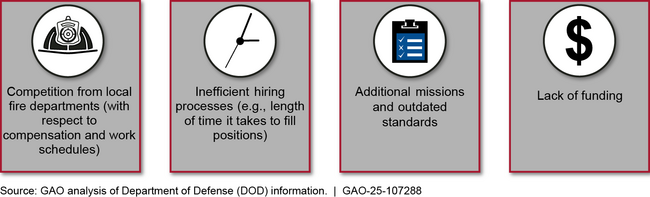
DOD has taken limited steps to address long-standing staffing gaps in its civilian firefighter workforce. Since 2003 DOD has identified causes of civilian firefighter staffing gaps (see figure), such as competition from local fire departments. DOD has taken some steps, such as including strategies for civilian firefighter retention in the department’s strategic workforce plan updates, to address these gaps.
Causes of the Civilian Firefighter Staffing Gaps Identified by DOD Since 2003
However, DOD has not fully addressed the identified causes of its civilian firefighter staffing gaps through sustained or coordinated efforts. Specifically:
- DOD has not developed and implemented a department-wide strategy to mitigate the causes of and close civilian firefighter staffing gaps. Such a strategy is required by DOD policy and federal regulations. Developing this would better position DOD to address long-standing civilian firefighter staffing gaps that put firefighters at increased risk of injury.
- DOD has not consistently set staffing targets for its civilian firefighter workforce or reported on progress in closing identified gaps. Monitoring such efforts will provide DOD leadership better visibility over progress in closing the identified staffing gaps that have the potential to put a strategic program or goal at risk of failure.
- The military services have not consistently developed or implemented Fire and Emergency Services civilian strategic human capital plans. Such plans, as required by DOD policy, would assess the current state of the workforce and forecast future requirements to manage risks.
GAO also found that DOD civilian firefighters at all five selected locations worked more hours than local firefighters and made less per hour in base compensation, while total cash compensation varied. Including an analysis of DOD and local fire departments’ work hours and compensation differences within its department-wide strategy would help DOD make progress toward addressing staffing gaps.
Why GAO Did This Study
DOD’s Fire and Emergency Services community supports efforts to safeguard and advance vital U.S. national interests by ensuring safety and minimizing loss on DOD installations. DOD civilian firefighters comprise 95 percent of all federal civilian firefighters who provide structural firefighting services, such as responding to building fires. According to DOD, meeting firefighter staffing requirements is important to maintain safe operations.
GAO was asked to review issues facing federal agencies with civilian firefighter workforces. This report (1) compares DOD civilian firefighter authorizations with staffing levels, (2) assesses DOD’s efforts to address civilian firefighter staffing gaps, and (3) compares DOD and local government firefighter work schedules and compensation at five locations.
GAO reviewed relevant regulations and policies; analyzed DOD and OPM data on staffing, compensation, and hours worked; and interviewed cognizant DOD and OPM officials. GAO interviewed a nongeneralizable sample of firefighters and officials at five DOD installations, selected to obtain variation among the services.
Recommendations
GAO is making six recommendations that DOD implement a strategy to mitigate firefighter staffing gaps and monitor efforts to set annual staffing targets and close gaps, and the military services develop strategic human capital plans that include all required elements. DOD generally concurred with the recommendations and identified actions it plans to take to implement them.
Recommendations for Executive Action
| Agency Affected | Recommendation | Status |
|---|---|---|
| Department of Defense | The Secretary of Defense should ensure the Safety and Public Safety Functional Community Manager (Deputy Assistant Secretary of Defense for Force Safety and Occupational Health) develops and implements a DOD-wide strategy to mitigate and close staffing gaps in the civilian firefighter workforce, which should include an analysis of work schedule and compensation differences between DOD and local fire departments that may affect staffing levels. (Recommendation 1) |
In written comments on the draft report, the Department of Defense (DOD) concurred with the recommendation. In July 2025, DOD provided a corrective action plan, which said DOD has begun initial planning and coordination among relevant offices to outline the specific issues associated with firefighter staffing, as well as the roles, responsibilities, timelines, and supporting actions necessary to develop and implement a workforce strategy to mitigate and close staffing gaps in the civilian firefighter workforce, among other things. DOD estimates completion of actions in response to this recommendation by the end of December 2030. In order to fully implement this recommendation, DOD will need to analyze work schedule and compensation differences between DOD and local fire departments and develop and implement a DOD-wide strategy to mitigate and close staffing gaps. We will continue to monitor the department's efforts to address this recommendation and will update the status as more information, including documentation of efforts to analyze work schedule and compensation differences and to develop and implement a DOD-wide strategy, becomes available.
|
| Department of Defense | The Secretary of Defense should ensure that the Under Secretary of Defense for Personnel and Readiness implements monitoring activities to verify that the Safety and Public Safety Functional Community and the heads of the DOD components, in collaboration with DCPAS, set annual staffing targets for civilian firefighters and report progress in closing staffing gaps to OPM, as required. (Recommendation 2) |
In written comments on the draft report, the Department of Defense (DOD) partially concurred with the recommendation. In July 2025, DOD stated that the department now concurs with the recommendation and is actively coordinating with the Defense Civilian Personnel Advisory Service and the Civilian Personnel Policy Programs office to outline roles, responsibilities, timelines, and supporting actions necessary to implement monitoring activities to verify the setting of annual staffing targets and reporting of progress toward closing staffing gaps. DOD estimates completion of actions in response to this recommendation by the end of December 2030. In order to fully implement this recommendation, DOD will need to establish annual staffing targets, implement monitoring activities, and annually report to the Office of Personnel Management on staffing targets and gaps for civilian firefighters. We will continue to monitor the department's efforts to address this recommendation and will update the status as more information, including documentation of any efforts to establish annual staffing targets and implement monitoring activities, among other things, becomes available.
|
| Department of the Air Force | The Secretary of the Air Force should update and implement the Air Force's Fire and Emergency Services civilian strategic human capital plan and ensure that the updated plan assesses the current state of the Air Force's civilian firefighter workforce and forecasts future workforce requirements. (Recommendation 3) |
In written comments on the draft report, the Department of Defense concurred with the recommendation. In July 2025, the Department of the Air Force stated that, as of June 2025, it identified metrics to evaluate for current and future workforce planning, but has not provided documentation related to those efforts. Additionally, the Department of the Air Force estimates completion of remaining actions in response to this recommendation by the end of December 2025. In order to fully implement this recommendation, the Department of the Air Force will need to update and implement its Fire and Emergency Services civilian strategic human capital plan, and ensure that the plan assesses the current state of the civilian firefighter workforce and forecasts future workforce requirements. We will continue to monitor the Department of the Air Force's efforts to address this recommendation and will update the status as more information, including documentation of its efforts to update its plan, conduct an assessment of the current state and forecast future workforce requirements, and implement the plan, becomes available.
|
| Department of the Navy | The Secretary of the Navy should update and implement the Navy's Fire and Emergency Services civilian strategic human capital plan and ensure that the updated plan assesses the current state of the Navy's civilian firefighter workforce and forecasts future workforce requirements. (Recommendation 4) |
In written comments on the draft report, the Department of Defense concurred with the recommendation. In July 2025, the Department of the Navy stated that it will verify the number of currently unfilled positions and provide data to senior leaders to advocate for prioritization of hiring civilian firefighters, among other actions, to develop and implement the Navy's Fire and Emergency Services human capital strategy plan. The Navy estimates completion of actions in response to this recommendation by the end of November 2026. In order to fully implement this recommendation, the Navy will need to update and implement its Fire and Emergency Services civilian strategic human capital plan, and ensure that the plan assesses the current state of the civilian firefighter workforce and forecasts future workforce requirements. We will continue to monitor the Department of the Navy's efforts to address this recommendation and will update the status as more information, including documentation of its efforts to update its plan, conduct an assessment of the current state and forecast future workforce requirements, and implement the plan, becomes available.
|
| Department of the Army | The Secretary of the Army should develop and implement a Fire and Emergency Services civilian strategic human capital plan and ensure that the plan assesses the current state of the Army's civilian firefighter workforce and forecasts future workforce requirements. (Recommendation 5) |
In written comments on the draft report, the Department of Defense concurred with the recommendation. As of May 2026, the Department of the Army has developed and implemented a Fire and Emergency Services civilian strategic human capital plan, which included establishing a human resources planning team, developing a civilian firefighter career path, and developing civilian firefighter competencies. The Army's plan also assesses the current state of its civilian firefighter workforce and forecasts future workforce requirements, such as comparing current requirements to authorizations and forecasting future requirements through fiscal year 2030. In so doing, the Army has implemented this recommendation.
|
| Department of the Navy | The Secretary of the Navy, in coordination with the Commandant of the Marine Corps, should develop and implement a Fire and Emergency Services civilian strategic human capital plan for the Marine Corps and ensure that the plan assesses the current state of the Marine Corps' civilian firefighter workforce and forecasts future workforce requirements. (Recommendation 6) |
In written comments on the draft report, the Department of Defense concurred with the recommendation. In July 2025, the Marine Corps stated that it will initiate a staffing study of civilian firefighter positions at installations. This initiative will include a review of the Talent Support system, development of a career progression module, and the submission of any staffing increases as unfunded requirements. The Marine Corps further stated that it will develop the applicable Program Objective Memorandum for any needed requirements to address this recommendation. The Marine Corps estimates completion of actions in response to this recommendation by the end of November 2028. In order to fully implement this recommendation, the Marine Corps will need to develop and implement its Fire and Emergency Services civilian strategic human capital plan, and ensure that the plan assesses the current state of the civilian firefighter workforce and forecasts future workforce requirements. We will continue to monitor the Marine Corps' efforts to address this recommendation and will update the status as more information, including documentation of its efforts to develop its plan, conduct an assessment of the current state and forecast future workforce requirements, and implement the plan, becomes available.
|