
Veterans Crisis Line: Actions Needed to Better Ensure Effectiveness of Communications with Veterans
Fast Facts
Suicides occur among veterans at twice the rate of nonveterans. Preventing them is a top priority of Veterans Affairs. To help, it runs the Veterans Crisis Line, a 24/7 phone, chat, and text service.
We looked at some challenges facing the crisis line. For example, staff handle multiple chat and text interactions at once, which makes it harder for staff to focus and can lead to burnout.
Another challenge is routing calls from "complex needs" callers—those who are abusive or call frequently. If these calls go to responders who aren't trained for them, it can cause stress and put callers at risk.
Our recommendations address these issues and more.
Highlights
Why This Matters
An average of 17.6 U.S. veterans died by suicide per day in 2022—the most recent data available. This was more than double the rate for nonveterans. Preventing suicide is a top stated priority of the Department of Veterans Affairs (VA). VA runs the Veterans Crisis Line: a 24/7 phone, chat, and text service, staffed by crisis responders who support veterans and their family and friends (i.e., customers).
GAO Key Takeaways
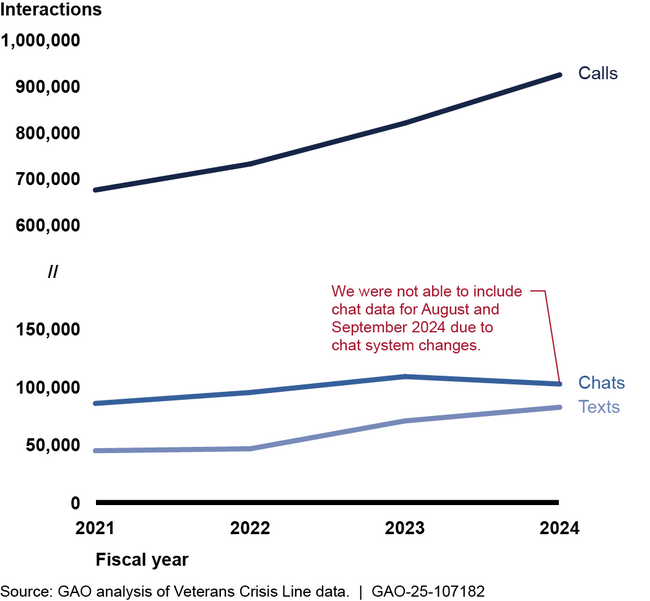
Crisis line data show it had about 3.8 million customer interactions from fiscal year 2021 through 2024, with the number increasing each year (see figure). We found the crisis line faces challenges:
- Customers with complex needs. The crisis line provides specialized training to responders in a unit that addresses complex callers. However, these callers are increasingly being routed to responders who may not have received the training, raising service quality and staffing concerns that could put customers at risk.
- Chat and text. Procedures for staff in this unit—such as responding to more than one customer at once—as well as how the unit is staffed may have adverse effects, including increased customer wait times and responder burnout, which could also put customers at risk.
Further, in July 2024, VA determined that, as a non-clinical service, the procedure the crisis line was using to disclose incidents to customers or their representatives in cases when actions or inactions created a significant risk of harm to the customer was not applicable. The crisis line withdrew the procedure and a new one has not been established. This runs counter to VA’s goal of building trust with stakeholders through transparency and accountability.
Number of Veterans Crisis Line Customer Interactions, Fiscal Years 2021-2024
How GAO Did This Study
We obtained, reviewed, and analyzed crisis line documents as well as data from fiscal years 2021 through 2024; interviewed crisis line officials; surveyed all crisis line responders and conducted interviews with a non-generalizable sample of eight responders.
Recommendations
VA should ensure the crisis line more comprehensively assesses risks of adverse effects for its customers with complex needs and those using chat and text, making adjustments to procedures and staffing, as needed; and ensure that it has a procedure for disclosing incidents. VA agreed with GAO’s recommendations and identified steps VHA plans to take to implement them.
Recommendations for Executive Action
| Agency Affected | Recommendation | Status |
|---|---|---|
| Department of Veterans Affairs | The Under Secretary for Health should ensure the VCL more comprehensively assesses the risks of adverse effects associated with its procedure for immediately routing CWCN callers to main phone line responders when there is no availability in the CWCN unit. Such an assessment should include comparing the quality of CWCN calls handled by main line responders with those handled by CWCN-trained responders. Depending on the results of the assessment, the VCL should make adjustments to its procedure for routing CWCN calls and to how it staffs the CWCN unit to better meet the needs of CWCN callers, as appropriate. (Recommendation 1) |
In January 2026, the VCL reported that it had assessed the impacts of routing CWCN callers to main phone line crisis responders and determined that CWCN unit responders may have better call quality ratings than main phone line responders for multiple reasons, including the specialized training provided to them. VCL officials stated that they are training additional responders to serve on the CWCN unit in an effort to route CWCN callers directly to these responders. Based on VCL data, the number of trained CWCN unit responders has increased from 119 in July 2024 to 245 in February 2026. VCL officials reported that the VCL will continue to monitor CWCN unit responder staffing levels through a dashboard and adjust staffing levels as necessary to meet operational needs. In addition, the VCL provided documentation of a review of all customers who are directly routed to the CWCN unit or subject to a queue when calling the VCL. The results of the review demonstrated a need for improved in documentation. As a result, as of October 1, 2025, decisions to route customers directly to the CWCN unit or subject them to a queue now require supervisory review and concurrence.
|
| Department of Veterans Affairs | The Under Secretary for Health should ensure the VCL more comprehensively assesses the risks of adverse effects associated with its digital services procedures, making modifications to them and to how it staffs the unit, as appropriate. Such an assessment may require obtaining and analyzing additional data on digital services responder workload, such as time spent interacting with customers as well as on documentation after interactions. (Recommendation 2) |
In January 2026, VA reported that the VCL had conducted a comprehensive assessment on the risks of adverse effects associated with digital services procedures to include staffing, concurrent interactions, documentation of interactions, and assignment of chats. Based on this assessment, the VCL implemented several changes to its digital services procedures, including the following: In August 2025, the VCL launched an updated prediction model that allows for more precise staffing and accounting of demand patterns and operational needs. The VCL also implemented procedures to address concurrent interactions, including providing training to crisis responders and allowing them to notify a supervisor regarding their inability to accept a second chat or text interaction if they are engaged in an interaction that that requires their full attention. VCL officials stated that the VCL has a long-term goal of reducing the percentage of concurrent interactions to below 5 percent. VCL officials reported that no change was needed to address documentation of chat and text interactions as crisis responders typically wait between 2 to 5 minutes between customer responses, allowing time to summarize notes and input data during the interaction. Finally, VCL officials reported that they have not identified uneven distribution of chat workload since shifting to a new chat platform in August 2024. Officials stated that supervisors oversee the assignment of chats through a dashboard displaying crisis responder capacity, number of chats waiting, and other metrics.
|
| Department of Veterans Affairs | The Under Secretary for Health should ensure the VCL instructs its chat platform provider to develop a solution to address chats being abandoned after customer redirection to unavailable responders. (Recommendation 3) |
In June 2025, we reported that VCL officials provided documentation that they updated their chat system so responders with an unavailable status cannot receive new chat interactions. This update automatically changes responder's status to 'unavailable' if they do not accept a chat within 25 seconds. Responders must manually change their status back to 'available' to receive new incoming chats. This update also sends alerts to crisis responder supervisors when a chat responder does not accept an incoming chat within 25 seconds. This update will ensure that chat customers are not routed between two unavailable responders if their initial chat is not accepted by a responder within 25 seconds.
|
| Department of Veterans Affairs | The Under Secretary for Health should establish a procedure for the VCL, as a non-clinical service, that identifies the types of incidents that warrant disclosure to customers or their representatives and outlines a process for disclosing such incidents, or direct the VCL to develop such a procedure. (Recommendation 4) |
In January 2026, the VCL provided documentation that it had convened workgroups composed of subject matter experts in non-clinical services to discuss disclosure policies for non-clinical VA services. The workgroups reviewed relevant established policies and procedures to identify potential areas for VCL consideration. The VCL reported that it is in the process of working with the Office of General Counsel Healthcare Law Group and VHA National Policy Office to discuss a plan for an interim notice to be developed. We will consider this recommendation for closure once the interim notice has been issued.
|