
Nuclear Waste: An Integrated Disposal Plan Could Help DOE Complete Its Cleanup Mission and Save Billions
Fast Facts
The Department of Energy is responsible for disposing millions of cubic meters of radioactive waste from 15 cleanup sites across the country.
Disposal options vary depending on how the waste was generated and the risks it poses. For example, some facilities can accept low-level radioactive waste, but there may be more waste than these facilities can currently handle. And there are no disposal options for high-level radioactive waste.
We recommended DOE develop a comprehensive plan for waste disposal. Such a plan could save billions in costs and help DOE communicate with regulators who oversee disposal facilities.
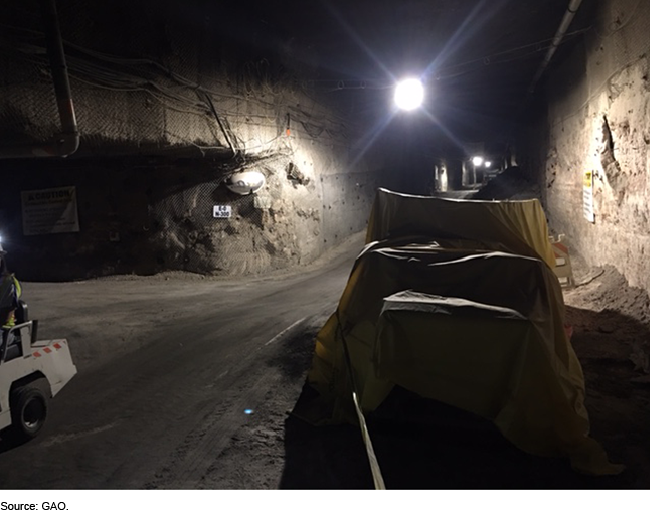
Underground at the Waste Isolation Pilot Plant
Highlights
What GAO Found
The Department of Energy's (DOE) Office of Environmental Management (EM) is responsible for cleaning up and disposing of nuclear waste from 15 federal sites, known as the EM complex. EM primarily manages four types of nuclear waste: low-level radioactive waste (LLW), transuranic waste, high-level radioactive waste, and spent nuclear fuel. EM develops estimates of the amount of each type of waste that it expects to dispose of to complete its cleanup work. However, EM's estimates include significant uncertainties. For example, waste amounts could vary depending on the future cleanup approaches selected.
Department of Energy Nuclear Waste Types and Disposal Options
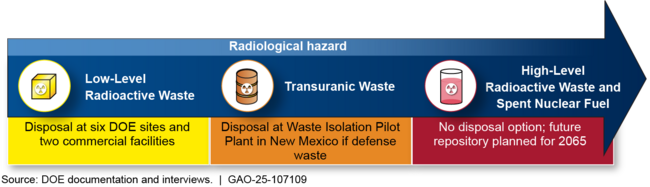
EM has multiple disposal options for LLW, including six DOE facilities and two commercial facilities. GAO's analysis found that EM's disposal needs exceed these facilities' current capacity and future expansion will be required. Further, transuranic waste currently has only one disposal option—the Waste Isolation Pilot Plant in New Mexico—and additional future transuranic waste could nearly exceed the facility's capacity. High-level radioactive waste and spent nuclear fuel have no existing disposal option and will require the siting of a new deep geologic repository.
EM headquarters delegates disposal decisions to individual cleanup site officials and supports them as needed. However, EM has not assessed opportunities to optimize complex-wide disposal decisions—GAO has previously found that EM could save billions of dollars by considering alternate disposal plans for certain waste. EM has also not developed an integrated waste disposal plan to address factors affecting EM's ability to complete its cleanup mission.
EM officials told GAO they have not assessed complex-wide strategic alternatives to current disposal plans because regulatory constraints limit alternatives. However, the use of models, such as optimization models, could reduce the costs of EM's cleanup mission by billions of dollars. By developing a complex-wide plan, EM will be better able to address interrelated issues across its 15 sites and identify opportunities to address regulatory constraints. Moreover, implementing its disposal plan will likely require EM to negotiate with multiple regulators to revise agreements at different sites. By leveraging modeling and integrated planning, EM would be better positioned to engage with regulators in a complex-wide forum to ensure that each waste stream is disposed of in a cost-effective manner that protects human health and the environment.
Why GAO Did This Study
To complete its cleanup mission, EM must dispose of over 11 million cubic meters of nuclear waste that pose a range of risks to human health and the environment. In addressing its nuclear waste disposal needs, EM chooses among disposal options with different costs and risks. Final approval of a disposal pathway can take years of careful planning and communication with regulators and a variety of federal, state, and other stakeholders.
Senate Report 117-130 includes a provision for GAO to report on EM's nuclear waste disposal planning efforts. This report addresses (1) available information about nuclear waste requiring disposal to complete EM's mission, (2) disposal options available to EM, and (3) how EM and cleanup sites plan for nuclear waste disposal.
GAO analyzed EM waste data, interviewed or requested information from all 15 EM sites, visited commercial nuclear waste disposal facilities, and developed a hypothetical model for optimizing transuranic waste disposal using EM data.
Recommendations
GAO is making five recommendations to EM, including that EM develop complex-wide analyses—such as optimization models—to identify optimal disposal pathways; develop a complex-wide disposal plan; and create a forum for EM and cleanup site and disposal facility regulators to address regulatory constraints to optimal disposal approaches. EM did not agree or disagree with the five recommendations and deferred its response for whether it will implement them to a later date.
Recommendations for Executive Action
| Agency Affected | Recommendation | Status |
|---|---|---|
| Department of Energy | The Senior Advisor for EM should improve the quality of its LLW estimates by (1) adding headquarters oversight procedures that ensure reported waste streams are comprehensive in representing remaining cleanup at DOE sites; and (2) assessing the quality of waste estimates in the BLDD using available information, such as the previous years' actual disposal data, and using the results of this assessment to inform additional improvements. (Recommendation 1) |
EM has implemented GAO's May 2025 recommendation. In 2026, EM improved its data quality procedures and conducted a targeted quality control review focusing on data elements that had significant change from the prior year. As a result of these improvements to its data quality procedures for LLW estimates, EM will have greater confidence in making complex-wide waste disposal decisions using this data.
|
| Department of Energy | The Senior Advisor for EM should update guidance for the BLDD to clarify site reporting responsibilities. Such clarifications include that LLW estimates should encompass waste beyond the current cleanup contract and how sites should report waste streams facing significant uncertainty about the scope of cleanup (e.g., related to final disposal decisions, barriers to disposal). (Recommendation 2) |
EM has implemented GAO's May 2025 recommendation. In January 2026, EM updated its LLW data gathering guidance to include procedures for sites to annually certify that their estimates include waste beyond current contracts and those with significant uncertainty. As a result of EM's update of its LLW data gathering guidance, EM will have greater confidence in making complex-wide waste disposal decisions using more reliable data.
|
| Department of Energy |
Priority Rec.
The Senior Advisor for EM should develop complex-wide analyses, including optimization models, that identify optimal disposal pathways and schedules for its radioactive waste and analyze strategic alternatives to current disposal plans. (Recommendation 3) |
In April 2026, DOE provided its 180-day letter to GAO stating that it partially concurs with this recommendation and considers this recommendation to be complete. According to EM officials, EM routinely conducts analyses to evaluate strategic alternatives to waste stream disposition, and EM sites evaluate alternative approaches to dispose of waste both known and projected to require disposal. EM officials also told us that given the nature of optimization and logistics modeling and detailed site-specific aspects of waste streams, a complex-wide analysis of all waste streams and disposal pathways would not be the best way to analyze and improve upon current disposal plans. Furthermore, officials noted that implementing the recommendation would require EM to redirect limited resources from cleanup and disposal activities to modeling efforts with limited benefits. However, as we found in our May 2025 report, by developing complex-wide analyses, such as optimization models, that identify optimal disposal pathways and schedules for its radioactive waste, EM would be able to compare strategic alternatives to its current disposal plans. This, in turn, could allow EM to reduce the costs of its cleanup mission by billions of dollars. Evaluation of complex-wide strategic alternatives for waste disposal could also help EM better understand where engaging with regulators to renegotiate and potentially revise existing agreements, permits, and commitments may allow EM to achieve its disposal mission more efficiently and effectively.
|
| Department of Energy | The Senior Advisor for EM should develop a nationwide, integrated radioactive waste disposal plan that includes an assessment of strategic alternatives and modeling, and addresses complex-wide disposal issues, such as waste with no disposal pathway. EM should share this integrated plan with key stakeholders—such as state and federal regulators at cleanup sites and disposal facilities—and incorporate their feedback as appropriate. (Recommendation 4) |
In April 2026, DOE provided its 180-day letter to GAO stating that it "concurs in principle" with this recommendation. EM officials told us that it has a ten-year strategic vision, and in 2022, it issued the Environmental Management Program Plan. EM officials told us that these two documents guide EM in safely executing its mission, fulfilling cleanup obligations, and identifying opportunities for progress. According to EM officials, both documents have been shared with key stakeholders and presented at many of EM's intergovernmental and stakeholder forums. EM officials added that the regulatory framework at each site may affect the remedy selection and the sequencing of cleanup, among other things. Therefore, EM officials stated that a "a top-down, integrated, and nationwide disposal plan is not practical given the unique regulatory, court-imposed, and legislative frameworks at each site." EM officials also noted that the next update to the Environmental Management Program Plan will provide detailed complex-wide strategic objectives for waste management and disposition mission areas and expand on current plans and opportunities. However, as we found in our May 2025 report, these documents focus on each site individually and do not integrate site-level information into a complex-wide disposal plan. By developing a nationwide, integrated radioactive waste disposal plan informed by assessments of strategic alternatives and modeling, EM will be better able to address complex-wide disposal issues and implement potential alternatives. Such a plan would better position EM to pursue potential disposal approaches that may require negotiation or other changes at all relevant sites. In addition, by sharing this plan with key stakeholders-such as state and federal regulators at cleanup sites and disposal facilities-and incorporating their feedback as appropriate, EM can better ensure the plan addresses the perspectives of parties EM may need agreement from to implement the plan.
|
| Department of Energy | The Senior Advisor for EM should leverage the results of radioactive waste disposal optimization analyses and integrated planning to identify specific opportunities to optimize radioactive waste disposal by addressing regulatory constraints and create a forum for regulators from cleanup sites and disposal facilities to holistically negotiate implementing these opportunities. (Recommendation 5) |
In April 2026, DOE provided its 180-day letter to GAO stating that it disagrees with this recommendation. EM provided three reasons for its disagreement: (1) according to EM officials, it consistently engages local, state, federal and tribal officials on technical topics, including waste management and disposal opportunities; (2) officials believe creating a regulators' forum to negotiate a holistic approach to implement optimized opportunities is not realistic because of competing priorities for funding at cleanup sites and the unique regulatory frameworks at each site; and (3) EM's site-specific advisory boards are DOE's most effective vehicle for fostering two-way communication between DOE-EM and communities. We continue to believe that there is value in EM implanting this recommendation. As we found in our May 2025 report, by creating a forum for regulators from cleanup sites and disposal facilities to holistically negotiate implementing these opportunities, EM will ensure that all parties involved in achieving a more optimal outcome for waste disposal across the nation are included in the decision-making process.
|