
Water Infrastructure Resilience: Agencies Could Better Assess Efforts to Assist Communities Vulnerable to Natural Disasters
Fast Facts
Natural disasters can disrupt local drinking water and wastewater services. The Environmental Protection Agency, Federal Emergency Management Agency, and U.S. Department of Agriculture have given billions in grants and loans to make community water infrastructure more resilient.
But rural, low-income, and other vulnerable communities struggle to get access to this funding. Agencies have taken some steps to address this but could do more.
Also, maps of water service areas differ in quality and may not always help agencies identify communities that could benefit from help. Our recommendations address this and more.
Drinking water treatment plant
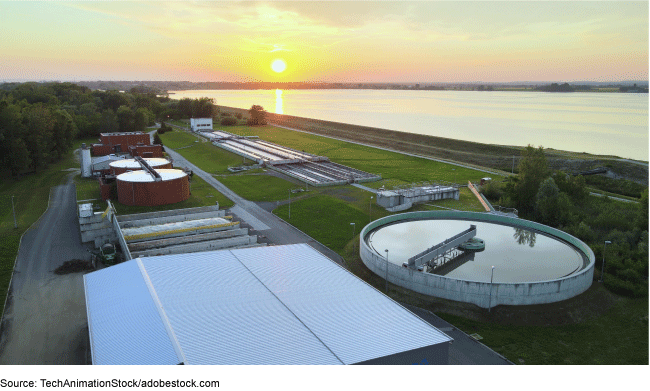
Drinking water treatment plant
Highlights
What GAO Found
The U.S. Environmental Protection Agency (EPA), Federal Emergency Management Agency (FEMA), and U.S. Department of Agriculture (USDA) provided different types of financial assistance to improve drinking water and wastewater infrastructure in fiscal years 2014 through 2023. Specifically, 14 of the agencies’ programs provided $35 billion in grants (at least 22,000 projects) and $29 billion in direct loans (about 4,800 projects) during this period.
EPA, FEMA, and USDA took steps to reduce barriers to financial assistance faced by vulnerable communities—those likely to face challenges preparing for and recovering from disasters, such as rural and low-income areas. In this report, GAO used the term “vulnerable communities” to refer to communities defined in some programs’ authorizing statutes that may receive additional assistance under these programs. These statutes were not affected by recent executive orders or actions. Agencies provided technical assistance and allowed grantees to use assistance from other federal programs to meet requirements to provide matching funds, known as nonfederal cost share. However, FEMA has not adequately communicated about the option to use assistance from USDA programs to meet cost-share requirements in certain cases.
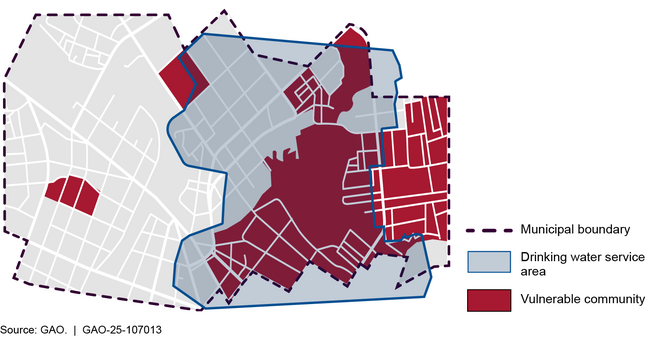
EPA, FEMA, and USDA used national or state measures to assess the extent to which vulnerable communities benefitted from certain programs. However, EPA, FEMA, and USDA officials said that limited data about the geographical areas served by drinking water and wastewater utilities made it difficult to accurately assess who benefited from their programs. EPA created a mapping tool with the geographical service areas of drinking water systems, which may differ from municipal boundaries (see fig.). EPA plans to complete a similar tool for wastewater service areas in summer 2025. Using EPA’s mapping tools could enable EPA, FEMA, and USDA to more accurately identify the communities, including vulnerable communities, their programs are benefiting.
Example Municipal Boundary and Drinking Water System Service Area
Why GAO Did This Study
Drinking water and wastewater utilities have experienced disruption or failure after disasters, threatening public health. For example, disasters in Mississippi in 2022 and North Carolina in 2024 left residents without potable water for weeks. Federal agencies provide assistance for utilities to build resilience against natural disasters—including communities in rural and low-income areas vulnerable to disasters.
This report examines, among other things, (1) financial assistance that EPA, FEMA, and USDA provided to improve water infrastructure; (2) the extent to which these agencies addressed barriers vulnerable communities face accessing and participating in selected programs; and (3) how these agencies assessed the extent to which assistance reached vulnerable communities.
GAO analyzed fiscal year 2014–2023 data for EPA, FEMA, and USDA programs that provided financial assistance for water infrastructure projects—the most recent data available during the review. GAO also reviewed relevant executive orders and agencies’ plans and actions taken to address barriers faced by vulnerable communities. Finally, GAO interviewed a nongeneralizable sample of 14 utilities selected based on factors including vulnerability and disaster experience.
Recommendations
GAO is making eight recommendations, including that FEMA communicate about options to meet cost-share requirements, and that EPA, FEMA, and USDA use service area map tools. EPA and FEMA disagreed with using the tools. USDA did not comment. GAO maintains its recommendations are valid, as discussed in this report.
Recommendations for Executive Action
| Agency Affected | Recommendation | Status |
|---|---|---|
| Federal Emergency Management Agency | The FEMA Administrator should ensure that FEMA's hazard mitigation assistance programs communicate with potential applicants about USDA financial assistance that may be used to fulfill nonfederal cost-share requirements in certain circumstances. (Recommendation 1) |
DHS concurred with this recommendation, stating that FEMA's Hazard Mitigation Assistance (HMA) Directorate would review the agency's existing Hazard Mitigation Assistance Cost Share Guide and update it to include information about USDA financial assistance options. DHS also said that the finalized guide will be shared externally on FEMA's website. In January 2026, DHS stated that the update will also include additional information about match sources, including nonfederal match options. FEMA plans to complete these activities by December 31, 2026. We will continue to follow up on this recommendation.
|
| Federal Emergency Management Agency | The FEMA Administrator should ensure that FEMA's hazard mitigation assistance programs systematically track and assess the number of, and reasons for, subapplicant withdrawals and address any related barriers, as appropriate. (Recommendation 2) |
DHS concurred with this recommendation, stating that FEMA's HMA Directorate will collaborate with the team that oversees FEMA's Grants Outcomes (GO) grants management system to add "withdrawn" as a status option for projects in the FEMA GO system, in addition to the current "approved" or "denied" status options. DHS also stated that FEMA's HMA Directorate will use an existing comment field in the FEMA GO system to list the reason for withdrawal. In January 2026, DHS stated that FEMA remains on track to add the "withdrawn" status option and conduct testing with FEMA staff. DHS also stated that FEMA's HMA Directorate is considering how to assess the information from these fields and whether further action is required to address any related barriers. FEMA expects to finalize the change to FEMA GO by the end of June 2026, and to complete all activities related to this recommendation by December 31, 2026. We will continue to follow up on this recommendation.
|
| Federal Emergency Management Agency | The FEMA Administrator should ensure that FEMA's hazard mitigation assistance programs identify and track projects related to drinking water infrastructure. Then, these programs should consult with relevant EPA officials on how to use EPA's community water system service area mapping tool to more accurately assess the beneficiaries of these projects—including vulnerable communities, as defined in the relevant laws—and use the tool for this purpose. (Recommendation 3) |
DHS did not concur with our recommendation, stating that FEMA tracks information that is sufficient for understanding how funds are being used and for meeting statutory and programmatic requirements. DHS officials stated that FEMA tracks information that is sufficient to understand how funds are being used, including the primary activity and project type, and FEMA is not required to use EPA's mapping tools. In January 2026, DHS acknowledged GAO's findings that the primary activity and project type fields do not allow FEMA to distinguish drinking water infrastructure projects nor to identify the population these projects serve. They stated that requiring the use of EPA's mapping tools would necessitate significant system modifications, additional burden on applicants and staff, and expanded interagency coordination. FEMA has requested that we consider this recommendation resolved and closed. While recognizing the additional workload, we believe the benefits are worth it. Identifying and tracking drinking water projects, along with the use of EPA's mapping tools, would provide FEMA information on its investments in this sector. It would allow FEMA to more accurately identify areas with greater risk of disruption from a natural disaster and assess who benefits from these investments. We will continue to follow up on this recommendation.
|
| Federal Emergency Management Agency | The FEMA Administrator should ensure that FEMA's hazard mitigation assistance programs identify and track projects related to wastewater infrastructure. Then, these programs should consult with relevant EPA officials on how to use EPA's wastewater system service area mapping tool, once available, to more accurately assess the beneficiaries of these projects—including vulnerable communities, as defined in the relevant laws—and use the tool for this purpose. (Recommendation 4) |
DHS did not concur with our recommendation, stating that FEMA tracks information that is sufficient for understanding how funds are being used and for meeting statutory and programmatic requirements. DHS officials stated that FEMA tracks information that is sufficient to understand how funds are being used, including the primary activity and project type, and FEMA is not required to use EPA's mapping tools. In January 2026, acknowledged GAO's findings that the primary activity and project type fields do not allow FEMA to distinguish wastewater infrastructure projects nor to identify the population these projects serve. They stated that requiring the use of EPA's mapping tools would necessitate significant system modifications, additional burden on applicants and staff, and expanded interagency coordination. FEMA has requested that we consider this recommendation resolved and closed. While recognizing the additional workload, we believe the benefits are worth it. Identifying and tracking wastewater projects, along with the use of EPA's mapping tools, would provide FEMA information on its investments in this sector. It would allow FEMA to more accurately identify areas with greater risk of disruption from a natural disaster and assess who benefits from these investments. We will continue to follow up on this recommendation.
|
| Department of Agriculture | The Secretary of Agriculture should ensure that USDA financial assistance programs for drinking water infrastructure consult with relevant EPA officials on how to use EPA's community water system service area mapping tool to more accurately assess the beneficiaries of assistance for drinking water infrastructure, including vulnerable communities, as defined in the relevant laws. Then, these USDA programs should use the tool for this purpose. (Recommendation 5) |
As of April 2026, USDA has not provided updated information on how they plan to address this recommendation. We will continue to follow up on this recommendation.
|
| Department of Agriculture | The Secretary of Agriculture should ensure that USDA financial assistance programs for wastewater infrastructure consult with relevant EPA officials on how to use EPA's wastewater system service area mapping tool, once it is available, to more accurately assess the beneficiaries of assistance for wastewater infrastructure, including vulnerable communities, as defined in the relevant laws. Then, these USDA programs should use the tool for this purpose. (Recommendation 6) |
As of April 2026, USDA has not provided updated information on how they plan to address this recommendation. We will continue to follow up on this recommendation
|
| Environmental Protection Agency | The Administrator of EPA should provide guidance and technical assistance to states on the agency's community water system service area mapping tool and how to use it to assess the extent to which the beneficiaries of the Drinking Water State Revolving Fund program are disadvantaged communities, using states' definitions of such communities as required by law. (Recommendation 7) |
In February 2026, EPA generally agreed with our recommendation. EPA stated it will provide guidance and technical assistance, within the scope of EPA's Drinking Water State Revolving Fund program's statutory authority. The agency stated that it will focus on interested states to support their efforts to implement the statutory requirements of the Safe Drinking Water Act. EPA stated that such guidance and technical assistance will incorporate EPA's Community Water System Service Area Boundary dataset and the Water Infrastructure and Capacity Assessment Tool as potential resources for states. We will continue to follow up on this recommendation.
|
| Environmental Protection Agency | The Administrator of EPA should provide guidance and technical assistance to states on the agency's wastewater system service area mapping tool, once it is available, and how to use it to assess the extent Page 53 GAO-25-107013 Water Infrastructure Resilience to which the beneficiaries of the Clean Water State Revolving Fund program are communities with significant financial hardship, using states' definitions of such communities as required by law. (Recommendation 8) |
In February 2026, EPA generally agreed with our recommendation. EPA officials stated they will provide guidance and technical assistance, within the scope of EPA's Clean Water State Revolving Fund program's statutory authority. The officials said they would focus on interested states to support their efforts to implement the statutory requirements of the Clean Water Act. EPA stated that such guidance and technical assistance will incorporate EPA's national Sewershed Service Area Boundary dataset as a potential resource for states. We will continue to follow up on this recommendation.
|