
Navy Readiness: Actions Needed to Improve Support for Sailor-Led Maintenance
Fast Facts
Navy sailors maintain the ships that are needed to keep the U.S. safe and the seas open for world commerce.
But the Navy faces a range of challenges that hinder sailors' ability to complete maintenance work:
There aren't always enough sailors available—and the Navy doesn't track and report data that could help it better oversee personnel assignments
Newer sailors might not be fully prepared for maintenance work. Sailors want more hands-on training
The Navy uses old software to manage maintenance logistics, and efforts to replace it are running behind
Our 7 recommendations address these issues.
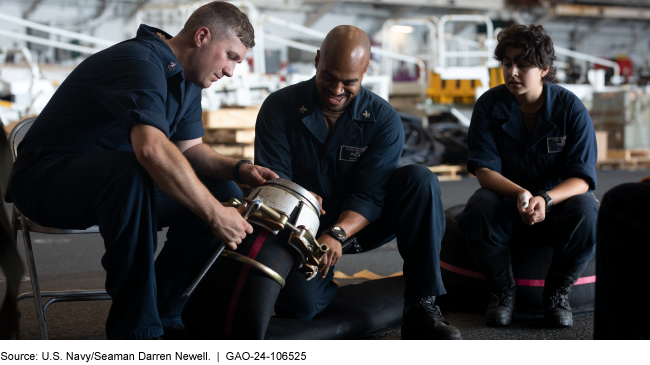
Senior sailors can give new sailors on-the-job training on ship maintenance.
Highlights
What GAO Found
The Navy faces several interrelated personnel and training challenges that inhibit sailors' ability to complete required ship maintenance. GAO found that the Navy does not fill all required ship positions, and that sailors assigned to a ship are sometimes unavailable for duty (for example, temporarily assigned to another ship) or may have inadequate training or preparation for their positions.
Interrelated Personnel and Training Challenges Inhibit Sailor-Led Maintenance
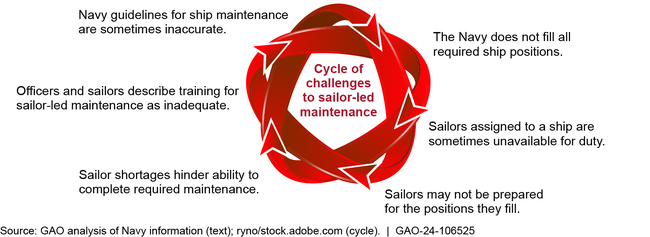
Sailor shortages hinder sailors' ability to complete required maintenance, according to survey respondents, sailors from GAO's 25 ship visits, and GAO's review of Navy data. For example, 63 percent of executive officers completing GAO's survey said it was moderately to extremely difficult to complete repairs while underway with the number of sailors assigned to their ships. In addition, the Navy does not track and report data on the number of sailors assigned to a ship, but not available for duty, according to officials. The Navy could improve the quality of information reported to Congress by updating policy to report data on whether sailors assigned to a ship were available and reported for duty.
Navy executive officers and sailors told GAO there were widespread concerns about sailor training. When relying on available formal (classroom) training, 64 percent of executive officers responding to GAO's survey said it is moderately to extremely difficult to conduct sailor-led maintenance, and 75 percent found it moderately to extremely difficult for sailors to complete repairs. In addition, the Navy's guidelines for performing ship maintenance are sometimes inaccurate with respect to the time and personnel needed and are not written appropriately for sailors' maintenance skills and supervisor's experience levels. Ensuring the Navy's guidelines better reflect the actual number and skill level of maintenance personnel will enhance sailors' ability to maintain ships.
The Navy is working to replace old and fragmented logistics information technology (IT) systems it currently uses to manage sailor-led maintenance. But it did not effectively share its vision for logistics IT improvements to meet stakeholder needs. Establishing a process to inform stakeholders—such as shipboard personnel—will improve the Navy's ability to implement a new system that better harmonizes maintenance information and meets user needs.
Why GAO Did This Study
The Navy must have combat-ready ships to keep the U.S. safe and ensure the seas are open to trade. Sailors perform basic maintenance and repairs that are essential for preserving a ship's operational capabilities.
House Report 117-397, accompanying a bill for the National Defense Authorization Act for Fiscal Year 2023, includes a provision for GAO to assess the extent to which the Navy supported sailor-led maintenance and repairs aboard ships. This report evaluates, among other things, the extent to which the Navy provides (1) personnel and training, and (2) management processes and systems for sailor-led maintenance.
GAO analyzed guidance, policy, and data; conducted a survey of executive officers aboard 232 ships of the active battle fleet (91 percent response) and interviewed relevant officials; and met with more than 140 leadership personnel and 200 sailors on 25 ships of the active battle fleet.
Recommendations
GAO is making seven recommendations to the Navy to, among other things, improve the quality of information on the number of ship's crew available for duty; ensure that maintenance guidelines reflect personnel numbers and skill levels specific to ships or ship classes; and better communicate with stakeholders on logistics IT improvement efforts. The Navy concurred with each recommendation.
Recommendations for Executive Action
| Agency Affected | Recommendation | Status |
|---|---|---|
| Department of the Navy | The Secretary of the Navy should ensure that the Deputy Chief of Naval Operations for Personnel, Manpower, and Training updates Navy policy to require the Navy to periodically gather and report personnel data specific to sailor-led maintenance, such as comparing assigned personnel to the number of mustering personnel available for duty and tracking the quality of sailors' alignment across departments. (Recommendation 1) |
The Department of Defense concurred with this recommendation. In June 2025, the Navy provided additional documentation that shows the service has taken some action by updating the Navy's Systems, Training Requirements, and Management guidance, OPNAVINST 1500.76E, to require the collection of some sailor maintenance data, such as collecting data on specific organizational level corrective maintenance tasks, as part of its training development efforts. However, the updated guidance does not require collecting personnel data specific to sailor-led maintenance, and the Navy has also not provided revisions to the crewing and maintenance guidance cited in the report, including OPNAVINST 4700.7M, OPNAVINST 1000.16L, or OPNAVINST 1300.21. We will continue to monitor the Navy's efforts to address this recommendation.
|
| Department of the Navy | The Secretary of the Navy should ensure that the Commander, Naval Education and Training Command, evaluates and optimizes the balance between classroom training and on-the-job training on maintenance skills for junior sailors as it implements Ready Relevant Learning. (Recommendation 2) |
The Department of Defense concurred with this recommendation. In August 2025, the Navy provided additional documentation that shows that in response to our report, the Navy planned to take action that could address this recommendation. We have requested additional documentation from the Navy to determine if this recommendation has been addressed, and we will continue to monitor the Navy's efforts.
|
| Department of the Navy | The Secretary of the Navy should ensure that policy is updated to include commanding officers as key stakeholders in updating maintenance cards to better reflect actual time expended in accomplishing sailor-led maintenance tasks in light of ship-specific conditions. (Recommendation 3) |
The Department of Defense concurred with this recommendation. In August 2025, the Navy provided additional documentation that shows the service was in the process of updating the Joint Fleet Maintenance Manual (JFMM) to be more prescriptive about the role of commanding officers in maintenance card updates. We have requested additional documentation from the Navy to determine if this recommendation has been addressed, and we will continue to monitor the Navy's efforts.
|
| Department of the Navy | The Secretary of the Navy, in collaboration with Naval Sea Systems Command, should ensure that maintenance cards are written at an appropriate level of detail to reflect specific conditions affecting the amount of time, number of personnel needed, and training necessary to conduct sailor-led maintenance. (Recommendation 4) |
The Department of Defense concurred with this recommendation. In August 2025, the Navy provided additional documentation outlining the processes the Navy uses to write maintenance cards, but the Navy has not demonstrated that it has taken corrective action to ensure that maintenance cards are written at an appropriate level of detail to reflect specific conditions affecting the amount of time, number of personnel needed, and training necessary to conduct sailor-led maintenance. We will continue to monitor the Navy's efforts to address this recommendation.
|
| Department of the Navy | The Secretary of the Navy should direct the Deputy Chief of Naval Operations for Fleet Readiness and Logistics, in collaboration with Naval Supply Systems Command and Naval Sea Systems Command, to ensure that shipboard allowance lists are updated and accurate. (Recommendation 5) |
The Department of Defense concurred with this recommendation. In September 2025, in response to our report, the Navy provided documentation on several additional mechanisms Naval Supply Systems Command had established to ensure shipboard allowance lists remain accurate and current. Specifically, NAVSUP has implemented bi-monthly allowance updates, quality assurance checks, a bi-monthly process that conducts allowance checks on selected ships, primarily ships approaching deployment. NAVSUP has also established a Maritime Allowance Readiness Based Sparing Reprovisioning, and Change Review Board to ensure technical compliance of readiness-based sparing models. NAVSUP has also established mechanisms for the fleet to report discrepancies and request changes to shipboard allowances. The Navy has also implemented a working group for submarine allowances and is in the process of developing a tool to track allowances fleetwide. By taking action to implement our recommendation, the Navy is better positioned to address persistent spare parts and materials shortages that have hindered readiness.
|
| Department of the Navy | The Secretary of the Navy should ensure that the Deputy Chief of Naval Operations for Fleet Readiness and Logistics, in collaboration with Naval Sea Systems Command and Naval Supply Systems Command, clarifies guidance to specify how and when program offices must use readiness-based sparing. (Recommendation 6) |
The Department of Defense concurred with this recommendation. In September 2025, in response to our report, the Navy provided documentation citing one existing guidance document relating to readiness-based sparing, OPNAVINST 4442.5B, but the Navy has not demonstrated that it has taken action to clarify other relevant guidance cited in the report, including DOD Manual 4140.01, NAVSEA Manual, Provisioning, Allowance and Fitting Out Support (PAFOS), or NAVSUP P-488. We will continue to monitor the Navy's efforts to address this recommendation.
|
| Department of the Navy | The Secretary of the Navy should ensure that the Assistant Secretary of the Navy for Research, Development, and Acquisition, in conjunction with the Program Executive Office for Manpower, Logistics, and Business Solutions, establishes a mechanism for management to periodically communicate quality information throughout the Navy to ensure stakeholders fully understand the purpose of the N-MRO program and its applicability to their organizations and successfully enlists users in solving remaining challenges. (Recommendation 7) |
DOD concurred with this recommendation. As of November 2025, the Navy has not taken actions to implement this recommendation.
|