
National Nuclear Security Administration: Actions Needed to Improve Integration of Production Modernization Programs and Projects
Fast Facts
The National Nuclear Security Administration plans to invest tens of billions of dollars in its decades-long effort to modernize the facilities and infrastructure needed to produce nuclear weapons.
To achieve its modernization goals, NNSA must integrate 8 key programs and 16 related projects managed by separate offices within the agency. But NNSA doesn't follow certain best practices to ensure this integration occurs—specifically for schedules and cost estimates. As a result, NNSA runs the risk of further delays and cost increases.
We recommended NNSA revise its requirements and practices to follow our best practices.

Highlights
What GAO Found
The National Nuclear Security Administration's (NNSA) Production Modernization effort consists of eight programs and 16 related and ongoing major projects. These programs and projects are managed by separate offices and are subject to different management requirements. However, NNSA officials told GAO that each program and its associated projects must be integrated to achieve NNSA's modernization goals and that they use established teams and meetings for this purpose as well as schedule and cost information.
NNSA's Office of Production Modernization
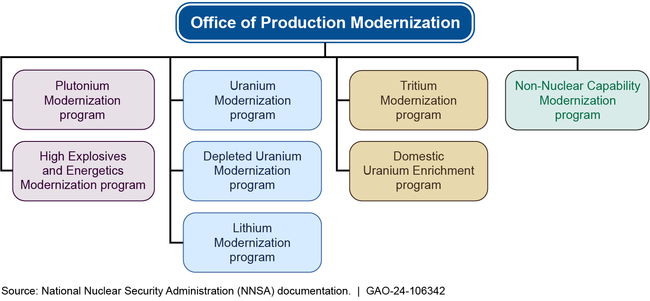
Production Modernization program schedules are insufficient for ensuring the effective integration of programs and their associated major projects. Specifically, NNSA's schedule requirements do not incorporate the 10 best practices for developing reliable and integrated program schedules identified in the Schedule Guide GAO published and that define the characteristics of schedules that support program success. Further, the program schedules GAO reviewed are insufficient for ensuring effective integration because most are not resource-loaded integrated master schedules. Developing such schedules, according to the Schedule Guide, would allow NNSA to better integrate programs' operations with their major projects and other activities that, together, represent one of NNSA's most urgent, complex, and costly efforts.
Production Modernization program cost estimates are insufficient for ensuring the effective integration of programs and their associated major projects. Specifically, NNSA's cost estimate requirements do not fully incorporate all 12 steps for developing reliable cost estimates identified in the Cost Guide GAO published. Further, none of the Production Modernization programs have developed cost estimates that cover the full life cycle of program activities. The Cost Guide states that reliable life cycle cost estimates are a key tool for informing decision-making and ensuring that resources are available to support program execution. Developing such estimates would provide NNSA and congressional decision-makers with greater assurance that they have accurate cost information when making critical decisions on how to estimate program budgets and spend the tens of billions of dollars requested to achieve NNSA's modernization goals.
Why GAO Did This Study
NNSA plans to invest tens of billions of dollars in its decades-long effort to modernize the facilities and infrastructure needed to produce the strategic materials and components required for nuclear weapons. However, NNSA has a history of program management challenges, and recent GAO reports have identified challenges with NNSA's use of program schedules and cost estimates.
A committee report accompanying a bill for the National Defense Authorization Act for Fiscal Year 2024 includes a provision for GAO to review NNSA's requirements for the integrated planning of the Production Modernization effort. This GAO report (1) describes NNSA's Production Modernization programs and their associated major projects and how NNSA manages them, (2) examines the extent to which NNSA effectively uses schedules to ensure integration, and (3) examines the extent to which NNSA effectively uses cost estimates. Program schedules and cost estimates, among other tools and practices, are essential to help ensure integration. GAO reviewed NNSA's program management requirements for using these tools for eight Production Modernization programs, and interviewed NNSA officials. GAO also assessed agency requirements and practices against best practices GAO has published for using reliable schedules and cost estimates.
Recommendations
GAO is making four recommendations, including that NNSA revise its requirements and practices to follow best practices. NNSA agreed with all four recommendations.
Recommendations for Executive Action
| Agency Affected | Recommendation | Status |
|---|---|---|
| National Nuclear Security Administration | The NNSA Administrator should ensure that the NNSA schedule requirements applicable to Production Modernization programs are revised to fully incorporate the 10 best practices for developing reliable program schedules from GAO's Schedule Assessment Guide. (Recommendation 1) |
NNSA agreed with our recommendation and has taken steps to implement it. In December 2024, NNSA's Office of Defense Programs revised its Program Execution Instruction to require programs in the Enhanced Management B category--which at the time of the revision included five of the eight Production Modernization programs--to follow the 10 best practices for developing reliable program schedules outlined in GAO's Schedule Assessment Guide. According to information NNSA officials provided, a sixth Production Modernization program will transition to the Enhanced Management B category as the program matures. In addition, NNSA took steps to ensure that the remaining Production Modernization programs not subject to the requirements under Enhanced Management B nonetheless considered developing resource-loaded integrated master schedules and, as applicable, documented with senior leadership approval their rationale for not doing so. Bolstering the schedule requirements applicable to most Production Modernization programs will help NNSA to ensure programs develop and maintain reliable schedules.
|
| National Nuclear Security Administration |
Priority Rec.
The NNSA Administrator should ensure that the other Production Modernization programs, as statutorily required for the Plutonium Modernization program, are managed in accordance with GAO's best practices for schedule development by developing and maintaining reliable, resource-loaded integrated master schedules, or otherwise documenting with senior leadership approval their rationale for not doing so. (Recommendation 2) |
NNSA agreed with our recommendation and has taken steps to implement it. As of February 2026, NNSA's Office of Defense Programs had revised certain schedule requirements in its Program Execution Instruction and, in fiscal year 2026 Program Implementation Plans, directed most Production Modernization programs to follow best practices for schedule development. As a result of NNSA's actions, all Production Modernization programs are therefore required to develop and maintain reliable, resource-loaded integrated master schedules, or to document with senior leadership approval their rationale for not doing so. These new requirements will help to ensure these programs develop and maintain reliable schedules that sufficiently integrate each program's full scope of work, assign necessary resources to program activities, allow for measuring program performance, and more. Further, NNSA provided documentation approved by senior leadership of the rationale for why one Production Modernization program did not need to be managed in accordance with best practices for schedule development. Such documentation meets the intent of our recommendation.
|
| National Nuclear Security Administration | The NNSA Administrator should ensure that the NNSA cost estimating requirements applicable to Production Modernization programs are revised to fully incorporate the 12 steps for developing reliable program cost estimates from GAO's Cost Estimating and Assessment Guide. (Recommendation 3) |
NNSA agreed with our recommendation and has taken steps to implement it. In December 2024, NNSA's Office of Defense Programs revised its Program Execution Instruction to require programs in the Enhanced Management B category--which at the time of the revision included five of the eight Production Modernization programs--to follow the 12 steps for developing reliable program cost estimates outlined in GAO's Cost Estimating and Assessment Guide. According to information NNSA officials provided, a sixth Production Modernization program will transition to the Enhanced Management B category as the program matures. In addition, NNSA took steps to ensure that the remaining Production Modernization programs not subject to the requirements under Enhanced Management B nonetheless considered developing reliable program cost estimates and, as applicable, documented with senior leadership approval their rationale for not doing so. Bolstering the cost estimating requirements applicable to most Production Modernization programs will help NNSA to ensure programs develop and maintain reliable cost estimates.
|
| National Nuclear Security Administration | The NNSA Administrator should ensure that the other Production Modernization programs, as statutorily required for the Plutonium Modernization program, are managed in accordance with GAO's best practices for cost estimating by developing and maintaining reliable life cycle cost estimates, or otherwise documenting with senior leadership approval their rationale for not doing so. (Recommendation 4) |
NNSA agreed with our recommendation and has taken steps to implement it. Specifically, as of February 2026, NNSA had revised certain cost estimating requirements in its Program Execution Instruction and, in fiscal year 2026 Program Implementation Plans, directed most Production Modernization programs to be managed in accordance with GAO best practices for cost estimating. As a result of NNSA's actions, all Production Modernization programs are therefore required to develop and maintain reliable life cycle cost estimates or to document with senior leadership approval their rationale for not doing so. These new requirements will help NNSA to ensure that Production Modernization programs take steps to develop and maintain reliable life cycle cost estimates that provide NNSA and congressional decision-makers with accurate and timely cost information when making programmatic, budgetary, and investment decisions. Further, NNSA provided documentation approved by senior leadership of the rationale for why one Production Modernization program does not need to be managed in accordance with GAO's best practices for cost estimating. Such documentation meets the intent of our recommendation.
|