
Quantum Technologies: Defense Laboratories Should Take Steps to Improve Workforce Planning
Fast Facts
Quantum technologies build on quantum physics to process and communicate information in ways that existing technologies can't. Nations leading quantum research and development may have an edge in cryptography and computing—which are critical to national security.
DOD has created multiple pathways to recruit highly specialized staff in physics, chemistry, and math and followed leading practices to build its quantum workforce. But some defense laboratories haven't fully adopted all practices. For example, Army and Navy don't consistently measure progress toward their workforce goals.
We recommended addressing these workforce planning issues.
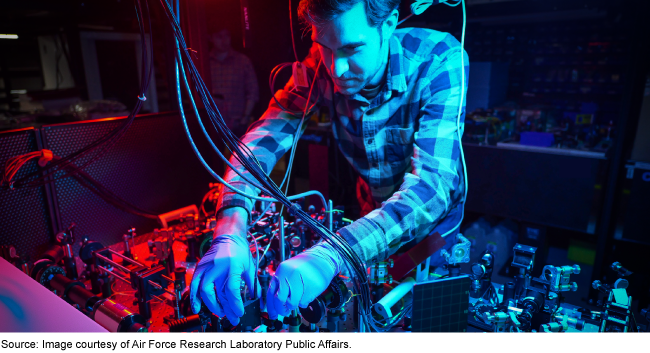
Air Force Research Laboratory scientists work on quantum communication and networking
Highlights
What GAO Found
In fiscal year 2023, seven defense laboratories reported 255 staff working all or part of their time on quantum projects. Most of these quantum workers had PhDs, were either physicists or engineers, and were a mix of mostly federal civilian employees and some contractors. Consistent with DOD's priority to expand the quantum workforce beyond the field of physics, these laboratories also had specialists from fields such as chemistry, computer science, and mathematics.
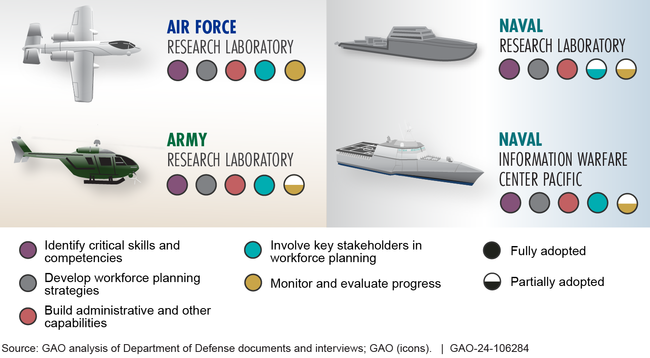
The four defense laboratories conducting most of DOD's quantum work included quantum information science as part of their broader strategic workforce planning but varied in their adoption of five leading practices (see figure). One laboratory fully adopted all five, while three laboratories conducted workforce planning that was aligned with most but not all leading practices. Three laboratories did not fully adopt the leading practice of monitoring and evaluating progress because their strategic workforce plans either did not have performance measures or inconsistently applied them. One laboratory also did not fully adopt the leading practice of involving key stakeholders in workforce planning because it did not have a means to communicate its workforce goals, initiatives, and metrics for success. Better workforce planning could help these laboratories build and retain the workforce needed to maintain global leadership in quantum technologies.
Defense Laboratories' Adoption of Leading Practices for Strategic Workforce Planning
According to GAO's questionnaire results, 41 DOD science, technology, engineering, and mathematics (STEM) education programs contributed to quantum workforce development from fiscal years 2019 through 2023. Through these programs, at least 423 students and postdoctoral researchers gained quantum work experience at defense laboratories. These programs also reported developing students through exposure to DOD quantum research, postdoctoral research funding, and training in a variety of STEM disciplines that can feed into the quantum workforce, such as physics, engineering, and computer science.
Why GAO Did This Study
DOD considers quantum technologies as critical to protecting national security. Nations that lead in quantum technologies can gain a competitive edge in areas such as cryptography, sensing, and computing. To remain competitive, DOD is developing its quantum workforce.
A Senate report included a provision for GAO to review DOD's quantum workforce planning and workforce development activities. This report examines (1) the size and composition of the quantum workforce at defense laboratories that conduct quantum research and development, (2) the extent to which the primary defense laboratories conducting this research and development followed leading practices for strategic workforce planning, and (3) how DOD's STEM education programs have contributed to quantum workforce development and the extent to which DOD has monitored these contributions.
GAO analyzed defense laboratories' workforce data and workforce planning activities, compared workforce planning activities to GAO leading practices for strategic workforce planning, and administered a questionnaire to 86 DOD STEM education programs. GAO received responses from 59 programs.
Recommendations
This report includes four recommendations for the defense laboratories to fully adopt leading practices for strategic workforce planning. DOD concurred with all four recommendations.
Recommendations for Executive Action
| Agency Affected | Recommendation | Status |
|---|---|---|
| Department of the Army | The Secretary of the Army should direct the Commander of ARL to fully adopt the leading practice of monitoring and evaluating progress toward human capital goals and programmatic results by developing performance measures tailored to its mission needs. (Recommendation 1) |
In July 2025, ARL provided evidence that it was monitoring and evaluating progress towards its human capital goals through internal hiring plans that address the needs of its projects, which are linked to the lab's research goals. It also provided evidence that it was monitoring and evaluating progress toward its programmatic results through project workbooks featuring performance measures tailored to its mission needs.
|
| Department of the Navy | The Secretary of the Navy should direct the Commander of NIWC Pacific to fully adopt the leading practice of monitoring and evaluating progress toward human capital goals and programmatic results by developing performance measures for evaluating success across the center. (Recommendation 2) |
NIWC Pacific concurred with this recommendation. According to information provided in April 2026, NIWC Pacific had established several performance measures, such as the number of quantum training events held. NIWC Pacific planned additional steps to collect data to monitor and evaluate progress using these measures and expected to fully implement the recommendation by December 2026. We will update the recommendation status when NIWC Pacific provides further information.
|
| Department of the Navy | The Secretary of the Navy should direct the Commander of NRL to fully adopt the leading practice of involving top management, employees, and other stakeholders in workforce planning by developing and implementing an enterprise-wide strategic workforce plan or otherwise communicating its workforce goals, initiatives, and metrics for evaluating success throughout the laboratory. (Recommendation 3) |
NRL concurred with this recommendation. According to information NRL provided, in December 2025, a new director of the lab's Quantum Science Institute was appointed with the responsibility for strategic workforce planning in quantum science and technology. In the first quarter of 2026, the Director began coordinating with Human Resources on the development, implementation, and communication of a strategic workforce plan in accordance with Navy and ONR guidance. As of April 2026, NRL planned to fully implement this recommendation by May 2026. We will update the recommendation status when NRL provides further information about the status and contents of the strategic workforce plan.
|
| Department of the Navy | The Secretary of the Navy should direct the Commander of NRL to fully adopt the leading practice of monitoring and evaluating progress toward human capital goals and programmatic results by developing performance measures for evaluating success. (Recommendation 4) |
NRL concurred with this recommendation. According to information NRL provided, the director of the lab's Quantum Science Institute performed an internal survey in January 2026 of quantum S&T workforce and programs both within and external to the lab's base research program. NRL stated that the survey would form the basis of lab-wide monitoring of progress toward quantum human capital goals and programmatic results in quantum S&T. As of April 2026, NRL planned to fully implement this recommendation by August 2026. We will update the recommendation status when NRL provides further information.
|