
Critical Infrastructure Protection: Agencies Need to Enhance Oversight of Ransomware Practices and Assess Federal Support
Fast Facts
Ransomware—software that makes data and systems unusable unless ransom is paid—can severely impact government operations and critical infrastructure. Such attacks have led to significant financial losses, health care disruptions, and more.
Most federal agencies that lead and manage risk for 4 critical sectors—manufacturing, energy, healthcare and public health, and transportation systems—have assessed or plan to assess risks associated with ransomware. But agencies haven't fully gauged the use of leading cybersecurity practices or whether federal support has mitigated risks effectively in the sectors.
Our recommendations address these issues.
Highlights
What GAO Found
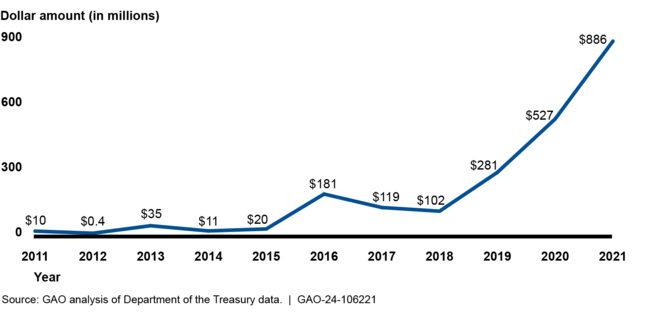
Ransomware—software that makes data and systems unusable unless ransom payments are made—is having increasingly devastating impacts. For example, the Department of the Treasury reported that the total value of U.S. ransomware-related incidents reached $886 million in 2021, a 68 percent increase compared to 2020 (see figure).
Treasury Reported Dollar Value of U.S. Ransomware-Related Incidents
In addition to monetary losses, ransomware has led to other impacts, such as the inability to provide emergency care when hospital IT systems are unusable. The FBI reported that 870 critical infrastructure organizations were victims of ransomware in 2022, affecting 14 of the 16 critical infrastructure sectors. Among those incidents, almost half were from four sectors—critical manufacturing, energy, healthcare and public health, and transportation systems. The full impact of ransomware is likely not known because reporting is generally voluntary. The Department of Homeland Security is planning to issue new reporting rules by March 2024 that could provide a more complete picture of ransomware's impact.
The four selected sectors' adoption of leading practices to address ransomware is largely unknown. None of the federal agencies designated as the lead for risk management for selected sectors have determined the extent of adoption of the National Institute of Standards and Technology's recommended practices for addressing ransomware. Doing so would help the lead federal agencies be a more effective partner in national efforts to combat ransomware.
Most of the six selected lead federal agencies have assessed or plan to assess risks of cybersecurity threats including ransomware for their respective sectors, as required by law. Regarding lead agencies assessing their support of sector efforts to address ransomware, half of the agencies have evaluated aspects of their support. For example, agencies have received and assessed feedback on their ransomware guidance and briefings. However, none have fully assessed the effectiveness of their support to sectors, as recommended by the National Infrastructure Protection Plan. Fully assessing effectiveness could help address sector concerns about agency communication, coordination, and timely sharing of threat and incident information.
Why GAO Did This Study
The nation's 16 critical infrastructure sectors provide essential services such as electricity, healthcare, and gas and oil distribution. However, cyber threats to critical infrastructure, such as ransomware, represent a significant national security challenge.
This report (1) describes the reported impact of ransomware attacks on the nation's critical infrastructure, (2) assesses federal agency efforts to oversee sector adoption of leading federal practices, and (3) evaluates federal agency efforts to assess ransomware risks and the effectiveness of related support.
To do so, GAO selected four critical infrastructure sectors—critical manufacturing, energy, healthcare and public health, and transportation systems. For each sector, GAO analyzed documentation, such as incident reporting and risk analysis, and compared efforts to leading cybersecurity guidance. GAO also interviewed sector and federal agency officials to obtain information on ransomware-related impacts, practices, and support.
Recommendations
GAO is making 11 recommendations to four agencies to, among other things, determine selected sectors' adoption of cybersecurity practices. DHS and HHS agreed with their recommendations. DOE partially agreed with one recommendation and disagreed with another. DOT agreed with one recommendation, partially agreed with one, and disagreed with a third. GAO continues to believe that the recommendations are valid.
Recommendations for Executive Action
| Agency Affected | Recommendation | Status |
|---|---|---|
| Department of Energy | The Secretary of Energy should, in coordination with CISA and sector entities, determine the extent to which the energy sector is adopting leading cybersecurity practices that help reduce the sector's risk of ransomware. (Recommendation 1) |
DOE partially agreed with our recommendation. DOE stated that it continues to evaluate approaches, through collaboration with CISA, sector entities, and existing analytic efforts to understand how the energy sector applies cybersecurity best practices. DOE also said that it did not complete a standalone study due to shifting strategic and resource priorities and that it integrates insights from ongoing engagements, voluntary assessments, and federal‑industry exchanges to inform its understanding of sector readiness and capability. As of June 2026, DOE has not demonstrated that it determined the extent to which the energy sector is adopting leading cybersecurity practices that help reduce the sector's risk of ransomware. We will continue to monitor the status of this recommendation.
|
| Department of Energy | The Secretary of Energy should, in coordination with CISA and sector entities, develop and implement routine evaluation procedures that measure the effectiveness of federal support in helping reduce the risk of ransomware to the energy sector. (Recommendation 2) |
DOE disagreed with our recommendation. DOE stated that while it disagreed with the recommendation's framing, it continues to coordinate closely with CISA to explore feasible and appropriate mechanisms for assessing the effectiveness of federal support, consistent with current authorities, resource prioritization, and Administration guidance. DOE stated that its efforts focus on identifying practical evaluation approaches informed by real‑world operational collaboration and sector feedback rather than rigid or duplicative procedures. As of June 2026, DOE has not demonstrated that it developed and implemented routine evaluation procedures that measure the effectiveness of federal support in helping reduce the risk of ransomware to the energy sector. We will continue to monitor the status of this recommendation.
|
| Department of Health and Human Services | The Secretary of Health and Human Services should, in coordination with CISA and sector entities, determine the extent to which the healthcare and public health sector is adopting leading cybersecurity practices that help reduce the sector's risk of ransomware. (Recommendation 3) |
HHS agreed with our recommendation and has taken steps to implement it. In September 2025, the department demonstrated that it tracked health care entities' use of its Risk Identification and Site Criticality toolkit (version 2.0) in 2024 and 2025. The toolkit includes a variety of questions that guide health care entities in conducting a self-assessment of their cybersecurity, including leading practices that can help reduce the risk of ransomware. For example, it asks questions about steps taken to train users, limit access privileges, monitor and detect potential cybersecurity events, and protect backup data. HHS demonstrated that it analyzed the responses to these and other cybersecurity-related questions to assess the extent sector entities have adopted leading practices that help reduce the risk of ransomware. According to HHS, it has seen a generally positive increase in the adoption of ransomware-related practices from 2024 to 2025. By routinely analyzing the responses from its toolkit, HHS has improved its awareness of the sector's adoption of cybersecurity practices and is better positioned to make resource decisions based on the sector's resilience to withstand ransomware threats.
|
| Department of Health and Human Services | The Secretary of Health and Human Services should, in coordination with CISA and sector entities, develop and implement routine evaluation procedures that measure the effectiveness of federal support in helping reduce the risk of ransomware to the healthcare and public health sector. (Recommendation 4) |
HHS agreed with our recommendation. In September 2025, HHS stated that the department continues to work with its components, CISA, and sector entities, as appropriate, to develop and implement procedures to routinely evaluate the effectiveness of federal support in reducing the risk or ransomware to the Healthcare and Public Health Sector. According to HHS, it leads a Healthcare and Public Health sector cyber working group that solicits feedback on the effectiveness of federal support in helping reduce the risk of ransomware to the sector. HHS also stated that discussions are held on feedback received during these meetings and any actionable items are documented. HHS provided documentation of working group meetings that included an agenda item for obtaining sector stakeholders' feedback on the effectiveness of its support. To fully implement our recommendation, HHS needs to demonstrate its evaluation of the feedback it has received and that it routinely gathers this type of feedback. As of July 2026, HHS has not completed those actions. We will continue to monitor the status of this recommendation.
|
| Department of Homeland Security | The Secretary of Homeland Security should, in coordination with CISA and sector entities, determine the extent to which the critical manufacturing sector is adopting leading cybersecurity practices that help reduce the sector's risk of ransomware. (Recommendation 5) |
DHS agreed with our recommendation. In July 2024, DHS stated that the agency released its cross-sector Cybersecurity Performance Goals (CPGs) in October 2022, which are voluntary practices that outline the highest-priority measures that critical infrastructure owners and operators can implement to protect themselves against cyber threats, including ransomware. In January 2025, CISA reported on the adoption of six CPGs across critical infrastructure sectors, including the critical manufacturing sector. The CPGs included in CISA's study aligned with eight of the leading practices identified by NIST for reducing the risk of ransomware. In April 2025, DHS reported that CISA Cybersecurity Advisors conducted facilitated assessments covering all CPGs for critical manufacturing sector entities. To fully implement our recommendation, DHS needs to demonstrate how it has assessed adoption of CPGs that are associated with additional ransomware practices. This could include assessments conducted by cybersecurity advisors or through other methods. As of July 2026, DHS has not completed those actions. We will continue to monitor the status of this recommendation.
|
| Department of Homeland Security | The Secretary of Homeland Security should, in coordination with CISA and sector entities, develop and implement routine evaluation procedures that measure the effectiveness of federal support in helping reduce the risk of ransomware to the critical manufacturing sector. (Recommendation 6) |
DHS agreed with our recommendation. In April 2025, DHS stated that it has collected feedback from sector entities through several mechanisms, including its stakeholder engagement survey, the Cybersecurity Performance Goals (CPG) webpage, and collaboration with government and industry stakeholders in drafting version 2.0 of the CPGs. According to DHS, CISA uses a survey to regularly collect feedback from enrollees who receive cyber hygiene scans, which includes entities from the critical manufacturing sector. Surveys are administered on a monthly and semiannual basis, with the option to request a one-on-one discussion. According to DHS, respondents were generally satisfied with CISA's service. To fully implement our recommendation, DHS needs to demonstrate its evaluation procedures that measure effectiveness of other support it provides that helps reduce the risk of ransomware for the critical manufacturing sector. For example, we reported that DHS provides warnings of systems with vulnerabilities common to ransomware intrusions, notifications of potential early-stage ransomware activity, and remote penetration tests. As of July 2026, DHS has not completed those actions. We will continue to monitor the status of this recommendation.
|
| Department of Homeland Security | The Secretary of Homeland Security should, in coordination with CISA, co-SRMAs, and sector entities, determine the extent to which the transportation systems sector is adopting leading cybersecurity practices that help reduce the sector's risk of ransomware. (Recommendation 7) |
DHS agreed with our recommendation. In July 2024, DHS stated that the agency released its cross-sector Cybersecurity Performance Goals (CPGs) in October 2022, which are voluntary practices that outline the highest-priority measures that critical infrastructure owners and operators can implement to protect themselves against cyber threats, including ransomware. In January 2025, CISA reported on the adoption of six CPGs across critical infrastructure sectors, including the transportation systems sector. The CPGs included in CISA's study aligned with eight of the leading practices identified by NIST for reducing the risk of ransomware. In April 2025, DHS reported that CISA Cybersecurity Advisors conducted facilitated assessments covering all CPGs for transportation systems sector entities. To fully implement our recommendation, DHS needs to demonstrate how it has assessed adoption of CPGs that are associated with additional ransomware practices. This could include assessments conducted by cybersecurity advisors or through other methods. As of July 2026, DHS has not completed those actions. We will continue to monitor the status of this recommendation.
|
| Department of Homeland Security | The Secretary of Homeland Security should, in coordination with CISA, co-SRMAs, and sector entities, develop and implement routine evaluation procedures that measure the effectiveness of federal support in helping reduce the risk of ransomware to the transportation systems sector. (Recommendation 8) |
DHS agreed with our recommendation. In April 2025, DHS stated that it has collected feedback from sector entities through several mechanisms, including its stakeholder engagement survey, the Cybersecurity Performance Goals (CPG) webpage, and collaboration with government and industry stakeholders in drafting version 2.0 of the CPGs. According to DHS, CISA uses a survey to regularly collect feedback from enrollees who receive cyber hygiene scans, which includes entities from the transportation systems sector. Surveys are administered on a monthly and semiannual basis, with the option to request a one-on-one discussion. According to DHS, respondents were generally satisfied with CISA's service. To fully implement our recommendation, DHS needs to demonstrate its evaluation procedures that measure effectiveness of other support it provides that helps reduce the risk of ransomware for the transportation systems sector. For example, we reported that DHS provides warnings of systems with vulnerabilities common to ransomware intrusions, notifications of potential early-stage ransomware activity, and remote penetration tests. As of July 2026, DHS has not completed those actions. We will continue to monitor the status of this recommendation.
|
| Department of Transportation | The Secretary of Transportation should, in coordination with CISA, co-SRMAs, and sector entities, assess ransomware risks to the transportation systems sector. (Recommendation 9) |
DOT agreed with our recommendation and has taken steps to implement it. In October 2024, DOT assessed various cybersecurity risks to the transportation systems sector in collaboration with DHS. Specifically, DOT and DHS identified the level of risk across the sector by assessing the likelihood and consequence of select cyber incidents, including those caused by ransomware attacks. Additionally, the assessment identified existing mitigations, best practices, and gaps, which may help sector entities identify additional security protections needed to address ransomware risks. DOT's coordinated effort with DHS to assess ransomware risks has strengthened the transportation systems sector's ability to understand and protect critical infrastructure from ransomware threats.
|
| Department of Transportation | The Secretary of Transportation should, in coordination with CISA, co-SRMAs, and sector entities, determine the extent to which the transportation systems sector is adopting leading cybersecurity practices that help reduce the sector's risk of ransomware. (Recommendation 10) |
DOT disagreed with our recommendation. In June 2024, DOT reiterated that it believes that determining measures of adoption would only provide a snapshot in time. DOT also reiterated its concerns that the department and co-sector risk management agencies (SRMA) can neither verify nor cite voluntary information as comprehensive. The department noted that it can highlight the existing best practices readily available to mitigate ransomware risks through its co-SRMA efforts to implement risk management activities as part the National Security Memorandum on Critical Infrastructure Security and Resilience (NSM-22). As we stated in our January 2024 report, DOT's plan to encourage leading cybersecurity practices may help spread awareness, but this approach does not assess the sector's adoption of the practices. A snapshot evaluation would still have value because it can help determine the sector's initial level of adoption of the practices and establish a baseline for DOT's assessment of sector risks. Further, even collecting limited, voluntary information from the sector can help SRMAs to better identify gaps, assess risks, and prioritize cybersecurity-related support. Improving its understanding of the transportation systems sector's practices that address ransomware will make DOT a more effective partner in national efforts to combat ransomware. To fully implement this recommendation, DOT needs to determine the extent to which the transportation sector is adopting leading cybersecurity practices that help reduce the sector's risk of ransomware. As of January 2026, it has not completed those actions. We will continue to monitor the status of this recommendation.
|
| Department of Transportation | The Secretary of Transportation should, in coordination with CISA, co-SRMAs, and sector entities, develop and implement routine evaluation procedures that measure the effectiveness of federal support in helping reduce the risk of ransomware to the transportation systems sector. (Recommendation 11) |
DOT partially agreed with our recommendation. In June 2024, DOT stated that assessing federal support within the transportation systems sector would require a cross-sector lead such as DHS. According to DOT, it has been in discussions with DHS about such efforts, and agreed to collaborate with DHS and sector entities to help address the recommendation. To fully implement our recommendation, DOT needs to develop and implement routine evaluation procedures that measure the effectiveness of federal support in helping reduce the risk of ransomware to the transportation systems sector. As of January 2026, it has not completed those actions. We will continue to monitor the status of this recommendation.
|