
VA Disability Benefits: Actions Needed to Address Challenges Reserve Component Members Face Accessing Compensation
Fast Facts
Members of the National Guard and the Reserves can claim Veterans Affairs disability benefits. But they may struggle to prove that disabilities are service-related when they only serve part-time—making it harder for them to access benefits.
Although DOD and VA have guidance about disability benefits for those in the reserves, it doesn't cover the importance of documenting how health conditions are related to time on duty. Also, gaps in VA data make it difficult to verify these claims.
We recommended that DOD and VA improve their guidance and data sharing to help those who served in the reserves with this issue, and more.

Highlights
What GAO Found
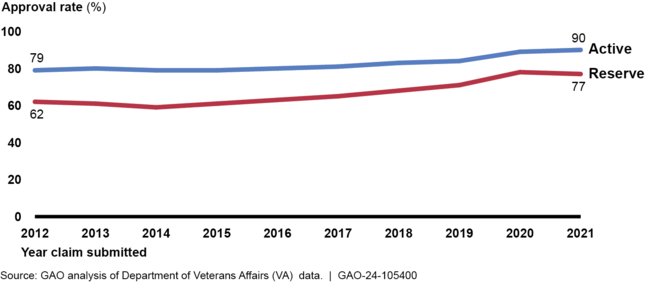
The Department of Veterans Affairs (VA) approved 11 to 20 percent fewer initial disability compensation claims from members of the reserve components—the Reserves and National Guard—than the active components (i.e., full-time active-duty military) each year from 2012 through 2021, the most recent data available. VA and Department of Defense (DOD) officials were unaware of this difference. Reserve component approval rates remained lower across characteristics such as military rank and age, but the size of the difference sometimes varied.
Active and Reserve Component VA Disability Compensation Claim Approval Rates
DOD and VA partially addressed challenges reserve component members face accessing disability compensation. Disability compensation claims generally must include evidence of a health condition that developed during military duty and led to a disability. Stakeholders—who study or work with reserve component members—identified challenges related to reserve component members' timely documentation of their health conditions and VA claims processors' ability to obtain evidence to support their claims. For example:
- All 15 stakeholders told GAO that reserve component members do not always understand the importance of immediately documenting health conditions to support any future disability compensation claims. DOD and VA guidance does not address this knowledge gap.
- Thirteen stakeholders and several claims processors told GAO that finding evidence needed to support reserve component claims, such as service dates, is difficult. One form lists active-duty service but not reserve component members' two-week annual training. DOD designed a new form that will list dates of annual training, but the military services have not fully applied sound planning practices to implement it. VA claims processors also lack a reliable data source for the dates of monthly weekend drills.
Guidance on documenting health conditions, efficient rollout of DOD's new form, and better VA data on service dates could help reserve component members prove that their disabilities are connected to their military service. Without this proof, VA claims processors will likely deny disability compensation claims.
Why GAO Did This Study
Over one-third of the U.S. military serve in the reserve components. In return for their service, the nation has committed to compensate veterans for service-connected disabilities. The Identifying Barriers and Best Practices Study Act includes a provision for GAO to study reserve component members' access to VA disability benefits.
This report examines VA's approval rates for reserve and active component disability compensation claims and how DOD and VA addressed stakeholder-identified challenges facing reserve component members in accessing disability compensation, among other topics.
GAO analyzed VA data; reviewed relevant federal laws, DOD and VA policies, and other documents; and interviewed VA and DOD officials and 15 selected stakeholders, including researchers and veterans service organizations.
Recommendations
GAO is making 14 recommendations, including that DOD and VA develop guidance for reserve component members on documenting health conditions; the military services fully apply sound planning practices to implement the new form; and VA ensure claims processors have data on reserve component members' dates of training. DOD concurred and VA concurred or concurred in principle with GAO's recommendations.
Recommendations for Executive Action
| Agency Affected | Recommendation | Status |
|---|---|---|
| Department of Veterans Affairs | VA's Under Secretary for Benefits should ensure that VBA develops a mechanism, such as a document that lists known reliability issues with VADIR, to better communicate to federal and non-federal users the limitations of its incomplete data, particularly the unreliable variables on military personnel records from before 1985. (Recommendation 1) |
VA agreed in principle with this recommendation and has addressed it. VBA's Office of Performance Analysis & Integrity coordinated with VADIR staff by creating a one-page document for purposes of sharing with future consumers of VADIR data. This document explains the VADIR scope limitation cited in our recommendation--that VADIR data on military personnel are unreliable before 1980--and gives the reasons why. This aligns with the results of our own reliability testing of VADIR data, which found that data on military personnel were unreliable before 1980.
|
| Department of Defense | The Secretary of Defense should work with the Secretary of Veterans Affairs to develop guidance, such as outreach materials, brochures, or trainings, which: (1) makes reserve component members aware of their potential eligibility for disability compensation under various duty statuses; (2) explains how reporting health conditions when they occur can affect subsequent eligibility for disability compensation; and (3) explains the importance of obtaining and maintaining sufficient documentation of duty status and medical treatment received. (Recommendation 2) |
DOD agreed with this recommendation. As of February 2026, DOD is coordinating with VA as VA develops guidance for reserve component members. When the guidance is complete, DOD plans to establish a working group to review the guidance and analyze DOD policies for potential updates. We will continue to monitor DOD's progress in these efforts.
|
| Department of Veterans Affairs | The Secretary of Veterans Affairs should work with the Secretary of Defense to develop guidance such as outreach materials, brochures, or trainings, which: (1) makes reserve component members aware of their potential eligibility for disability compensation under various duty statuses; (2) explains how reporting health conditions when they occur can affect subsequent eligibility for disability compensation; and (3) explains the importance of obtaining and maintaining sufficient documentation of duty status and medical treatment received. (Recommendation 3) |
VA agreed with this recommendation. In December 2025, VA officials said they were planning to provide updated guidance, outreach, and training materials to DOD once coordination was finalized, with a target completion date of May 2026. We will continue to monitor the progress of these efforts.
|
| Department of Defense | The Secretary of Defense should ensure that DOD's reserve components make the guidance on reporting and documenting health conditions for the purposes of disability compensation prominently available to reserve component members. (Recommendation 4) |
DOD agreed with this recommendation. Once VA provides DOD with the guidance, DOD plans to establish a working group to identify how to make the guidance prominently available to reserve component members. By the end of fiscal year 2027, DOD plans to issue guidance to ensure that each military service provides the guidance to its reserve component members. We will close this recommendation when this effort is complete.
|
| Department of Veterans Affairs | VA's Under Secretary for Benefits should make the guidance on reporting and documenting health conditions for the purposes of disability compensation prominently available to reserve component members. (Recommendation 5) |
VA agreed in principle with this recommendation, stating that VA has limited access to reserve component members but would work with DOD to make the guidance available to them. In December 2025, VA officials stated that they planned to make updated guidance publicly available on VA.gov by May 2026 and would defer to DOD to make the information readily available to reserve component members. We will monitor the progress of these efforts.
|
| Department of Defense | The Secretary of Defense should ensure the Director of ODEI clarifies policies for military service assessments of their reserve component Military Equal Opportunity programs, to reduce medical bias, which in turn could help improve reserve component members' access to disability compensation. (Recommendation 6) |
DOD agreed with this recommendation. ODEI plans to clarify policy in the next revision of DoD Instruction (DoDI) 1350.02 for which the Secretaries of the Military Departments are responsible for ensuring their Reserve MEOs are assessed. ODEI will coordinate with the Military Departments on the frequency of assessment for the Reserve MEO programs. The next revision is expected in Fall 2024. We will monitor DOD's progress to complete this effort.
|
| Department of Defense | The Secretary of Defense should ensure the Director of ODEI conducts oversight reviews of the military services' Military Equal Opportunity programs, in accordance with DOD policy, to reduce medical bias, which in turn could help improve reserve component members' access to disability compensation. (Recommendation 7) |
DOD agreed with this recommendation. ODEI plans to coordinate with the Military Departments to establish a schedule to assess the effectiveness of the Military Services' MEO offices, starting in FY 2025. ODEI also plans to coordinate with the Defense Equal Opportunity Management Institute to develop a standardized assessment methodology to help ensure consistency in the assessment process. We will monitor DOD's progress on these efforts.
|
| Department of the Army | The Secretary of the Army should develop and document plans so the Army can implement the new DD Form 214-1 by February 2025. Such plans should fully apply sound planning practices, such as (1) identifying resources; (2) developing activities and timelines; (3) establishing roles, responsibilities, and coordination; (4) conducting a risk assessment; and (5) establishing performance management, such as goals and indicators to measure progress. (Recommendation 8) |
DOD concurred with this recommendation and has addressed it. The Army implemented the Form DD-214-1 in July 2025, about 5 months after the February 2025 statutory deadline. Army officials told us that DOD had approved this extension for the Army. To help implement the form, the Army developed plans that identified resources, timelines, roles and responsibilities, as well as risk assessments and performance indicators. These plans helped the Army guide and monitor progress toward providing reserve component members with the Form DD-214-1.
|
| Department of the Air Force | The Secretary of the Air Force should develop and document plans so the Air Force can implement the new DD Form 214-1 by February 2025. Such plans should fully apply sound planning practices, such as (1) identifying resources; (2) developing activities and timelines; (3) conducting a risk assessment; and (4) establishing performance management, such as goals and indicators to measure progress. (Recommendation 9) |
DOD concurred with this recommendation and has addressed it. Air Force met the February 2025 implementation deadline to issue the Form DD-214-1 to departing reserve component members and were working to overcome identified shortfalls with fully automating production of these forms. Although Air Force officials had told us they used an Agile methodology for planning the implementation of the Form DD-214-1 for reserve component members, they did not provide us with planning documents that fully reflected this methodology. Nevertheless, as of May 2026, the Air Force developed plans identifying activities and timelines, resources, risks, and indicators to measure progress. As the Air Force officials work to fully automate production of the forms, we encourage them to continue using sound planning practices.
|
| Department of the Navy | The Secretary of the Navy should develop and document plans so the Navy can implement the new DD Form 214-1 by February 2025. Such plans should fully apply sound planning practices, such as (1) identifying resources; (2) developing activities and timelines; (3) establishing roles, responsibilities, and coordination; (4) conducting a risk assessment; and (5) establishing performance management, such as goals and indicators to measure progress. (Recommendation 10) |
DOD concurred with this recommendation and has addressed it. Specifically, the Navy developed plans that identified resources, timelines, roles and responsibilities, and risk assessments, including processes for ensuring that the DD-214-1 form meets stakeholder needs. For example, the Navy reported that its tests of the system were mainly successful but identified a shortfall with certain separation codes for Reserve Components that it planned to address before implementation. As of May 2025, the Navy has a corrective action plan to address the shortfall with the separation codes and documentation showing that their system can produce these forms.
|
| Department of the Navy | The Secretary of the Navy should ensure the Commandant of the Marine Corps develops and documents plans so the Marine Corps can implement the new DD Form 214-1 by February 2025. Such plans should apply sound planning practices, such as (1) identifying resources; (2) developing activities and timelines; (3) establishing roles, responsibilities, and coordination; (4) conducting a risk assessment; and (5) establishing performance management, such as goals and indicators to measure progress. (Recommendation 11) |
DOD concurred with this recommendation and has addressed it. The Marine Corps implemented the form by the February 2025 deadline and were working to fully automate production of the form. The Marine Corps developed project plans and timelines that contain milestones and indicators that officials used to compare to completion dates, identified resources, roles, and risks. As Marine Corps officials work to fully automate production of the forms, we encourage them to continue using sound planning practices.
|
| Department of Veterans Affairs | VA's Under Secretary for Benefits should work with DOD to ensure VA claims processors have ready access to a reliable source of data verifying reserve component members' dates of service and duty status. (Recommendation 12) |
VA agreed in principle with this recommendation and planned to work with DOD to ensure that claims processors have access to all available data. In December 2025, VA officials stated that claims processors had access to pay data in a computable, efficient format. We have requested documentation that these data are readily accessible to claims processors and can be used to verify service members' dates of service and duty status.
|
| Department of Veterans Affairs | VA's Under Secretary for Benefits should monitor differences in initial disability compensation claim approval rates between active and reserve component members, including trends over time, and use this information to inform whether course corrections, additional interventions, or analyses are needed to address challenges facing reserve component members in accessing disability compensation. (Recommendation 13) |
VA agreed in principle with this recommendation. In March 2024, VA completed an initial report comparing disability compensation claim outcomes for reserve and active component members. The report can be stratified by component, service, rank, and other factors. VA updated the report in September 2025 and plans to continue to run the report on an annual basis. Officials said their report showed no observable difference in VA benefits paid to active and reserve component members who have been deployed. However, when we analyzed the data from VA's report, we found that claims adjudicated from fiscal year 2021 through fiscal year 2025 awarded deployed reserve component members $500 (22 percent) less per month on average than deployed active component members. Additionally, the challenges described in our report largely do not apply to deployments, when reserve component members have the same access to medical treatment and service documentation as active component members. VA's report finds large differences in claim outcomes for non-deployed active and reserve component members. However, VA did not provide evidence that it investigated the causes of these differences. Instead, VA suggests that it is explained by different exposure to risks, including combat service and toxic exposures. However, these risks would largely affect deployed members and would not likely cause the large differences in access to disability compensation among non-deployed members. To close this recommendation, VA needs to provide evidence that it has identified the challenges leading to reserve component members' lower claim outcomes and determined how to address them. We will continue to monitor VA's efforts.
|
| Department of Defense | The Secretary of Defense should ensure that that the Under Secretary of Defense for Personnel and Readiness, in consultation with VA's Under Secretary for Benefits, uses information from VA about differences in initial disability compensation claim approval rates between active and reserve component members, including trends over time, to inform whether course corrections, additional interventions, or analyses are needed to address challenges facing reserve component members in accessing disability compensation. (Recommendation 14) |
DOD agreed with this recommendation. VA provided the first report to DOD in June 2024 and has since produced a second report. By March 31, 2026, DOD plans to establish a working group with the military services and relevant DOD stakeholders to analyze the VA report and discuss how to address any identified discrepancies. DOD also plans to issue guidance to the military services on implementing further actions, if needed, but does not have an estimated completion date. We will continue to monitor the progress of these efforts.
|