
Department of Education: Federal Student Aid System Modernization Project Should Better Estimate Cost and Schedule
Fast Facts
The Department of Education is modernizing its student aid application system. The system, which processes millions of federal student aid applications annually, is over 30 years old.
Education has made progress in planning the modernization project. But when the agency estimated costs and developed the project's schedule, it didn't account for the cost of government labor or the availability of needed materials and resources. These estimation problems put the project at risk of cost growth and schedule delays.
We recommended that Education address these issues.

Highlights
What GAO Found
In 2021, the Department of Education's Office of Federal Student Aid (FSA) initiated the Award Eligibility Determination (AED) project to, among other things, modernize and replace an over 30-year-old system used to process federal student aid applications. FSA has completed selected project planning and development activities. For example, in March 2022, FSA awarded a system development contract for approximately $122 million. In October 2022, FSA completed development of the infrastructure foundation for the system. Future planned activities include conducting user acceptance and system integration testing. FSA plans to deploy the system by December 2023 (see figure).
Key Completed and Future Implementation Activities for the Award Eligibility Determination (AED) Project
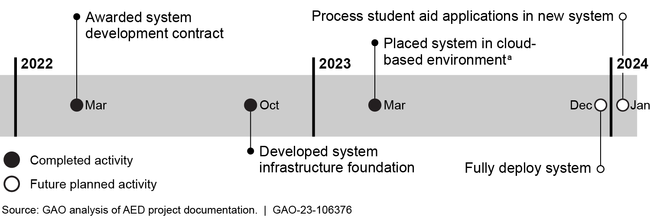
*The cloud refers to network access to a shared pool of configurable computing resources that can be rapidly provisioned with minimal management effort.
The AED project implemented four of five selected planning best practices that are intended to increase the likelihood that a project meets its objectives. For example, the project developed management plans and identified the skills needed to perform the work.
However, critical gaps exist in the fifth practice related to cost and schedule. Specifically, contrary to best practices, the project did not develop a life cycle cost estimate to inform the budget. Instead, officials roughly estimated that the office would need approximately $336 million to develop, deploy, and support AED. However, this estimate was incomplete since it did not include government labor costs.
With regard to the schedule, GAO found that project officials developed a schedule for AED and kept it updated. However, the officials did not document the assumptions, such as resource availability, that informed the schedule. In addition, the schedule did not provide rationales for constraints that limit the movement of activities. For example, the AED schedule did not identify the rationales for why 43 activities could not start any earlier than a specific date. These gaps limit the reliability of the schedule.
Developing a life cycle cost estimate to inform the budget and establishing a reliable schedule are critical steps to ensuring the project does not overrun costs or delay the schedule. Until project officials take these steps, the project is at risk of cost increases and schedule delays.
Why GAO Did This Study
FSA is the largest provider of student financial aid in the nation. In fiscal year 2022, the office processed approximately 17 million student aid applications and delivered over $100 billion in aid to more than 10 million postsecondary students and their families. Most applications are submitted electronically through FSA's legacy Central Processing System. In 2019, GAO reported that this system was among the 10 most critical federal systems in need of modernization.
The House report accompanying the Departments of Labor, Health and Human Services, and Education, and Related Agencies Appropriations Bill, 2021 includes a provision for GAO to examine FSA's efforts to replace the Central Processing System. GAO's report (1) describes the status of FSA's AED project and (2) examines the extent to which FSA implemented selected planning best practices to oversee the AED project.
GAO reviewed relevant agency documentation to describe completed and planned development activities. GAO also assessed AED planning documentation against selected Information Systems Audit and Control Association Capability Maturity Model Integration planning best practices and interviewed appropriate officials.
Recommendations
GAO is making two recommendations to Education to develop a life cycle cost estimate, and document schedule assumptions and constraints. FSA, on behalf of Education, concurred with both of the recommendations.
Recommendations for Executive Action
| Agency Affected | Recommendation | Status |
|---|---|---|
| Department of Education | The Secretary of Education should direct the Chief Operating Officer of FSA to ensure that the AED project develops a life cycle cost estimate and updates the budget based on this estimate. (Recommendation 1) |
FSA agreed with this recommendation. In May 2023, the office stated that Education is actively working to revise the AED project's cost estimates. In August 2025, FSA provided documentation that had been updated to include recent cost estimates in relation to ongoing operations and maintenance, as well as upcoming development, modernization, and enhancements. However, as of December 2025, FSA has not yet provided a life cycle cost estimate for the AED project that provides a structured accounting of all labor, material, and other efforts required to develop, produce, operate and maintain, and dispose of the project. Further, this estimate should also account for government labor costs for the entirety of the project. Additionally, regarding the budget, FSA has not yet provided associated budget documentation for AED that reflects the cost data included in AED's updated life cycle cost estimate. As such, we will continue to monitor FSA's actions to address this recommendation.
|
| Department of Education | The Secretary of Education should direct the Chief Operating Officer of FSA to ensure that the AED project documents its schedule assumptions and constraints. (Recommendation 2) |
FSA agreed with this recommendation. In May 2023, the office stated that the AED project will document the schedule constraints through weekly reviews of the project schedule. In September 2025, FSA provided the most recent integrated master schedule (IMS) for the project and documentation of the schedule's assumptions and constrains. However, the documentation appears to be at a high-level and are not inclusive of the entire IMS to ensure a mutual understanding for all stakeholders of the integrated schedule's underlying assumptions and constraints. FSA also provided schedule review meeting minutes from March 2025 through August 2025. However, while the meeting minutes have updated notes and dates by system, this information does not readily track back to the IMS for tracking activities to the system update information in the meeting minutes. It is unclear what activity this information traces to in the IMS and there is no discussion of the resource availability, required effort, or availability of materials, among other things, for these action item updates. Further, there was no evidence provided that details the rationale for schedule logic that imposes calendar restrictions that override the calculated start or finish dates of when an activity can begin or end. As such, we will continue to monitor FSA's actions to address this recommendation.
|