
Coast Guard: Assessment of a Risk-Based Approach for Conducting Gas Carrier Exams is Needed
Fast Facts
Ships that transport liquefied natural gas and other highly combustible gases could pose safety and environmental risks. The U.S. Coast Guard is required to conduct compliance exams for these gas carriers annually, but a shortage of about 400 marine inspectors sometimes leads to exam delays.
The Coast Guard inspects other vessels based on risk, but it hasn't assessed the effects of adopting this approach for gas carriers' compliance exams. Doing so could free up resources to focus inspections on riskier vessels.
We recommended that the Coast Guard assess the effects of taking a risk-based approach for gas carrier compliance exams.
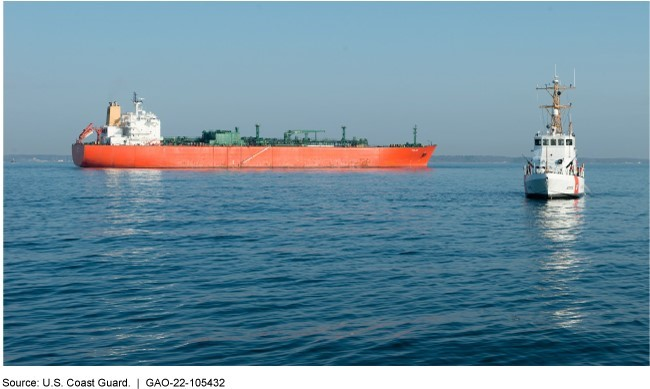
A Coast Guard cutter provides a security escort to a gas carrier entering a U.S. port.
Highlights
What GAO Found
The U.S. Coast Guard has an overall shortage of approximately 400 marine inspectors, according to its workforce modeling, which affects its ability to conduct gas carrier compliance exams. GAO analysis of the data shows that from 2016 through 2020 the Coast Guard staffed the key operational field units that conduct gas carrier exams at below 70 percent of their estimated need. Coast Guard officials stated they complete all required exams, but representatives from six of nine industry stakeholders told GAO they sometimes experienced costly delays because marine inspectors were not available. The Coast Guard has ongoing initiatives to address its marine inspection workforce challenges. Additionally, GAO, in a companion report, made a number of recommendations to strengthen the Coast Guard's workforce planning efforts.
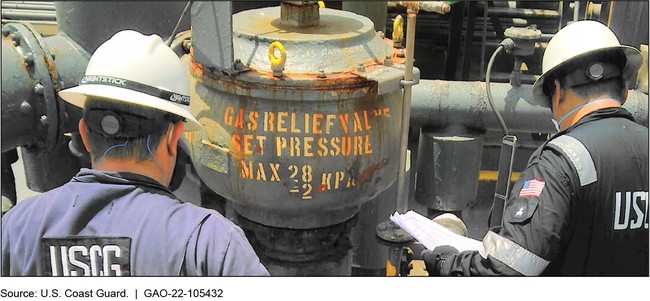
Photo of Coast Guard Marine Inspectors Undergoing Gas Carrier Examiner Training
The Coast Guard regularly updates gas carrier exam policies and procedures to reflect industry changes. For example, according to Coast Guard officials, every 4 years they update the key guidance document for conducting the exams. Representatives from all nine gas carrier industry stakeholders stated marine inspectors are well trained and the exams are thorough.
The Coast Guard has not considered potential gas carrier exam efficiencies in the context of potential risks when assessing its policies and procedures. For example, it has not assessed the benefits and risks of adopting a risk-based inspections approach. GAO analysis of Coast Guard data shows that marine inspectors identified low instances of more serious deficiencies that pose a risk to the cargo, vessel, or crew during gas carrier compliance exams from fiscal years 2016 through 2020—about 12 percent (250 out of 2,075). Further, Coast Guard officials stated that gas carriers are generally well run. However, given the nature of their cargo, gas carriers present safety concerns. The Coast Guard previously considered developing legislative change proposals to reduce the annual exam requirement. However, it did not conduct a risk assessment for the potential legislative change. Conducting such an assessment and taking actions, as appropriate and feasible, would help ensure that the Coast Guard is efficiently and effectively using its marine inspection resources.
Why GAO Did This Study
Gas carrier ships that transport liquefied natural gas and other products overseas can pose safety and environmental risks because the cargo is highly combustible. Further, gas carrier vessel traffic in U.S. ports has increased from about 1,200 in 2011 to more than 3,200 in 2020. The Coast Guard is the principal federal agency responsible for marine safety and is required by statute to conduct gas carrier compliance exams annually.
The National Defense Authorization Act for Fiscal Year 2021 includes a provision for GAO to report on gas carrier compliance exam issues. This report addresses (1) Coast Guard marine inspector staffing levels and its ability to meet gas carrier compliance mission needs, (2) the extent to which the Coast Guard updates its gas carrier compliance exam policies and procedures, and (3) the extent to which the Coast Guard has assessed the efficiency of its policies and procedures in the context of risk. To address these objectives, GAO reviewed relevant laws and regulations; reviewed Coast Guard workforce planning documents, policies, and procedures; analyzed Coast Guard workforce and exam data from 2016 through 2020; and interviewed agency officials and a nongeneralizable sample of nine industry stakeholders.
Recommendations
GAO recommends the Coast Guard conduct an assessment of adopting a risk-based approach to conducting gas carrier compliance exams and take actions, as appropriate and feasible. The Department of Homeland Security concurred with this recommendation.
Recommendations for Executive Action
| Agency Affected | Recommendation | Status |
|---|---|---|
| United States Coast Guard | The Commandant of the Coast Guard should conduct an assessment of adopting a risk-based approach for conducting gas carrier compliance exams and take actions to address the results, as appropriate and feasible. (Recommendation 1) |
The Coast Guard incorporated this recommendation into the Statement of Objectives for the National Academies of Sciences Transportation Research Board study, mandated by the Elijah E. Cummings Coast Guard Authorization Act (CGAA) of 2020. The study was to evaluate the constraints and challenges to maintaining gas carrier exam efficiency and issue related recommendations. The National Academies completed the study in 2024. Subsequently, the Coast Guard evaluated the National Academies study. It determined that analysis from the National Academies study and internal Coast Guard data confirms that gas carriers have a demonstrably superior safety record compared to other vessel types and that they exhibit significantly lower deficiency and detention rates. The Coast Guard further determined that this strong safety culture, supported by a robust international regulatory framework and industry vetting programs, justifies shifting from a fixed annual examination schedule to a more flexible, performance-based model. According to the Coast Guard, passage of the National Defense Authorization Act for Fiscal Year 2026 removed the statutory obstacle to implementing a performance-based examination schedule. Specifically, the Act amended 46 U.S.C. § 3714, granting the Coast Guard the authority to establish a performance-driven examination schedule with intervals other than annually. The Coast Guard has taken action to address the results of the study following the statutory change. For example, it developed a flexible framework for a performance-based examination model, which the Coast Guard provided to us for review. According to Coast Guard officials, this framework is designed to analyze available data to assign a performance score to each vessel, allowing the Coast Guard to focus its limited resources on higher-risk vessels while maintaining appropriate oversight of the entire gas carrier fleet. The Coast Guard also developed a dashboard that captures the required performance criteria, which we reviewed. Further, the Coast Guard developed the following implementation steps: 1. Policy Development: Develop and issue policy guidance outlining strategic goals, the performance-based methodology, arrival screening procedures, and documentation requirements. 2. Training: Allocate resources to train inspectors on the performance-based framework and associated analytical tools. 3. Oversight: To demonstrate that the program provides an equivalent or greater level of safety, the Coast Guard stated that it will establish key risk indicators to monitor vessel performance. This will include conducting root cause analyses for vessels showing declining performance and refining the model as needed to ensure its continued effectiveness. According to Coast Guard officials, a performance-based gas carrier exam program offers the potential for increased efficiency and optimized resource allocation. By leveraging existing data sources and implementing a robust risk assessment model, the Coast Guard can more effectively target its gas carrier exam efforts.
|