
Navy Ship Maintenance: Actions Needed to Monitor and Address the Performance of Intermediate Maintenance Periods
Fast Facts
High-priority planned ship and submarine maintenance happens pier-side in homeports, allowing the Navy to interrupt repairs and get ships underway quickly if needed.
These "intermediate maintenance periods" are critical to fleet readiness, but the Navy generally doesn't collect or analyze sufficient data to monitor or improve them.
For example, while the Navy had some FY 2015-2020 data on submarine maintenance periods—showing 2,525 days of delays—it didn't have other useful data for submarine, surface ship, or aircraft carrier maintenance periods.
Our recommendations are to help the Navy improve its oversight and address other challenges.
Highlights
What GAO Found
The Navy collected, but did not analyze, limited data on the performance of intermediate maintenance periods—work often occurring while a ship is pier-side and capable of getting underway within 96 hours. Based on these data, GAO found that the Navy completed 191 of 414 (46 percent) submarine intermediate maintenance periods late from fiscal years 2015 through 2020, totaling 2,525 days of maintenance delay. The Navy did not collect several categories of data for submarines, surface ships, and aircraft carriers, including the planned and actual maintenance period costs. Without establishing and implementing procedures to collect and analyze these data, the Navy cannot effectively track and improve the performance of intermediate maintenance periods.
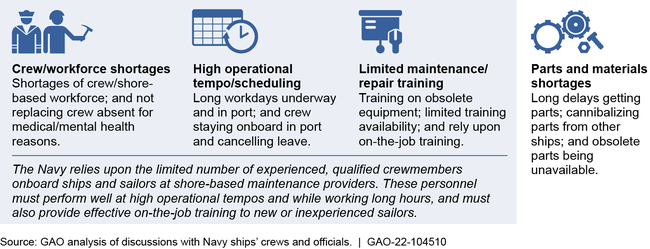
GAO identified four main challenges affecting the performance of intermediate maintenance periods for submarines, surface ships, and aircraft carriers based on discussions with ships' crews and officials from Navy organizations (see fig.).
Four Main Challenges Affecting the Performance of Intermediate Maintenance Periods
Ships' crews and shore-based maintenance providers have taken steps to address these challenges, but have had limited success because the Navy's efforts have been fragmented, have not generally included the sharing of best practices and lessons learned, and have not included the performance of intermediate maintenance periods in its strategic planning. For example:
- The Navy's aircraft carrier community independently created a working group to address some aspects of parts shortages, but has not shared this effort across the fleet. Implementing a mechanism to share best practices and lessons learned will better enable the Navy to address challenges affecting the performance of these maintenance periods.
- The Navy has not included the performance of intermediate maintenance periods for submarines, surface ships, and aircraft carriers in strategic planning efforts. Without including consideration of the performance of intermediate maintenance periods in its strategic planning and related initiatives, the Navy risks negatively affecting the readiness of the fleet.
Addressing these issues will better position the Navy to increase the readiness of submarines, surface ships, and aircraft carriers needed to perform their missions.
Why GAO Did This Study
During fiscal years 2015 through 2020, the Navy spent an average of $2.1 billion per year performing high priority maintenance on submarines, surface ships, and aircraft carriers. The Navy's ships' crews and shore-based maintenance providers, located at homeports throughout the world, generally performed this maintenance—referred to by GAO as “intermediate maintenance periods”—to prepare the ships to get underway to execute their next missions.
The House Armed Services Committee, in a report accompanying a bill for the National Defense Authorization Act for Fiscal Year 2021, included a provision for GAO to review Navy ship intermediate maintenance periods. GAO evaluated the extent to which the Navy (1) collected and used data regarding the performance of intermediate maintenance periods for submarines, surface ships, and aircraft carriers during fiscal years 2015 through 2020, and (2) has addressed challenges affecting the performance of intermediate maintenance periods. GAO analyzed data related to Navy intermediate maintenance periods during fiscal years 2015 through 2020, reviewed key documents, and met with Navy crews and officials.
Recommendations
GAO is making four recommendations to the Navy, including to establish and implement procedures to collect and analyze reliable maintenance data; share best practices and lessons learned; and include the performance of intermediate maintenance periods in strategic planning efforts. The Navy concurred with all four recommendations.
Recommendations for Executive Action
| Agency Affected | Recommendation | Status |
|---|---|---|
| Department of the Navy | The Secretary of the Navy should ensure that the shore-based maintenance providers and the fleet/type commanders establish and implement procedures to collect and analyze complete and reliable data on the performance of intermediate maintenance periods for submarines, surface ships, and aircraft carriers. These data should include the planned and actual start and completion dates, costs, and the causes of any delays in the completion of maintenance periods, among other things. (Recommendation 1) |
The Navy concurred with this recommendation. The Navy stated it recognizes the value of data collection and will take action to standardize the collection and analysis of Intermediate Maintenance Period data at Regional Maintenance Centers and within the four public shipyards and at NAVSEA headquarters. As of May 2025, the Navy provided evidence that it is tracking some data regarding the performance of intermediate maintenance periods. Specifically, the Navy provided evidence that it is tracking the planned and actual start and completion dates and costs for these maintenance periods. As of December 2025, the Navy provided evidence from multiple regional maintenance centers that it was tracking maintenance delays and the causes of those delays for intermediate maintenance periods. This recommendation is closed as implemented.
|
| Department of the Navy | The Secretary of the Navy should ensure that a single entity is designated to address challenges affecting intermediate maintenance periods for submarines, surface ships, and aircraft carriers. (Recommendation 2) |
The Navy concurred with this recommendation. The Navy stated NAVSEA will be the lead organization tasked with improving Intermediate Maintenance in close partnership with Fleet and the Type Commanders to execute these responsibilities. In December 2025, the Navy provided an updated OPNAVINST 4700.7N that did two things. First, the Navy created updates and organizational changes in the intermediate maintenance period category (non-CNO). Second, while it still appears that multiple entities share responsibility, there were two additions to the TYCOM responsibilities in section 303. Specifically, TYCOMs are now responsible for ensuring that shipboard execution of 3M maintenance is validated and that there is to be effective scheduling and timely execution of intermediate maintenance periods (non-CNO work) to prevent migration of work intended to be completed during intermediate maintenance periods into depot maintenance periods. These changes satisfy the intent of the recommendation, which is now closed as implemented.
|
| Department of the Navy | The Secretary of the Navy should ensure that shore-based maintenance providers and fleet/type commanders implement a mechanism to share best practices and lessons learned regarding the performance of intermediate maintenance periods across submarines, surface ships, and aircraft carriers. (Recommendation 3) |
The Navy concurred with this recommendation. The Navy stated it will expand efforts to standardize the procedures for collection and analysis of complete and reliable data on the performance of Intermediate Maintenance. As of May 2025, the Navy stated that it has efforts underway to establish a database with best practices and lessons learned from its regional maintenance centers. The Navy further stated that existing forums to share best practices and lessons learned from surface ship maintenance will be leveraged to include intermediate maintenance periods for surface ships. However, these efforts to share best practices should also include the sharing of best practices for intermediate maintenance periods performed on submarines and aircraft carriers. As of December 2025, the Navy provided evidence that forums were occurring in the carrier, surface, and submarine communities to share best practices that included intermediate maintenance periods. This recommendation is closed as implemented.
|
| Department of the Navy |
Priority Rec.
The Secretary of the Navy should ensure that the Navy's maintenance-related strategic planning and initiatives, such as the Navy's Performance to Plan efforts, include issues associated with the performance of intermediate maintenance periods. (Recommendation 4) |
The Navy agreed with our recommendation, stating that it will leverage the Performance to Plan and Naval Sustainment System forums to drive improvements to maintenance as a whole, encompassing both intermediate and depot-level maintenance. As of May 2024, the Navy provided some evidence that it has developed what it refers to as a "driver tree" that identifies some causes for delays in the performance of intermediate maintenance periods, such as growth work and personnel in training, for inclusion in its Performance to Plan initiative. Based on documentation provided in December 2025, intermediate maintenance periods have been fully included in the Navy's Performance to Plan efforts, which were called out specifically in the Chief of Naval Operations strategic guidance, the NAVPLAN 2024. Subsequently, the Navy's Fighting Instructions included the foundry as one of the strategic document's areas of focus, which included shore-based infrastructure that involves regional maintenance centers. This recommendation is closed as implemented.
|