
High-Performance Computing: NNSA Could Improve Program Management Processes for System Acquisitions
Fast Facts
The National Nuclear Security Administration maintains the nuclear stockpile. To analyze the performance, safety, and reliability of nuclear weapons, it acquires high-performance computing systems for simulations. The latest system is expected to be complete in 2024.
Is NNSA following best practices to acquire this $600 million system?
NNSA could have done a better job considering alternatives. For example, NNSA's analysis of alternatives was not conducted independently, as its policies require. The contractor that manages the acquisition program conducted the analysis.
Our recommendations address this and other issues we found.
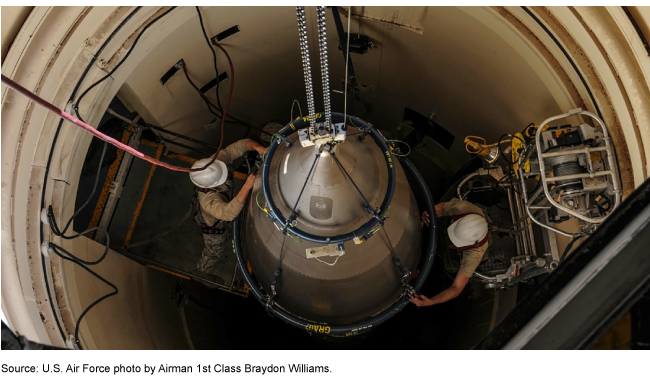
U.S. Air Force missile maintainers working on an intercontinental ballistic missile
Highlights
What GAO Found
The National Nuclear Security Administration's (NNSA) analysis of alternatives (AOA) process for its $600 million El Capitan HPC acquisition did not fully follow agency policy that states that AOA processes should be consistent with GAO best practices, where possible, and any deviations must be justified and documented. According to GAO best practices, a reliable AOA process should meet four characteristics: it should be comprehensive, well documented, unbiased, and credible. As seen in the table, the AOA process for El Capitan partially met one of these characteristics and minimally met the other three. NNSA did not justify or document the deviations from these best practices, as required by NNSA policy. GAO also found that the AOA process was conducted by the contractor that manages the El Capitan acquisition program, contrary to agency policy and guidance stating that AOAs should be conducted by an independent entity. Without following AOA best practices where possible; justifying and documenting any deviations; and ensuring AOA processes are conducted by an independent entity, as required, NNSA cannot be assured of a reliable assessment of options for meeting critical mission needs.
Extent to Which the National Nuclear Security Administration (NNSA) Met the Characteristics of a Reliable Analysis of Alternatives (AOA) Process
|
AOA characteristic |
GAO assessment |
Example of deviation |
|
Comprehensive |
Partially met |
Cost estimates are incomplete and did not follow best practices. |
|
Well documented |
Minimally met |
The alternatives' descriptions are not detailed enough for a robust analysis. |
|
Unbiased |
Minimally met |
NNSA had a predetermined solution, acquiring an HPC system, before performing the AOA process. |
|
Credible |
Minimally met |
The selection criteria appear to have been written for the preferred alternative. |
Source: GAO analysis of NNSA information. | GAO-21-194
GAO found that, in the second year of the El Capitan acquisition program's 5-year acquisition life cycle, NNSA has fully implemented selected key practices related to program monitoring and control. However, NNSA has only partially implemented key practices related to requirements management. Specifically, El Capitan program officials did not update and maintain acquisition program documents to include current requirements. NNSA officials stated that once the program developed its program plan early in the program's life cycle, they did not require the program to update and maintain that program plan. However, NNSA's own program management policy requires programs to update program documents throughout the duration of the program. Without updating and maintaining El Capitan program documents to include current requirements, NNSA officials may be limited in their ability to ensure that all mission requirements are met.
Why GAO Did This Study
NNSA is responsible for maintaining the nation's nuclear stockpile. To analyze the performance, safety, and reliability of nuclear weapons, it acquires high-performance computing (HPC) systems to conduct simulations. The latest system, El Capitan, is expected to be fully deployed by March 2024.
The committee report accompanying the Energy and Water Development and Related Agencies Appropriations Act, 2019, includes a provision for GAO to review NNSA's management of its Advanced Simulation and Computing program. This report examines, among other things, (1) the extent to which NNSA's AOA process for the El Capitan acquisition met best practices and followed agency policy and guidance and (2) the extent to which NNSA is implementing selected acquisition best practices in carrying out the El Capitan acquisition program. GAO reviewed documents and interviewed NNSA officials and laboratory representatives involved in carrying out the AOA and acquisition processes.
Recommendations
GAO recommends that NNSA (1) ensure that future HPC acquisition programs follow AOA best practices, where possible, and justify and document any deviations consistent with policy; (2) ensure that an independent entity conducts future AOA processes; and (3) update and maintain acquisition program documents to include El Capitan requirements for the ongoing acquisition. NNSA generally concurred with these recommendations.
Recommendations for Executive Action
| Agency Affected | Recommendation | Status |
|---|---|---|
| National Nuclear Security Administration | The Administrator of NNSA should take steps to ensure that, for future HPC acquisitions, the ASC program follows GAO best practices for AOA processes, where possible, and justifies and documents any deviations, as required by agency policy. (Recommendation 1) |
In its official response to GAO's report, NNSA indicated it would follow analysis of alternatives (AOA) best practices only for capital acquisition projects; the agency does not consider the bulk of a high-performance computing (HPC) purchase as a capital acquisition. For the soon-to-be completed El Capitan acquisition, we found that NNSA's Analysis of Alternatives (AOA) met few, if any, of GAO best practices. However, a new ASC program Assistant Deputy Administrator (ADA), recently hired from another federal agency, directed in 2025 that an AOA be performed for the agency's next HPC system using DOE's AOA Guide (DOE G 413.3-22). According to this document, the guide is derived from GAO's AOA Best Practices and GAO best practice details are included in the September 2026 initial tasking memo. The ADA also established an Independent Review Board (IRB), consisting of representatives from other DOE program offices and non-NNSA National Labs. The IRB confirmed the HPC mission needs statement in October 2025 and recommended the AOA proceed in December 2025. The resulting AOA examined functional requirements and endorsed two of the nine HPC alternatives proposed. An NNSA federal employee-only team completed the AOA and in May 2026 the IRB reviewed both the AOA methods and results and determined that they were valid. Also, in May 2026 the ASC ADA directed LLNL, the HPC sponsor, to follow the results of the AOA. Specifically, the ASC ADA noted, "following an extensive [AoA] process, consistent with the recommendations and best practices identified by GAO, ASC has determined that there are two approaches to the FCR-30 procurement that can meet programmatic needs while providing best value for government." The ASC program directed the lab develop a procurement plan for the HPC, acknowledging that a hybrid model involving the two selected alternatives may be called for. ASC directed LLNL to prepare the procurement plan by the end of June 2026. LLNL submitted this plan to NNSA on 29 June 2026.
|
| National Nuclear Security Administration | The Administrator of NNSA should ensure that the ASC program's future AOA processes are performed by an entity independent of the contractor organization managing and executing the program. (Recommendation 2) |
NNSA agreed with this recommendation. However, at the time of our report, NNSA did not consider HPC systems capital acquisitions. As such, it did not believe AOA best practices needed to be followed for programs that are not capital acquisitions. As a result, the El Capitan HPC AOA was performed by contractor representatives for the lab (LLNL) where the new HPC system was going to be installed. This goes against GAO and DOE AOA best practices as it could introduce potential bias into their analysis. To reduce this possibility and to respond to our recommendation, the ASC Assistant Deputy Administrator (ADA), did not allow LLNL and other NNSA national labs to participating in a new AOA for a newly planned HPC acquisition (other than to provide technical support). The AOA team was, instead, composed of federal NNSA employees. Although, ASC program officials were involved in evaluating options, the ASC ADA created an Independent Review Board (IRB) to review both the mission need statement and the resulting AOA. The IRB was composed of officials from other DOE program offices and non-NNSA national labs. The IRB endorsed both, and in June 2026 NNSA directed LLNL to develop a procurement plan by end of June 2026. LLNL submitted this plan to NNSA on 29 June 2026.
|
| National Nuclear Security Administration | The Administrator of NNSA should update and maintain its acquisition program documents to include current El Capitan requirements and clearly document the relationship between El Capitan's mission and functional requirements. (Recommendation 3) |
In response to our recommendation, program officials provided documentation indicating that no additional mission requirements changes have been made to the program since 2019, and therefore the program documentation did not require any additional updates. In June 2024, program officials developed a requirements traceability document that demonstrated the relationship between the El Capitan functional requirements to the mission needs within the El Capitan. By updating and maintaining acquisition program documents to include current El Capitan requirements and clearly documenting the relationship between El Capitan's mission and functional requirements, NNSA will be able to better ensure that all mission requirements are met in the final system.
|