
Unaccompanied Children: Actions Needed to Improve Grant Application Reviews and Oversight of Care Facilities
Fast Facts
The Department of Health and Human Services (HHS) awards grants to provide care for unaccompanied children—those without legal immigration status or an available parent or guardian. The grants go to state-licensed organizations that provide shelter and other services.
HHS monitors these facilities to ensure they're keeping children safe, among other things. But it hasn't met its own targets for how frequently it visits facilities, and doesn't consistently share information with state agencies that license them.
Our recommendations include that HHS develop plans to meet its monitoring goals and share information with state agencies.
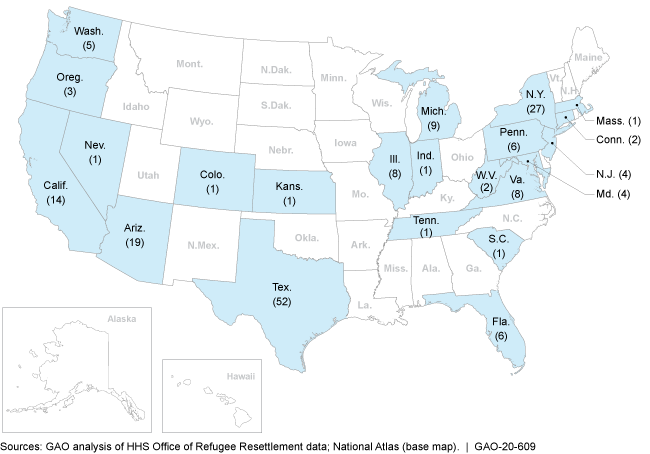
Number of facilities in each state that both received grants from the Department of Health and Human Services (HHS) and had unaccompanied children in care as of July 2020
Highlights
What GAO Found
The Office of Refugee Resettlement's (ORR) grant announcements soliciting care providers for unaccompanied children—those without lawful immigration status and without a parent or guardian in the U.S. available to provide care and physical custody for them—lack clarity about what state licensing information is required. Further, ORR does not systematically confirm the information submitted by applicants or document a review of their past performance on ORR grants, when applicable, according to GAO's analysis of ORR documents and interviews with ORR officials. The grant announcements do not specify how applicants without a state license should show license eligibility—a criterion for receiving an ORR grant—or specify what past licensing allegations and concerns they must report. In addition, the extent to which ORR staff verify applicants' licensing information is unclear. In fiscal years 2018 and 2019, ORR awarded grants to approximately 14 facilities that were unable to serve children for 12 or more months because they remained unlicensed. In addition, ORR did not provide any documentation that staff conducted a review of past performance for the nearly 70 percent of applicants that previously held ORR grants. Without addressing these issues, ORR risks awarding grants to organizations that cannot obtain a state license or that have a history of poor performance.
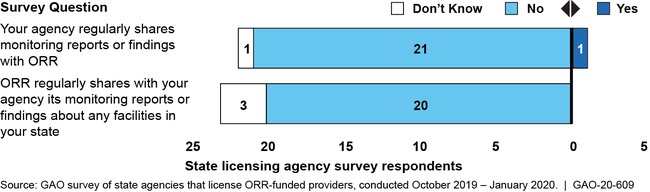
State licensing agencies regularly monitor ORR-funded facilities, but according to GAO's survey of these agencies, their information sharing with ORR is limited (see figure). State licensing agencies and ORR staff both said that improved information sharing would benefit their monitoring of facilities. Without such improvements, ORR may lack information about ongoing issues at its facilities.
Key Survey Responses on Information-Sharing with the Office of Refugee Resettlement (ORR) by the 23 State Agencies That Licensed ORR-Funded Facilities in Fall 2019
ORR requires grantees to take corrective action to address noncompliance it identifies through monitoring, but ORR has not met some of its monitoring goals or notified grantees of the need for corrective actions in a timely manner. For example, under ORR regulations, each facility is to be audited for compliance with standards to prevent and respond to sexual abuse and harassment of children by February 22, 2019, but by April 2020, only 67 of 133 facilities had been audited. In fiscal years 2018 and 2019, ORR also did not meet its policy goals to visit each facility at least every 2 years, or to submit a report to facilities on any corrective actions identified within 30 days of a visit. Without further action, ORR will continue to not meet its own monitoring goals, which are designed to ensure the safety and well-being of children in its care.
Why GAO Did This Study
ORR is responsible for the care and placement of unaccompanied children in its custody, which it provides through grants to state-licensed care provider facilities. ORR was appropriated $1.3 billion for this program in fiscal year 2020. GAO was asked to review ORR's grant making process and oversight of its grantees.
This report examines (1) how ORR considers state licensing issues and past performance in its review of grant applications; (2) state licensing agencies' oversight of ORR grantees, and how ORR and states share information; and (3) how ORR addresses grantee noncompliance. GAO reviewed ORR grant announcements and applications for fiscal years 2018 and 2019. GAO conducted a survey of 29 state licensing agencies in states with ORR facilities, and reviewed ORR monitoring documentation and corrective action reports. GAO also reviewed ORR guidance and policies, as well as relevant federal laws and regulations, and interviewed ORR officials.
Recommendations
GAO is making eight recommendations to ORR on improving clarity in its grant announcements, communication with state licensing agencies, and monitoring of its grantees. ORR agreed with all eight recommendations.
Recommendations for Executive Action
| Agency Affected | Recommendation | Status |
|---|---|---|
| Office of Refugee Resettlement | The Director of ORR should clarify in its grant announcements the information and supporting documentation applicants are required to provide in their grant applications with respect to their state licensing status, eligibility, and allegations and concerns. (Recommendation 1). |
HHS concurred with this recommendation. ORR took several steps to clarify this information in its grant announcements. In June and July 2020, ORR published four new grant announcements that require applicants to report any allegations or concerns of abuse and/or neglect, as well as any denial, suspension, and/or revocation of their license. In its 2023 grant announcement, ORR maintained this language and added clarification that the reporting period for these events is five years. We found that these grant announcements did not include clarification on whether applicants operating multiple facilities should report allegations and concerns that have occurred at any of their facilities, or only those at facilities specified in the application. ORR officials told us that the agency wanted applicants to report issues at any facilities they operate, not just the facility they are proposing in their application. In August 2025, ORR published a new grant announcement that clarified this expectation. The new grant announcement specifies that after the initial award, successful applicants must immediately report any allegations or concerns of abuse or neglect and any license denials, suspensions, or revocations over the past 5 years at any facility the awardee operates. It also specifies that successful applicants that do not already have a state license at the time of their award must provide monthly updates to ORR on their progress toward licensure and obtain a license within 6 months of receiving the award.
|
| Office of Refugee Resettlement |
Priority Rec.
The Director of ORR should take steps to develop, and ensure that officials reviewing grant applications implement, a process to verify the accuracy and completeness of information reported by grant applicants on state licensing status, eligibility, allegations and concerns. (Recommendation 2). |
HHS concurred with this recommendation. As of February 2022, ORR had updated its guide for project officers reviewing grant applications to enhance instructions for assessing licensing information included in grant applications. For example, HHS's guidance document instructs the project officer to determine whether the applicant is currently licensed and in good standing in the state in which they are proposing to provide services. Project officers are instructed to take steps, including searching state licensing agency websites or reaching out directly to state licensing agencies, if information is unavailable online, to verify the grantee's license, and determine whether they have any disciplinary actions against them. Additionally, this guidance requires project officers to request documentation from an applicant whose license has been restricted, suspended, or revoked. HHS has also incorporated this guidance into the training curriculum for project officers.
|
| Office of Refugee Resettlement |
Priority Rec.
The Director of ORR should ensure that the grant review process includes a documented review of applicants' past performance on ORR grants for those that have previously received grants to care for unaccompanied children. This could include, for example, a systematic review of previous quarterly and annual performance reports and a review of corrective actions issued by all ORR monitoring staff to all ORR-funded facilities previously operated by the applicant. (Recommendation 3). |
HHS concurred with this recommendation. As of February 2022, ORR updated its guidance for project officers on conducting and documenting reviews of grantee performance. ORR updated its standard operating procedure for ORR project officers and Office of Grants Management staff reviewing grantees' quarterly Performance Progress Reports. Under the procedure, staff are to use information from these reviews to ensure grantee performance is satisfactory and determine whether funding should be continued for another budget period. The procedure states that project officers should pay particular attention to grantees' descriptions of any issues they experienced in the past reporting period, including any and all documented state licensing allegations or concerns, and any corrective actions issued by ORR or others, and the steps the grantee took to resolve these issues. The procedure also states that project officers are to complete a Grants Monitoring Statement documenting their review. HHS has also incorporated this guidance into the training curriculum for project officers.
|
| Office of Refugee Resettlement | The Director of ORR should clarify in its instructions to grantees the information they are required to report on state licensing citations in their quarterly performance reports. (Recommendation 4). |
HHS concurred with this recommendation. ORR determined that an existing field in the quarterly performance report form, designated for significant findings and events, could be used to collect information on any state licensing citations a grantee received during the quarter. In March 2024, ORR sent an email notifying grantees serving unaccompanied children that, beginning with the next quarterly performance report, they were required either to report any state licensing citations, suspensions, or revocations that the grantee or any subrecipients had received during the quarter or affirmatively note that no such licensing issues had occurred.
|
| Office of Refugee Resettlement | The Director of ORR should take steps, such as through guidance or training, to ensure that project officers clearly understand the requirement that grantees report state licensing citations at any of their facilities within 24 hours and include state licensing citations in their quarterly performance reports. (Recommendation 5). |
HHS concurred with this recommendation. As of June 2024, ORR updated slides used to train project officers. The updated slides clearly state that grantees must report a license revocation or suspension to ORR within 24 hours and that licensing citations should be reported in the section of the quarterly performance reports on significant findings and events.
|
| Office of Refugee Resettlement | The Director of ORR should work with state agencies that license ORR-funded facilities to develop a plan for mutual information sharing, including processes for ORR outreach to states during the grant application review process and ongoing information sharing on ORR and state monitoring processes and identified deficiencies. (Recommendation 6). |
HHS concurred with this recommendation. ORR has made progress in establishing communication channels and developing mutually beneficial information-sharing relationships with state licensing agencies. For example, in 2024, ORR had entered into a Memorandum of Agreement with California's licensing agency. In December 2025, HHS officials said that ORR continues to engage state agencies on issues including licensing matters and incident reporting and response. We encourage ORR to continue working with each state to develop a mutually beneficial information sharing relationship. We will close this recommendation when HHS provides evidence of its outreach to all states where it has grantee facilities about developing information-sharing protocols.
|
| Office of Refugee Resettlement | The Director of ORR should ensure that ORR provides and maintains a current point of contact for each state agency that licenses ORR grantees to facilitate information sharing regarding ORR-funded facilities. (Recommendation 7). |
HHS concurred with this recommendation. As of December 2025, ORR maintains a list of points of contact at almost all state licensing agencies, and officials said that ORR plans to update the spreadsheet quarterly. ORR has not yet provided evidence that it has, in turn, provided an ORR point of contact to licensing agencies in all states with an ORR grantee. We believe it is important for both ORR and state licensing agencies to have points of contact for each other to facilitate licensing agency outreach and information sharing. We will consider closing this recommendation when ORR provides evidence that contact information has been provided in both directions.
|
| Office of Refugee Resettlement | The Director of ORR should develop a plan—including roles, responsibilities, and timeframes—to guide and focus ORR's efforts to meet its goals to:
(Recommendation 8). |
HHS concurred with this recommendation. With respect to auditing facilities' compliance with ORR standards on preventing and responding to sexual assault, as required under the Interim Final Rule, HHS awarded a new contract to conduct these audits in October 2021. The contract specifies the number of facilities the contractor must audit each year, requirements for the audits, and penalties for failure to meet these contract terms. ORR officials told us that, as of October 2023, the contractor had conducted audits at all facilities that missed the initial deadline set under the Interim Final Rule and anticipated conducting audits at an additional 70 facilities by October 2024. In addition, officials said that a newly formed Prevention of Child Abuse and Neglect team within ORR was working with the contractor to ensure they meet the timelines specified in the contract and the Interim Final Rule. With respect to conducting monitoring visits to each facility every 2 years and reporting noncompliance to facilities within 30 days of the site visit, ORR was close to meeting these goals as of Spring 2024. According to an ORR tracking document, as of March 2024, ORR came close to meeting the requirement to monitor all its standard facilities within a two-year period. Another ORR tracking spreadsheet showed that in fiscal year 2023 it took ORR staff 31 days after a monitoring visit, on average, to submit the report to the facility. The ORR Monitoring Team's Strategic Plan for calendar year 2024 reflects the agency's intent to fully meet these goals. The plan articulates the team's goals to increase its workforce capacity to meet monitoring needs and to monitor programs and submit monitoring reports within ORR's required timeframes. It also includes targets and timeframes for meeting these goals and identifies responsible staff.
|