
Air Force Readiness: Actions Needed to Address Depot Maintenance Delays and Staffing Challenges
Fast Facts
Three Air Force aviation depots maintain critical aircraft, such as the F-16 fighter and C-17 cargo transport. But maintenance delays are increasing—reducing aircraft availability for operations and training.
Also, the Air Force's method for tracking target completion dates of the maintenance process does not fully reflect delays, including the extent of unplanned work discovered during maintenance.
The Air Force is also competing with the private sector to staff essential aircraft maintenance jobs, including engineers and mechanics.
Our recommendations to the Air Force address these issues.
An Air Force C-17 Aircraft Delayed in Depot Maintenance
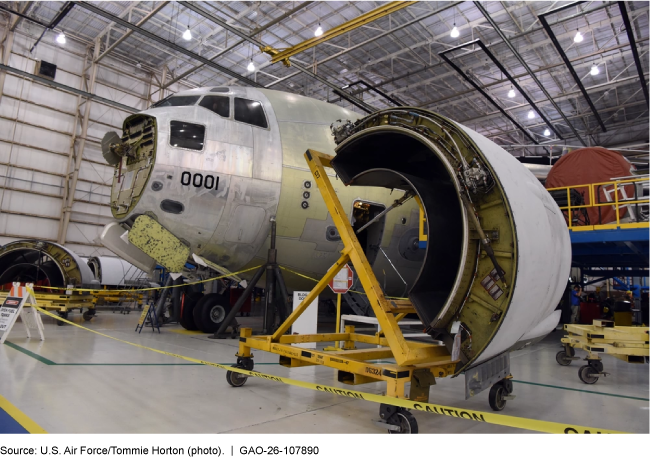
A C-17 aircraft undergoing maintenance at an Air Force depot.
Highlights
What GAO Found
The Air Force has three maintenance depots that maintain the readiness of aircraft required for military operations. Depot maintenance delays have increased considerably since fiscal year 2019, whether measured by the original target completion date set before aircraft arrive at the depot or the revised target completion date that accounts for unplanned work found during maintenance.
Percentage of Air Force Aircraft Delayed During Depot Maintenance, Fiscal Years 2019–2024
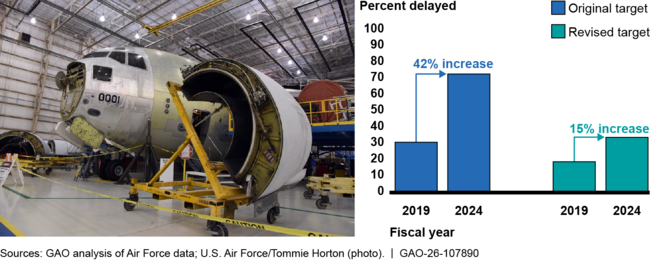
The Air Force tracks depot maintenance timeliness for both original and revised target completion dates but primarily uses the revised target for reporting on its performance.GAO found several limitations associated with the Air Force’s reporting on depot timeliness. For example:
- Reporting on the revised target masks the full extent of delays because it does not reflect unplanned work. Depots frequently revised targets after they completed maintenance to match the actual number of days it took to complete maintenance.
- Depots and aircraft program offices inconsistently apply the target completion date revision process.
As a result, the Air Force is not reporting the full extent of depot maintenance challenges and may not be able to make accurate comparisons across the fleet.
While all three depots have filled 90 percent or more positions since 2020, they have experienced shortages in specific occupations. According to depot officials, pay competition with the private sector is the primary challenge in recruiting and retaining personnel in occupations such as engineers and mechanics. The depots have taken some steps to mitigate this challenge by selectively using incentives and emphasizing the nonfinancial benefits of a federal career. However, the Air Force has not fully addressed pay competition with the private sector because DOD has not conducted a comprehensive assessment of pay gaps for occupations affected by private sector competition. Such an assessment would enable the depots to make informed decisions to address competition with the private sector for occupations critical to aircraft readiness.
Why GAO Did This Study
More than 2 decades of conflict has degraded the Air Force’s readiness, with wide-ranging effects on aircraft from continuous deployments. The Air Force is working to rebuild its readiness, in part by modernizing its maintenance depots to sustain an increasingly aging fleet. The Air Force’s three maintenance depots, also known as Air Logistics Complexes (ALC) are: Ogden ALC, Oklahoma City ALC, and Warner Robins ALC.
Senate Report 118-188 accompanying a bill for the National Defense Authorization Act for Fiscal Year 2025 includes a provision for GAO to assess maintenance and staffing at the three ALCs. This report assesses, among other things, the extent to which the Air Force has completed aircraft depot maintenance on time and addressed any staffing challenges at the depots.
GAO analyzed Air Force maintenance and staffing data; interviewed Department of Defense and Air Force officials; and conducted site visits to all three ALCs.
Recommendations
GAO is making 10 recommendations to DOD, including that it uses the original target completion date as a primary metric to report on maintenance timeliness, ensures consistent implementation of the target completion date revision process, and conducts a comprehensive assessment of any pay gaps for occupations affected by competition with the private sector. DOD concurred with 8 recommendations and partially concurred with 2 related to assessing root causes of delays. The Air Force agreed to capture this information and would identify where to store it. GAO maintains the existing Air Force system would be an effective way to capture these data.
Recommendations for Executive Action
| Agency Affected | Recommendation | Status |
|---|---|---|
| Department of the Air Force | The Secretary of the Air Force should ensure that AFMC uses the original target completion date as a primary metric for reporting on depot maintenance timeliness to show the full extent of depot maintenance delays. (Recommendation 1) |
When we confirm what actions the agency has taken in response to this recommendation, we will provide updated information.
|
| Department of the Air Force | The Secretary of the Air Force should ensure AFMC calculates and reports on the proportion of overall depot delays due to issues outside the depots' control, such as unplanned work. (Recommendation 2) |
When we confirm what actions the agency has taken in response to this recommendation, we will provide updated information.
|
| Department of the Air Force | The Secretary of the Air Force should ensure that AFMC revises guidance to limit target completion date revisions after depot maintenance has been completed. (Recommendation 3) |
When we confirm what actions the agency has taken in response to this recommendation, we will provide updated information.
|
| Department of the Air Force | The Secretary of the Air Force should ensure that AFMC establishes consistent implementation of the revision process for target completion dates across depots and program offices. (Recommendation 4) |
When we confirm what actions the agency has taken in response to this recommendation, we will provide updated information.
|
| Department of the Air Force | The Secretary of the Air Force should ensure that AFMC revises its delay cause categories to improve their specificity and make category definitions available to all stakeholders. (Recommendation 5) |
When we confirm what actions the agency has taken in response to this recommendation, we will provide updated information.
|
| Department of the Air Force | The Secretary of the Air Force should ensure that AFMC requires inputting a delay root cause analysis in the root cause reporting system for all aircraft exceeding their original target completion date. (Recommendation 6) |
When we confirm what actions the agency has taken in response to this recommendation, we will provide updated information.
|
| Department of the Air Force | The Secretary of the Air Force should ensure that AFMC establishes categories related to unplanned work in the root cause reporting system, such as additional labor time, unplanned parts delays, and additional time for obtaining engineering approvals. (Recommendation 7) |
When we confirm what actions the agency has taken in response to this recommendation, we will provide updated information.
|
| Department of the Air Force | The Secretary of the Air Force should ensure that AFMC conducts periodic quantitative analysis on the root causes of depot delays entered in the root cause reporting system and develops actions to address common issues across the depots. (Recommendation 8) |
When we confirm what actions the agency has taken in response to this recommendation, we will provide updated information.
|
| Department of Defense | The Secretary of Defense should ensure that the Deputy Assistant Secretary of Defense for Product Support conducts and periodically updates a comprehensive assessment of pay for depot occupations competing with the private sector that includes identifying significant internal and external factors affecting depot occupation pay—such as economic trends—and uses this information and results to update this assessment periodically. (Recommendation 9) |
When we confirm what actions the agency has taken in response to this recommendation, we will provide updated information.
|
| Department of Defense | The Secretary of Defense should ensure that the Deputy Assistant Secretary of Defense for Product Support uses the information and results from the periodic, comprehensive assessments of pay to develop tailored strategies for addressing challenges that arise from competition with the private sector, such as gaps in pay or staffing or skill shortages. (Recommendation 10) |
When we confirm what actions the agency has taken in response to this recommendation, we will provide updated information.
|