
U.S. Customs and Border Protection: Resources Deployed and Challenges Faced in Securing the Northern Border
Fast Facts
U.S. Customs and Border Protection is responsible for securing the 4,000-mile border between the U.S. and Canada. The number of people that CBP apprehended near the northern border more than tripled from FY 2019 to 2024.
In this same period, CBP increased the use of surveillance technology along the northern border. Specialists are responsible for monitoring this technology, such as by observing video feeds from camera towers.
But, CBP has faced challenges in staffing this specialist position along the northern border. We recommend that CBP develop and implement a plan to address workforce gaps in this position.
U.S.-Canada Border as Seen from Derby Line, Vermont
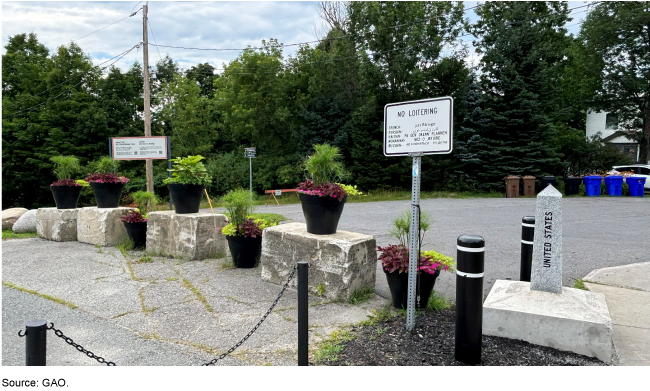
A row of flowerpots atop concrete blocks alongside a small stone obelisk marker that says "United States"
Highlights
Why This Matters
The Department of Homeland Security’s (DHS) U.S. Customs and Border Protection (CBP) has primary responsibility for securing the 4,000-mile border between the United States and Canada. Border Patrol, within CBP, reported that apprehensions in this region more than tripled from fiscal year 2019 through fiscal year 2024. As we reported in 2024, the agency has not met agent staffing targets in recent years.
GAO Key Takeaways
Border Patrol’s efforts to secure our nation’s borders include apprehending people suspected of illicit activity such as entry without inspection and drug smuggling.
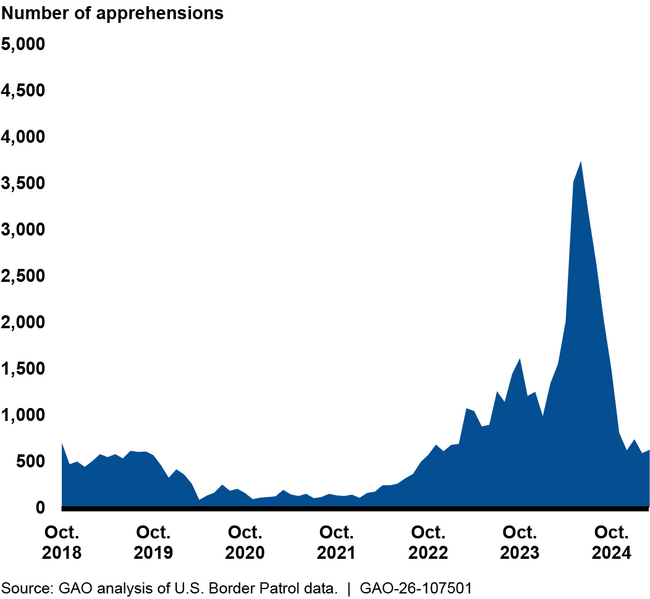
Apprehensions and drug seizures. From fiscal year 2023 to 2024, the number of people Border Patrol apprehended along the northern border increased sharply (see fig.). From fiscal year 2019 through fiscal year 2024, the number of Border Patrol’s drug seizures in this region varied.
Technology. CBP uses aircraft, vessels, and surveillance technology—such as cameras, radar sites, and sensors—as part of its efforts to secure the northern border. From fiscal year 2019 through fiscal year 2024, CBP’s deployment of this technology increased.
Staffing. In this same 5-year period, the number of agents staffed along the northern border decreased, but CBP has initiatives underway to address this issue. In addition, there was a decrease in the staffing rate for Law Enforcement Information Systems Specialists who monitor surveillance technology. The staffing rate for this key position along the northern border has been below its target, and the agency does not have a plan with strategies to address the staffing gap. Developing such a plan could help Border Patrol better carry out its responsibility to secure the northern border.
Border Patrol Apprehensions Along the Northern Border from Fiscal Year 2019 Through the First Half of Fiscal Year 2025
How GAO Did This Study
We analyzed Border Patrol data on apprehensions and drug seizures, as well as CBP data on staffing and resources since fiscal year 2019. We visited six CBP units along the northern border, selected based on apprehension levels, among other factors. We also interviewed CBP officials from the other units along the northern border.
Recommendations
We recommend that CBP develop and implement a plan with strategies to address workforce gaps in the Law Enforcement Information Systems Specialist position. DHS concurred with the recommendation.
Recommendations for Executive Action
| Agency Affected | Recommendation | Status |
|---|---|---|
| United States Customs and Border Protection | The Commissioner of CBP should develop and implement a plan with strategies for addressing workforce gaps in the Law Enforcement Information Systems Specialist position. |
DHS agreed with this recommendation. In July 2026, DHS reported that U.S. Border Patrol's Human Capital and Training Division continues to collaborate with CBP's Human Resources Management to establish a path forward for hiring additional Law Enforcement Information Systems Specialist positions. According to DHS, this includes developing a retention incentive package to encourage Law Enforcement Information Systems Specialist personnel to remain for a defined service period. It also includes developing a recruitment incentive program to increase applicant competitiveness. We requested additional documentation on these planned actions. As of August 2026, CBP notified us there was nothing additional to provide. DHS provided an estimated completion date of January 29, 2027, for the planned actions. We will continue to monitor Border Patrol's actions in response to this recommendation.
|