
Defense Budget: DOD Should Address All Statutory Elements for Unfunded Priorities
Fast Facts
Certain DOD components are required by law to communicate to Congress about "unfunded priorities" that were not included in the President's annual budget request.
Our review found that 18 DOD components submitted a total of $134 billion in unfunded priorities above the President's budget request for fiscal years 2020-2025. During that timeframe, the annual amount grew from $14.7 billion to $30 billion.
Five components also left out information required by law in their submissions that Congress needs to inform its decisions and address DOD's budget needs for the fiscal year.
Our recommendations address these omissions and more.
Unfunded Priorities Include Items Such as Additional Aircraft
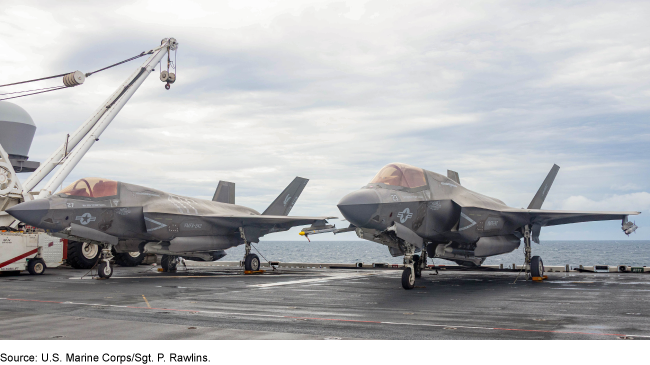
Two small, single-seat aircraft aboard an aircraft carrier at sea
Highlights
What GAO Found
Department of Defense (DOD) components submitted unfunded priorities to Congress totaling $134 billion from fiscal year 2020 through fiscal year 2025, an increase of 73 percent over the time frame when adjusted for inflation, according to GAO's analysis. These DOD components include the military services, the combatant commands, the National Guard Bureau and the Missile Defense Agency. For example, during the 6-year period, the military services identified $91.8 billion, which comprised 69 percent of the total amount for unfunded priorities. Of that, the Navy identified the most funding overall, $27 billion, largely for aircraft procurement and ship building. In fiscal year 2025, combatant commands identified the most for unfunded priorities, with U.S. Indo-Pacific Command having the largest amount of $11 billion.
Amounts Submitted for Unfunded Priorities by DOD Component Type, Fiscal Years 2020–2025
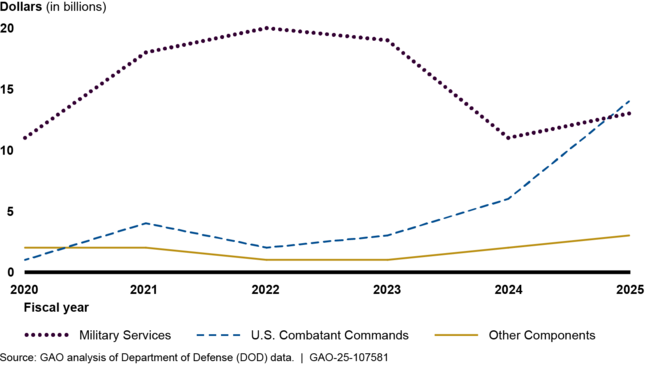
Note: The other components from DOD include the National Guard Bureau and the Missile Defense Agency. Amounts are not adjusted for inflation.
Selected DOD components inconsistently addressed required statutory reporting elements and used different methodologies to prioritize and report their fiscal year 2025 submissions for unfunded priorities, according to GAO analysis. Six of the 11 DOD components GAO reviewed addressed all required statutory elements in their submissions to Congress. However, five did not do so, leaving out information on appropriation accounts and the reason why the recommended funding was not in the President's budget request. GAO also found the statute is unclear on how unfunded priorities should be prioritized, which led to variation in the submissions reviewed. Without revising the statute to clarify how DOD should prioritize and report unfunded priorities to Congress, and without DOD components addressing all statutory elements, Congress may not have critical input to make informed funding decisions when assessing how to best address DOD's readiness and warfighter needs for the fiscal year.
Why GAO Did This Study
Specific DOD components are required by law to annually submit lists of unfunded priorities to Congress within 10 days of release of the President's budget request. Unfunded priority lists include billions of dollars' worth of additional military needs not included in the President's budget request, such as aircraft and military construction.
Senate Report 118-58 included a provision for GAO to review how specific DOD components develop unfunded priority lists. This report examines how amounts for unfunded priorities changed over time and the extent to which selected DOD components addressed statutory elements in the fiscal year 2025 submissions for unfunded priorities, among other objectives.
GAO reviewed the 87 unfunded priority lists submitted to Congress between fiscal years 2020 and 2025 by all 18 DOD components required to do so. GAO also reviewed associated budget documentation. GAO selected a mix of 11 DOD components, varying by type, to assess whether their respective fiscal year 2025 unfunded priority lists addressed statutory elements.
Recommendations
GAO recommends that Congress consider revising 10 U.S.C. § 222a to clarify how unfunded priorities should be prioritized. GAO is also making five recommendations to DOD to ensure that all statutory elements are addressed in future submissions. DOD concurred with four recommendations and did not concur with one. GAO continues to believe that this recommendation is warranted, as discussed in the report.
Matter for Congressional Consideration
| Matter | Status | Comments |
|---|---|---|
| Congress should consider revising 10 U.S.C. § 222a to clarify how designated DOD components should present their prioritization of unfunded priority lists. (Matter for Consideration 1) | As of February 2026, we are continuing to monitor Congressional actions that may address this matter. |
Recommendations for Executive Action
| Agency Affected | Recommendation | Status |
|---|---|---|
| Department of Defense | The Commander of U.S. Northern Command should take steps to ensure that all information required by 10 U.S.C. § 222a, particularly identifying and including appropriation account information, is included in future UPL submissions. (Recommendation 1) |
U.S. Northern Command concurred with the recommendation that it should take steps to ensure all information required by 10 U.S.C. § 222a, particularly identifying and including appropriation account information, is included in future UPL submissions. In follow-up documentation provided by the Department of Defense, U.S. Northern Command indicated that it would conduct a line-by-line review of current statutory elements to ensure compliance in its future unfunded priority lists. We will continue to follow-up with the command.
|
| Department of Defense | The Secretary of the Army should take steps to ensure that all information required by 10 U.S.C. § 222a, particularly the reason why an unfunded priority is not included in the budget request of the President and the effect of funding a priority on the FYDP, is included in future UPL submissions. (Recommendation 2) |
The Army concurred with the recommendation that it should ensure all information required by 10. U.S.C. § 222a, particularly the reason why an unfunded priority is not included in the budget request of the President and the effect of funding a priority on the FYDP, is included in future unfunded priority list submissions. In follow-up documentation provided by the Department of Defense, the Army indicated that it is implementing enhancements to its Unfunded Priorities Portal to include the statutory requirements as mandatory fields and capture the information for future unfunded priory list submissions. We will continue to follow up with the Army.
|
| Department of Defense | The Commander of U.S. Indo-Pacific Command should take steps to ensure that all information required by 10 U.S.C. § 222a, particularly the reason why an unfunded priority is not included in the budget request of the President and the effect of funding a priority on the FYDP, is included in future UPL submissions. (Recommendation 3) |
U.S. Indo-Pacific Command concurred with the recommendation that it should take steps to ensure that all information required by 10 U.S.C. § 222a, particularly the reason why an unfunded priority is not included in the budget request of the President and the effect of funding a priority on the future years defense plane is included in future unfunded priority list submissions. In follow-up documentation provided by the Department of Defense, U.S. Indo-Pacific Command indicated that it would take information contained in its Independent Assessment of the Pacific Deterrence Initiative and refine it to its Unfunded Priority List. We will continue to follow up with the command.
|
| Department of Defense | The Chief of the National Guard Bureau should take steps to ensure that all information required by 10 U.S.C. § 222a, particularly the reason why an unfunded priority is not included in the budget request of the President and the effect of funding a priority on the FYDP, is included in future UPL submissions. (Recommendation 4) |
The National Guard Bureau concurred with the recommendation that it should take steps to ensure that all information required by 10 U.S.C. § 222a, particularly the reason why an unfunded priority is not included in the budget request of the President and the effect of funding a priority on the future years defense plan, is included in future unfunded priority list submissions. In follow-up documentation provided by the Department of Defense, the National Guard Bureau indicated that it had updated its unfunded priority list template to include all statutory elements. We will continue to follow-up with the National Guard Bureau.
|
| Department of Defense | The Commander of U.S. Special Operations Command should take steps to ensure that all information required by 10 U.S.C. § 222a, particularly the reason why an unfunded priority is not included in the budget request of the President and the effect of funding a priority on the FYDP, is included in future UPL submissions. (Recommendation 5) |
U.S. Special Operations Command initially non-concurred with the recommendation that it take steps to ensure that all information required by 10 U.S.C. § 222a, particularly the reason why an unfunded priority is not included in the budget request of the President and the effect of funding a priority on the future years defense plan. In follow-up documentation provided by the Department of Defense, the command changed its position to "concur" and indicated that it had updated its unfunded priority list questionnaire for military construction projects to include a question asking why the project was not included in the budget of the President. We will continue to follow up with the command.
|