
VA Disability Benefits: Additional Oversight and Information Could Improve Quality of Contracted Exams for Veterans
Fast Facts
The Department of Veterans Affairs may require veterans filing disability claims to undergo medical exams, which are often conducted by contractors.
VA uses veteran feedback and other data to oversee the quality of the exams but could do more. For example, VA doesn’t collect feedback directly from contracted examiners—missing a key perspective to help identify exam quality issues.
Also, VA awards financial incentives based on contractor performance. But because VA made mistakes when it manually entered data used to calculate incentives, it overpaid contractors by more than $2 million in FY 2024. Our recommendations address these issues and more.

Person in a lab coat sitting at a desk with the American flag and writing down information.
Highlights
What GAO Found
The Department of Veterans Affairs (VA) relies on contracted examiners to provide most medical exams for veterans filing disability claims. VA’s Medical Disability Examination Office (MDEO) oversees contracted exams. MDEO uses exam error data to identify quality concerns but miscalculated certain payments intended to incentivize high-quality exams.
Error data. Each quarter, MDEO uses data on contracted exam errors to identify trends and improve exam quality. For instance, MDEO provides contractors with information on the exam types more likely to lead to errors, which contractors use to develop an action plan to prevent these exam errors.
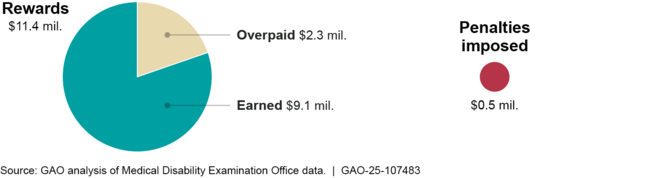
Financial incentives. MDEO also uses its exam error data to calculate financial incentives (rewards and penalties) based on contractor performance. However, it does not have written procedures for verifying the accuracy of these calculations. As a result, MDEO incorrectly paid over $2 million in incentives in the first quarter of fiscal year 2024 (see figure). Until MDEO develops and uses procedures to validate these calculations, it risks wasting funds on incorrect payments.
Incentives Paid for Contracted Disability Exams, Fiscal Year 2024, Quarter 1
MDEO uses other key information, such as Special Focused Review findings and stakeholder feedback, to improve exam quality—but its efforts are incomplete.
Special Focused Reviews. MDEO uses Special Focused Reviews to address exam quality issues. However, MDEO has not met its schedule for reviewing exams for complex claims (i.e., traumatic brain injury, military sexual trauma, and Gulf War Illness), which are more likely to result in errors. Reviews for each complex claim type are either overdue--by 9 months as of July 2025--or not yet scheduled, contrary to MDEO procedures that reviews happen every other year. This schedule helps MDEO monitor changes in exam quality and assess the effect of prior recommendations. Completing the reviews as scheduled would improve MDEO’s ability to oversee the quality of these higher-risk exams.
Stakeholder feedback. MDEO collects feedback on exam quality directly from stakeholders, such as veterans and contractor officials, but not from examiners. MDEO relies on contractors to relay examiner feedback, but contractors said they rarely elevate this feedback to MDEO. Further, examiners said there are issues that they would prefer to raise directly to MDEO because of conflicting or unhelpful responses from the contractors. Collecting feedback directly from examiners could improve MDEO’s awareness of potential quality challenges and help improve decisions on disability claims.
Why GAO Did This Study
Disability exams are a critical source of evidence for determining veterans’ eligibility for compensation for service-connected disabilities. In fiscal year 2024, contractors conducted over 3 million disability exams at a cost of over $5 billion, according to MDEO officials.
GAO was asked to review MDEO’s oversight of contracted exams. This report examines the extent to which MDEO uses exam data and other key information to improve exam quality.
GAO reviewed MDEO documents, such as policies and reports, and the most recent MDEO data on financial incentive calculations (April 2023 through September 2024). GAO compared MDEO’s efforts to MDEO procedures, GAO practices for evidence-based decision making, and federal standards for internal control. Additionally, GAO held two discussion groups with claims processors selected for variation in location and duties and grouped by years of experience. GAO also interviewed MDEO officials and six examiners selected for variation in the contractors they worked for, medical specialty, and years of experience.
Recommendations
GAO is making four recommendations, including that MDEO develop and use written procedures for validating financial incentive calculations, complete Special Focused Reviews for complex claims biennially, and identify and use a mechanism to collect and address direct feedback on exam quality from examiners.
VA concurred with three recommendations and concurred in principle with the recommendation on completing Special Focused Reviews. GAO continues to believe this recommendation is warranted, as discussed in the report.
Recommendations for Executive Action
| Agency Affected | Recommendation | Status |
|---|---|---|
| Department of Veterans Affairs | The Secretary of VA should ensure that MDEO develops and uses written procedures to validate the accuracy of its financial incentive calculations, including data entry and scoring of performance measures. (Recommendation 1) |
VA agreed with this recommendation and has addressed it. In September 2025, MDEO officials finalized new standard operating procedures for calculating and validating financial incentives. Under the new procedures, MDEO has partially automated the calculations, using a spreadsheet with locked formulas to apply the appropriate thresholds to the performance data. There is still some manual data entry, but the procedures call for a redundant process wherein managers use a separate automated spreadsheet to recalculate and verify all incentives before finalization.
|
| Department of Veterans Affairs | The Secretary of VA should ensure that MDEO recalculates all financial incentives since 2022 and documents and corrects any inaccurate penalties and payments. (Recommendation 2) |
VA agreed with this recommendation and stated that MDEO will recalculate all financial incentives since 2022 and document and correct any inaccurate penalties and payments. In September 2025, MDEO officials told us they had recalculated all financial incentives since 2022. A VA official further stated in a November 2025 congressional testimony that the overpayments we identified had been recouped and the recalculations had found no additional overpayments. When we receive documentation of the recalculations and corrections of inaccurate payments and penalties, we will be able to close this recommendation.
|
| Department of Veterans Affairs | The Secretary of VA should ensure that MDEO conducts Special Focused Reviews of contracted exams for complex claims (traumatic brain injury, military sexual trauma, and Gulf War Illness) on a biennial basis, in accordance with its procedures. (Recommendation 3) |
VA agreed with this recommendation in principle and has taken some steps to address it. In September 2025, VBA updated its procedures for performing Special Focused Reviews of contracted exams for complex claims, changing the frequency of reviews for each claim type from every other year to every 3 years. In other words, MDEO will now perform a review for one of the three complex claim types every year, rather than performing reviews for two claim types in some years. VBA stated that this change was made due to resource constraints at MDEO. Given this, a 3-year cycle may help MDEO conduct SFRs consistently, which is preferable to erratic reviews or halting them altogether. VBA added that the additional time between reviews further ensures that the changes resulting from a review for a given claim type will take place before the next review for that claim type is completed. MDEO completed its first review under this new timeframe-for claims related to Military Sexual Trauma in September 2025. We will consider closing this recommendation as MDEO continues to perform these reviews on the 3-year timeframe.
|
| Department of Veterans Affairs | The Secretary of VA should ensure that MDEO identifies and uses a mechanism to collect and address direct feedback from examiners on the quality of exams. (Recommendation 4) |
VA agreed with this recommendation and has addressed it. In September 2025, MDEO placed a feedback form on its examiner training website that examiners can email to MDEO. The form includes optional fields for examiners to identify themselves and an open text field for comments. MDEO notified examiners via a direct email, asked contractors to notify their examiners about the form, placed an announcement on the home page of the training site, and made the form searchable on the site. MDEO also created standard operating procedures detailing how MDEO staff handle incoming feedback forms, including distributing them to appropriate MDEO offices, tracking completion, and documenting how the feedback was addressed.
|