
Coast Guard: Actions Needed to Address Cutter Maintenance and Workforce Challenges
Fast Facts
To ensure the safety and security of the U.S. coastline and inland waterways, the Coast Guard relies heavily on a fleet of 241 cutters—vessels 65 feet or greater in length with accommodations for crew to live on board.
Due to deferred maintenance and challenges obtaining essential parts, the aging cutter fleet is becoming increasingly unavailable for missions as equipment fails.
To make up for these issues, the Coast Guard cannibalizes parts from working cutters and often deploys overworked and understaffed crews.
We recommended fully assessing and addressing how these challenges affect the cutter fleet and workforce.
Highlights
What GAO Found
The U.S. Coast Guard faces increasing challenges operating and maintaining its fleet of 241 cutters—vessels 65 feet or greater in length with accommodations for crew to live on board. Since fiscal year 2019, the cutter fleet's availability to conduct missions generally declined due, in part, to increasing equipment failures. Across the cutter fleet, the number of instances of serious cutter maintenance issues increased by 21 percent from 3,134 in fiscal year 2018 to 3,782 in fiscal year 2023. As a result, more cutters are operating in a degraded state and at an increased risk of further maintenance issues.
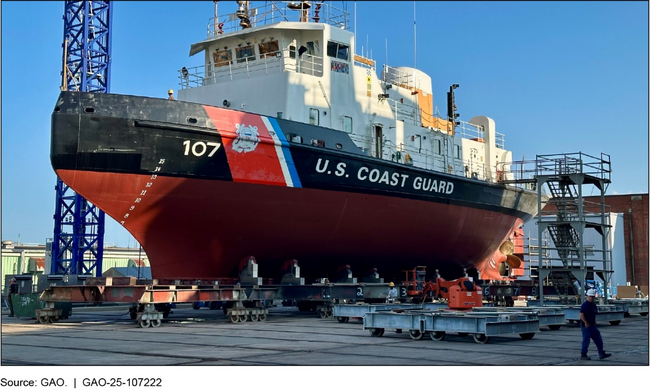
Coast Guard Cutter Penobscot Bay at a Major Repair Facility in Baltimore, Maryland
Two maintenance challenges that are particularly impactful are increasing deferred maintenance and delays in obtaining obsolete parts. In fiscal year 2024, the Coast Guard deferred $179 million in cutter maintenance, almost nine times the amount deferred in 2019 (based on inflation-adjusted values). Due to delays in receiving critical parts needed for repairs, the Coast Guard cannibalizes cutters by moving working parts between cutters. The Coast Guard lacks complete information to address the impacts of these challenges. Systematically collecting data on, and assessing, deferred maintenance and parts obsolescence could enable the Coast Guard to better prioritize projects and funding.
The Coast Guard has not fully addressed the impacts of personnel shortages that are a major challenge to operating and maintaining the cutter fleet. Cutter crew and support positions are short staffed, with vacancy rates increasing from about 5 percent in fiscal year 2017 to about 13 percent in fiscal year 2024. Cutter personnel workload has increased to meet mission demands and cutters often deploy without a full crew, which the Coast Guard does not account for in its staffing data. Regularly collecting and assessing data on staff availability could help ensure the Coast Guard is fully considering the workload faced by cutter crews and support personnel when making decisions on personnel assignments.
Why GAO Did This Study
The Coast Guard, a multi-mission military service within the Department of Homeland Security (DHS), is responsible for ensuring the safety, security, and stewardship of more than 100,000 miles of U.S. coastline and inland waterways. It relies heavily on its cutter fleet to meet these mission demands. In 2012, GAO reported that the Coast Guard's legacy cutters were approaching, or had exceeded, their expected service lives and that their physical condition was generally poor.
GAO was asked to review how the cutter fleet has changed since 2012. This report examines, among other things, the Coast Guard's (1) challenges in operating and maintaining its cutter fleet, and (2) the extent it has determined its cutter-related workforce needs.
GAO analyzed available Coast Guard documentation and data for the period 2012-2024 on types of cutters, cutter availability, and cutter usage time. GAO also conducted site visits to observe facility operations and interviewed Coast Guard officials, including maintenance officials and cutter crews representing a mix of cutter types and geographic locations.
Recommendations
GAO is making five recommendations, including that the Coast Guard collect and assess data on (1) the impact of deferred maintenance on cutter equipment failures and which parts and systems are or will become obsolete; and (2) staff availability for the cutter workforce. DHS agreed with four of the recommendations but did not agree to analyze staff availability data. GAO continues to believe this would help inform personnel assignments.
Recommendations for Executive Action
| Agency Affected | Recommendation | Status |
|---|---|---|
| United States Coast Guard | The Commandant of the Coast Guard should systematically collect and assess data on instances where previously deferred maintenance may have caused cutter equipment failures and develop mitigation strategies as appropriate. (Recommendation 1) |
In June 2025, we reported that deferred maintenance is a major challenge that negatively impacts the availability and capacity of the cutter fleet and is a compounding problem that poses a long-term risk to Coast Guard mission execution. However, we found that the Coast Guard does not systematically collect or assess data on deferred maintenance. We recommended that the Coast Guard should systematically collect and assess data on instances where previously deferred maintenance may have caused cutter equipment failures and develop mitigation strategies as appropriate. DHS agreed with this recommendation and described steps the Coast Guard plans to take to improve processes to document, develop, and validate the efficacy of a new maintenance-related metric by cutter and cutter class, which will be used to develop the recommended assessment. Coast Guard estimates completing these efforts by end-June 2027. We will continue to monitor the status of this recommendation.
|
| United States Coast Guard | The Commandant of the Coast Guard should complete Ship Structure and Machinery Evaluation Boards for all cutter types at the intervals prescribed by policy. (Recommendation 2) |
In June 2025, we reported that Coast Guard policy is to use Ship Structure and Machinery Evaluation Boards to assess obsolete parts and systems on some specific cutter types and that these assessments are the primary source of information on the condition and remaining service life of a cutter type. However, we found that the Coast Guard has completed these assessments for three out of 22 types of cutters since 2020. We recommended that the Coast Guard should complete Ship Structure and Machinery Evaluation Boards for all cutter types at the intervals prescribed by policy. DHS agreed with this recommendation and described Coast Guard plans to update relevant policy on completing these assessments for all cutter types. Coast Guard estimates completing these efforts by end-September 2027. We will continue to monitor the status of this recommendation.
|
| United States Coast Guard | The Commandant of the Coast Guard should systematically collect and assess data on which parts and systems across the cutter fleet are or will become obsolete and develop mitigation strategies as appropriate. (Recommendation 3) |
In June 2025, we reported that, in addition to not having information on what parts and systems are or will become obsolete for specific cutter types, the Coast Guard has also not determined the extent of obsolescence across the cutter fleet. We recommended that the Coast Guard should systematically collect and assess data on which parts and systems across the cutter fleet are or will become obsolete and develop mitigation strategies as appropriate. DHS agreed with this recommendation. In a February 2026 update, Coast Guard stated that a supply chain resilience contract was awarded (in October 2025) to evaluate tools, techniques, and databases for monitoring obsolescence within the supply chain. Utilizing this contract award, part manufacturing data will be aggregated to both a system- and ship-level to understand risks. Coast Guard estimated completing these efforts by end-March 2026. As of April 2026, DHS was subject to a lapse in appropriations that began February 14, 2026. We plan to follow up with DHS after the lapse has concluded.
|
| United States Coast Guard | The Commandant of the Coast Guard should systematically collect and assess data on cutter days lost due to unplanned maintenance issues. (Recommendation 4) |
In June 2025, we reported that the Coast Guard does not track the mission time lost when a cutter cannot accomplish scheduled, required tasks due to unplanned maintenance issues such as equipment failures. We recommended that the Coast Guard should systematically collect and assess data on cutter days lost due to unplanned maintenance issues. DHS agreed with this recommendation and stated that the Coast Guard will (1) formally direct operational commanders at the Area and District level to systematically collect and report cutter days lost due to unplanned maintenance, and, (2) once six months of data are available, complete the first assessment of the data and determine any additional actions. Coast Guard estimated completing these efforts by end-March 2026. As of April 2026, DHS was subject to a lapse in appropriations that began February 14, 2026. We plan to follow up with DHS after the lapse has concluded.
|
| United States Coast Guard | The Commandant of the Coast Guard should regularly collect and analyze data on staff availability for cutter crew and support personnel positions, including which cutter workforce positions are temporarily empty across the cutter fleet, and use this information to inform personnel assignments. (Recommendation 5) |
In June 2025, we reported that cutter personnel shortages are a major challenge to operating and maintaining the cutter fleet and that vacancy rates for both cutter crews and support positions have increased over time. However, we found that the Coast Guard does not collect detailed data to track whether cutter workforce positions are temporarily empty when individual crew members are unavailable, which limits the ability of Coast Guard leadership to fully understand the extent of cutter workforce gaps. We recommended that the Coast Guard should regularly collect and analyze data on staff availability for cutter crew and support personnel positions, including which cutter workforce positions are temporarily empty across the cutter fleet, and use this information to inform personnel assignments. DHS did not agree with this recommendation and stated that the Coast Guard tracks unit vacancies using a "Direct Access" tool and fills them through its standard assignment process and timelines. In a February 2026 update, Coast Guard stated that temporary vacancies are monitored and managed by unit-level commanders who have real-time visibility into staff availability and operational risk. When a temporary vacancy has the potential to impact cutter operations, units are required to elevate those concerns through their operational chain of command and, when appropriate, request support through the established surge staffing process. Coast Guard also provided additional information on how staffing data are (1) analyzed using existing workforce and readiness oversight mechanisms and (2) used by program managers and operational commanders to assess the effects of personnel gaps on cutter workload and mission execution and to inform broader workforce planning. We are currently assessing this additional information. As of April 2026, DHS was subject to a lapse in appropriations that began February 14, 2026. We plan to follow up with DHS after the lapse has concluded.
|