
Washington Metropolitan Area Transit Authority: Actions Needed to Safeguard Inspector General Independence and Evaluate Capital Investment Outcomes
Fast Facts
Nearly 760,000 trips are made each weekday using Washington, D.C.'s Metro rail and bus system. In recent years, Metro's operations have come under scrutiny.
Metro's Office of Inspector General is supposed to provide independent oversight of its operations, but we found some threats to that independence. For example, Metro's board doesn't have procedures to remove an IG—meaning an IG could be terminated for any reason. This may lead IGs to fear reprisal for issuing reports that are critical of the agency.
Our recommendations address this and other issues.

Highlights
What GAO Found
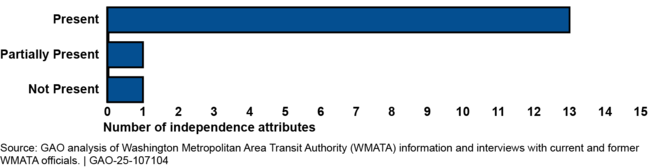
GAO identified 15 key attributes that help ensure the independence of Offices of Inspectors General (OIG). Most (13) of these attributes were present at the Washington Metropolitan Area Transit Authority's (WMATA) OIG, including the authority to audit and investigate, issue subpoenas, and develop the OIG's budget. In addition, WMATA has taken actions to carry out the reforms to WMATA's OIG contained in the Infrastructure Investment and Jobs Act (IIJA), including delegating human resources and procurement authorities to the OIG.
Of the remaining two key attributes of OIG independence, one was not present at WMATA's OIG and one was partially present.
- Not present: WMATA's Board of Directors (Board) does not have procedures in place for the removal of an Inspector General (IG), such as advance notice to Congress of a planned removal. Without established removal procedures, an IG may fear termination in response to issuing critical reporting.
- Partially present: The OIG has limited ability to communicate with Congress because the Board has not established a policy that the IG may communicate with Congress at the IG's discretion. Former WMATA IGs and OIG officials told GAO the Board and management discouraged the IG from communicating with Congress both privately and in public settings, such as hearings. Board officials told GAO the Board has never prevented the IG from communicating with Congress. Without a policy specifying that the IG may communicate with Congress at the IG's discretion, the OIG will not have assurance that it can inform Congress and respond to Congress's needs.
Presence of GAO-Identified Attributes of Independence at WMATA's Office of the Inspector General
The IIJA also contained provisions for WMATA to implement performance measures to assess the effectiveness and outcomes of major capital projects. In 2022, WMATA created a pilot program to measure capital investment outcomes. This program fully met two of five leading practices for the design of pilot programs. This program partially met or did not meet the three remaining leading practices related to 1) a data gathering strategy, 2) criteria to identify lessons learned and inform decisions about scalability, and 3) a data analysis plan to track program performance and evaluate final results. While WMATA is not required to follow these leading practices, adopting them could help WMATA assess whether the pilot program is achieving its objective of measuring the outcomes of capital investments.
Why GAO Did This Study
WMATA serves a critical function in the national capital region. Its rail and bus system connects residents and visitors to jobs, housing, and essential services. In recent years, WMATA's operations have come under scrutiny, raising the importance of WMATA's oversight.
The IIJA includes a provision for GAO to report on the implementation of reforms to WMATA's OIG and capital planning process. This report examines (1) how WMATA OIG's independence compares to key attributes of an independent OIG, and (2) the extent to which WMATA implemented the IIJA's requirement to develop performance outcome measures for WMATA's capital investments, among other objectives.
GAO reviewed WMATA documents and compared WMATA's OIG to attributes of an independent OIG identified by GAO based on the Inspector General Act of 1978, as amended, and other information. GAO assessed WMATA's pilot program to measure capital investment outcomes against GAO's leading practices.
Recommendations
GAO is making three recommendations to WMATA, that (1) the Board develop procedures for IG removal, (2) the Board develop a policy to ensure the IG's direct communication with Congress, and (3) the WMATA General Manager adopt leading practices to assess its measurement of capital investment outcomes. WMATA neither agreed nor disagreed with GAO's recommendations, but identified actions it plans to take. GAO stands by its recommendations.
Recommendations for Executive Action
| Agency Affected | Recommendation | Status |
|---|---|---|
| Other | The WMATA Board Chair should work with the Board members to develop formal procedures for the removal of an IG that include a Board vote and advance notification of Congress, for example by providing Congress with the Board's rationale for removing the IG 30 days in advance. (Recommendation 1) |
As of September 2026, the WMATA Board has partially addressed this recommendation. In responses to our questions, the Board provided GAO with a memo that clarified the procedures that apply for the removal of an IG under WMATA's Interstate Compact. According to the Board, action to appoint or remove the IG requires a quorum and a majority of the Board present and voting. That majority shall include at least one Director or alternate from each signatory jurisdiction of the Interstate Compact, representing the District of Columbia, Maryland, and Virginia. The Board also stated that an action to appoint or remove the IG is subject to a jurisdictional veto as set forth in the Interstate Compact. GAO discussed these procedures with the WMATA IG and she corroborated that these procedures are her understanding of the process for her removal. However, these actions do not fully address GAO's recommendation for two reasons. First, they do not require a rationale for the IG's removal, as called for in GAO's recommendation. Specifically, WMATA's Interstate Compact states that WMATA officers, which include the IG "shall be appointed and may be removed by the Board, shall serve at the pleasure of Board and shall perform such duties and functions as the Board shall specify." Second, WMATA's procedures do not include a mechanism to provide advance notification of Congress prior to the removal, as GAO recommended. We will continue to monitor the WMATA Board's progress in addressing this recommendation.
|
| Other | The WMATA Board Chair should work with the Board members to establish a policy providing that the IG may communicate directly with Congress about findings and recommendations from the OIG's work, at the IG's discretion. This would include communication with committees, subcommittees, members, and staff. (Recommendation 2) |
In 2026, GAO confirmed that the Board had established such a policy statement. In July 2026, Board members voted to include a statement on the Board's website stating that the Board's Executive Committee oversees internal and external audits, while enabling the IG to directly communicate with Congress, its committees, subcommittees, members, and staff, about findings and recommendations from the OIG, at the IG's discretion. Board officials stated that any change to this statement on the website, including its removal, would require a subsequent Board vote. GAO corroborated the Board's action by confirming that its statement had been added to the website. Furthermore, the WMATA IG told GAO that since the beginning of her tenure in June 2024, Board members have consistently told her that she may communicate directly with Congress or any jurisdiction at her discretion and that she has never been restricted from doing so. As a result of these actions, the Board has enhanced the independence of the IG and Congress has greater assurance that it will be able to receive independent information from the IG to inform its decision making.
|
| Washington Metropolitan Area Transit Authority | The General Manager of WMATA should adopt leading practices for the Capital Investment Performance Outcome Measurement Program. This includes (1) preparing and implementing an evaluation plan that clearly articulates an assessment methodology and data gathering strategy for all components of the program, (2) identifying criteria and standards to inform decisions about scalability, and (3) preparing and implementing a data analysis plan to track program progress and facilitate evaluation of final results of the program. (Recommendation 3) |
In June 2026, WMATA provided GAO with documentation demonstrating that it adopted these leading practices. Specifically, WMATA developed a report outlining its framework for consistently executing the program which includes an evaluation plan for evaluating outcomes of WMATA's capital projects. The report describes: (1) an assessment methodology outlining the annual process for implementing the program, (2) criteria for what projects will be evaluated through the program, including both completed and ongoing projects costing more than $100 million, (3) the roles of WMATA stakeholders, and (4) a strategy for gathering and analyzing quantitative and qualitative data for the projects. The report also includes a data analysis plan to provide a before and after assessment of the projects using performance measures aligning with WMATA strategic goals. The report also includes a plan for a broader evaluation of the program with criteria for assessing the program's effectiveness and gathering lessons learned. In its proposed FY2027 - FY2032 Capital Improvement Program, WMATA published the results of competed evaluations for 19 projects and reoccurring investments, including information on whether the investment achieved its goal or demonstrated improvement in performance. As a result of these actions, WMATA should have the information needed to assess whether its capital investments are achieving their expected outcomes.
|