
Homeland Security: Actions Needed to Address Acquisition Workforce Challenges and Data
Fast Facts
The Department of Homeland Security spends billions of dollars each year to buy goods and services. But recruiting, retaining, and managing the workforce overseeing these procurements is a challenge.
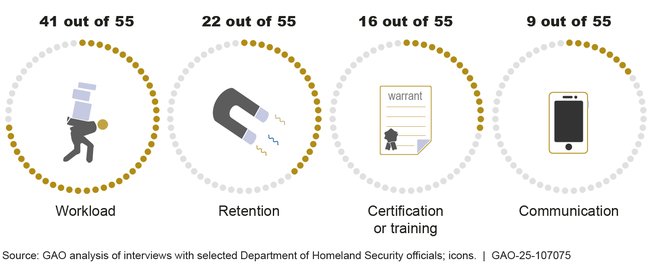
Most DHS acquisition staff we interviewed said that workload was the biggest challenge. For example, some staff had to fill multiple roles because they were short-staffed or other staff lacked adequate experience. And hiring new employees took longer than expected.
DHS is working to resolve its workforce challenges, but doesn't know if its efforts will address staff-identified concerns and issues.
We recommended addressing this and other issues.

Highlights
What GAO Found
The Department of Homeland Security's (DHS) acquisition workforce includes government personnel who oversee procurement and related acquisition functions and activities. This workforce includes three key acquisition positions identified in government-wide policy—program managers, contracting officers, and contracting officer's representatives—in addition to eight other DHS-identified disciplines that support acquisitions.
In interviews with GAO, acquisition staff from four selected DHS components identified various challenges facing the acquisition workforce. GAO found that 41 of the 55 program managers, contracting officers, and contracting officer's representatives that it interviewed identified heavy workload as their most considerable challenge.
Primary Workforce Challenges Identified by 55 Personnel in Key DHS Acquisition Positions
Among acquisition program managers, GAO found that lengthy hiring time frames were also a considerable challenge. Twelve of the 17 program managers that GAO interviewed cited this as a challenge. For context, a fiscal year 2023 DHS report noted that acquisition hiring time frames ranged from 3 to 18 months.
DHS has not evaluated whether it is effectively addressing the challenges that staff identified, such as those related to workload or the lengthy hiring process. GAO found that DHS and its components have implemented a variety of general efforts to mitigate workforce challenges related to hiring, training, and certification. These efforts included programs for career development, mentoring, and training for acquisition leaders. Without evaluating these efforts, DHS lacks reasonable assurance that it is using the most appropriate methods to support its acquisition workforce.
Furthermore, DHS does not have comprehensive data on the size or demographics of its acquisition workforce. DHS entities responsible for the workforce only collect data on certain segments of the acquisition workforce, but have not established a methodology for identifying personnel in the eight other disciplines supporting acquisitions. Without establishing a methodology to identify these personnel and collecting comprehensive data on them, DHS lacks reasonable assurance that its decisions about current and future workforce requirements are based on complete information.
Why GAO Did This Study
Each year, DHS obligates billions of dollars to acquire a wide range of goods and services. Since its inception in 2003, DHS has confronted numerous challenges related to recruiting, retaining, and managing its acquisition workforce.
GAO was asked to review DHS's management of its acquisition workforce. This report examines, among other things, (1) what challenges, if any, the acquisition workforce reported facing, and the extent to which leadership is mitigating these challenges; and (2) the extent to which DHS and selected components have comprehensive data on this workforce to inform decision-making.
GAO selected four DHS components based in part on the high value of contract obligations and the number of contracts awarded in fiscal year 2023. These components accounted for about 63 percent of DHS's obligations. GAO randomly selected a nongeneralizable sample of 55 key acquisition staff to interview from these components, and reviewed DHS acquisition program staffing plans and certification data.
Recommendations
GAO is making four recommendations to DHS, including that it assesses whether its mitigation efforts effectively address challenges facing the acquisition workforce, establishes a methodology for identifying personnel in acquisition disciplines, and collects comprehensive data on its acquisition workforce. DHS agreed with one of the recommendations and did not agree with three of them. GAO continues to believe the recommendations are valid, as discussed in the report.
Recommendations for Executive Action
| Agency Affected | Recommendation | Status |
|---|---|---|
| Department of Homeland Security | The Secretary of Homeland Security should ensure that the Under Secretary for Management develops a strategy to assess whether its mitigation efforts are aligned with the challenges facing the acquisition workforce and to monitor results, such as establishing and tracking performance metrics for the efforts it is using to address workforce challenges. (Recommendation 1) |
As of July 2026, DHS officials said they do not plan to take further action to address this recommendation. DHS determined its planned approach, which depended on surveying its acquisition workforce to identify DHS unique challenges, was not permissible based on an Office of Personnel Management (OPM) notice issued in 2025 that directed agencies not to conduct workforce-related surveys without OPM approval. However, as of July 2026, OPM made agencies responsible for administering their own employee surveys and provided official guidance to agencies on designing, administering and reporting survey feedback. We maintain that developing a strategy to assess whether mitigation steps are addressing challenges would provide reasonable assurance that DHS's mitigation efforts are achieving their purpose. Therefore, we believe this recommendation remains valid.
|
| Department of Homeland Security | The Secretary of Homeland Security should ensure that as the Office of Program Accountability and Risk Management continues to refine its staffing model, that it continues to identify and implement greater process efficiencies in its data collection efforts on the workforce supporting major acquisition programs, and works with components to identify what, if any, additional data and resources are needed to meet the model's intended goals, including justifying staffing needs and generating appropriate staff compositions for current and future programs. (Recommendation 2) |
In August 2026, we closed this recommendation as no longer valid because DHS has retired its acquisition workforce staffing model and eliminated the organization charged with developing it (the Program Accountability and Risk Management Office). Prior to retiring the model, DHS had taken some action in response to our recommendation. In June 2025, DHS reported that it aligned staffing data calls and created a new dashboard to display the average number of Full-Time Equivalent personnel required for acquisition tasks to better estimate staffing needs. DHS also reported that it made the newest version of the staffing model available to components in April 2025. However, in accordance with Executive Order 14222-signed in February 2025, DHS conducted a comprehensive review of existing contracts and grants, to ensure alignment with the Administration's priorities of reducing federal spending, promoting efficiency, and delivering measurable outcomes. As part of that review, DHS decided to terminate the contract for the staffing model and retire its acquisition workforce staffing model. DHS documented its decision in an August 2025 memorandum, and it phased out and officially closed the model at the end of fiscal year 2025.
|
| Department of Homeland Security | The Secretary of Homeland Security should ensure that the Under Secretary for Management establishes a methodology for identifying information about the personnel supporting the 11 DHS-defined acquisition disciplines that make up DHS's acquisition workforce. (Recommendation 3) |
DHS did not agree with this recommendation. However, as of July 2026, DHS reported that had taken actions to implement a three-step strategy to improve data quality and oversight. For example, DHS updated its policy for Federal Acquisition Certification in Contracting in February 2025 to direct those with, or seeking the certification to periodically review and update their profiles in Cornerstone OnDemand (CSOD). DHS also convened quarterly Component Acquisition Career Manager Council meetings that, according to DHS, allow it to confirm acquisition workforce role assignments and certification status with stakeholders across the components. DHS officials also said they are using information, including job series, from the Office of Personnel Management's Federal Workforce Data platform and the DHS Office of the Chief Human Capital Officer (OCHCO) to semi-annually correct CSOD records on certification status and whether staff have self identified that they are currently serving in the acquisition workforce. While DHS has taken several steps to improve its acquisition workforce data quality, this methodology focuses on correcting existing data instead of identifying the comprehensive information DHS needs to identify individuals that are more specifically part of its 11 acquisition disciplines. Specifically, since not all the OPM job series map onto DHS's acquisition disciplines DHS cannot be certain based on Cornerstone OnDemand data whether individuals are actually serving in an acquisition discipline or just received training in that discipline. We will continue to assess DHS's efforts.
|
| Department of Homeland Security | The Secretary of Homeland Security should ensure that the Office of the Chief Procurement Officer identifies methods to ensure it maintains comprehensive data across all 11 disciplines that constitute the acquisition workforce, such as identifying additional acquisition workforce data from the components or requiring acquisition personnel to regularly update their records in Cornerstone. (Recommendation 4) |
DHS did not agree with this recommendation. However, as of June 2026, DHS reported taking several steps to ensure it maintains comprehensive acquisition workforce data, including updating its robotic process automation, correcting data against human capital records, and updating the contracting certification policy. DHS employs two bots to review Cornerstone OnDemand profiles to ensure information is accurate and to remove inactive accounts. Since January 2026, the bots have removed more than 4,000 inactive accounts and identified about 1,200 accounts that require corrective action. According to DHS, it uses information, including job series, from the Office of Personnel Management's Federal Workforce Data platform and the DHS Office of the Chief Human Capital Officer (OCHCO) to semi-annually correct CSOD records on certification status and whether staff have self identified that they are currently serving in the acquisition workforce. Finally, DHS updated its policy for Federal Acquisition Certification in Contracting in February 2025 to direct acquisition workforce members to periodically review and update their profiles in Cornerstone OnDemand (CSOD). However, DHS's updates to the Contracting Officer's Representative and Program and Project Manager certifications did not include language directing the workforce to periodically review and update their profiles. We will continue to assess DHS's efforts.
|