
Army Watercraft: Actions Needed to Optimize Small but Critical Fleet
Fast Facts
The U.S. Army's watercraft fleet is designed to carry supplies, vehicles, and people in deep ocean and shallow coastal waters, as well as provide access by water to remote, undeveloped areas.
Demand for Army watercraft is increasing, especially in the Indo-Pacific. However, the fleet has shrunk by about half since 2018. Moreover, the Army has struggled to maintain its watercraft and less than 40% of the fleet can perform its missions.
The Army is working on building new watercraft and setting a strategy to modernize the fleet. However, it hasn't fully analyzed how to meet current and near-term needs. Our 4 recommendations address this issue.
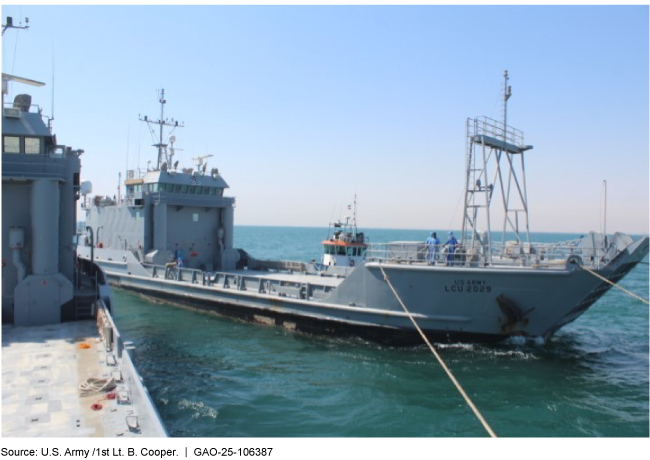
The Army’s Landing Craft Utility can transport 5 Abrams tanks as well as other cargo
Highlights
What GAO Found
The U.S. Army's watercraft fleet is responsible for moving supplies, equipment, and personnel in deep ocean water, shallow coastal waters, inland waterways, and rivers. However, the Army's ability to meet its mission requirements with its fleet of 70 watercraft is limited. Army policy establishes a fully mission capable goal of 90 percent for ground equipment, including watercraft. Fully mission capable means that watercraft are ready and available to perform their missions. However, the fully mission capable rate for watercraft has steadily declined, from 75 percent in 2020 to less than 40 percent thus far in 2024.
Army Watercraft Fleet Average Fully Mission Capable Rate, Fiscal Years 2020-2024

Low mission capable rates hinder the
- ability to meet mission requirements and operational readiness;
- availability of vessels in the fleet, as shown in the figure; and
- ability to conduct training for watercraft personnel.
The Army is drafting a revised watercraft modernization strategy to outline future end states for Army watercraft by 2030 and 2040. However, until the strategy is finalized, it remains unclear whether it will include any mitigation plans to address the current challenges, risks, and gaps affecting the watercraft fleet. Developing a mitigation plan to address challenges will enhance the Army's ability to meet current and near-term mission requirements. In addition, by assessing the costs and benefits of potential options to improve the Army's ability to meet mission requirements, the Army will be able to make better decisions on what actions to implement.
Moreover, the Army has struggled to address a series of longstanding maintenance challenges with its watercraft fleet. Using handwritten systems to manage maintenance has adversely affected the fleet's readiness. For example, as of May 2024, one vessel had been out of service for over 5 years. Army officials reported several factors contributing to significant delays, including maintenance work.
In February 2024, the Army established the Army Watercraft Enterprise Executive Board. The Board has taken steps to provide oversight and coordination of Army-wide watercraft activities. By developing and issuing a governance framework that reflects all leading practices of effective governance, the Army will be better positioned to develop integrated strategies to respond to persistent maintenance challenges.
Why GAO Did This Study
The Army's watercraft fleet provides critical logistical capabilities such as intratheater transportation of personnel and equipment in support of amphibious operations. Army watercraft also provide access to waterways in austere environments where ports and roads are unavailable. As such, this fleet is a key enabler of the joint force, particularly in the Indo-Pacific area of operations.
House Report 117-397, accompanying a bill for the National Defense Authorization Act for Fiscal Year 2023, included a provision for GAO to review Army watercraft. This report assesses the extent to which (1) the Army's watercraft fleet is able to meet current and future mission requirements, and (2) the Army has taken steps to address or mitigate maintenance challenges to its watercraft fleet.
GAO analyzed relevant Army policies, requirements, handbooks, and watercraft information; toured vessels; and interviewed Army and other cognizant officials.
Recommendations
GAO is making four recommendations to the Army, including that it develops a mitigation plan to meet current and near-term requirements, and ensures the Watercraft Board develops a framework that reflects leading practices for effective governance. The Army concurred with all four of GAO's recommendations.
Recommendations for Executive Action
| Agency Affected | Recommendation | Status |
|---|---|---|
| Department of the Army | The Secretary of the Army should ensure that the Deputy Chief of Staff G-3/5/7, in consultation with the Commander, U.S. Indo-Pacific Command and Commander, U.S. Army Pacific Command, develops a mitigation plan addressing challenges to the watercraft fleet, reducing risks, and bridging and mitigating gaps in Army watercraft capability and capacity, to meet current and near-term mission and campaign plan requirements in the Indo-Pacific theater. (Recommendation 1) |
The Army concurred with this recommendation. As of September 2025, the Army states that it is actively pursuing a holistic approach to mitigate the gaps in Army watercraft capability and capacity. According to the Army, it recently activated a Composite Watercraft Company (CWC) in the Pacific. The February 2024 approved Total Army Analysis (TAA) 2025-2029 increased force structure by two more CWCs in FY-27 and FY-29. The Army plans to withdraw an additional seven vessels from APS for activating the CWC in FY27 for the Pacific. The Army Watercraft Modernization Strategy (AWMS) under development, will provide a phased outline for watercraft investment opportunities and priorities for the Army. As of July 2026, the Army has not provided an update on this recommendation.
|
| Department of the Army | The Secretary of the Army should ensure that Headquarters, Department of the Army G-3/5/7 in consultation with Commander, Indo-Pacific Command, and Commander, U.S. Army Pacific Command, assesses the costs and benefits of potential courses of action to improve the ability of Army watercraft to meet current and near-term mission requirements. (Recommendation 2) |
The Army concurred with this recommendation. As of September 2025, the Army states that the Army Watercraft Modernization Strategy (AWMS) serves as the Army road map for relevant Army Watercraft capabilities aligned to concept is driven transformation efforts. This includes improving readiness and shortcomings in the current fleet as a near term solution, while developing and delivering new concepts, platforms, and capabilities that meet current and emerging Army and Joint Force requirements for Multidomain Operations (MDO). According to the Army, AWS should function as part of total intra-theater movement capabilities that includes joint, allied, partner, and potential contracted shipping support. That fleet possesses the key characteristics in terms of capacity, range, speed, survivability, and joint and allied interoperability to support Large Scale Combat Operations across multiple domains while leavening advances in autonomous watercraft and aerial delivery systems. As of July 2026, the Army has not provided an update on this recommendation.
|
| Department of the Army | The Secretary of the Army should ensure that the Army Watercraft Governance Board develops and issues a governance framework that reflects GAO's leading practices for effective governance. (Recommendation 3) |
The Army concurred with this recommendation. As of September 2025, the Army states that its Watercraft Governance forum is a maturing enterprise closely monitored by the Office of the Deputy Chief of Staff, G-3/5/7. According to the Army, the foundation of the governance framework is the three working groups addressing: Modernization, Integration, and Fleet Readiness. These working groups meet routinely and have the flexibility to increase tempo based on the topic sensitives. The Framework also contains deliberate touch points with senior leaders for decision points, and synchronization within Army's deliberate transformation and concept driven transformation efforts. As of July 2026, the Army has not provided an update on this recommendation.
|
| Department of the Army | The Secretary of the Army should ensure that the Army Watercraft Governance Board, in conjunction with other Army stakeholders, take actions to develop integrated strategies that identify, analyze, and respond to persistent maintenance challenges, including significant and unanticipated maintenance delays, fully capturing maintenance data within Army enterprise-wide system, and ensuring that maintenance manuals are issued in a timely manner. (Recommendation 4) |
The Army concurred with this recommendation. As of September 2025, the Army states that the Army Watercraft Governance, working group 3, "The Army Watercraft Fleet Management & Readiness" led by the HQDA G4, synchronizes all key stakeholders to develop options for ASLs approval, modernize all maintenance related functions across the spectrum of options to produce a more resilient Army Watercraft Fleet (AWS). According to the Army, the Watercraft Governance will ensure their actions are synchronized within existing Army processes such as Total Army Analysis (TAA), Senior Leader Readiness Forum (SLRF) and of course the Program Objective Memorandum (POM). As of July 2026, the Army has not provided an update on this recommendation.
|