
Missile Defense: Next Generation Interceptor Program Should Take Steps to Reduce Risk and Improve Efficiency
Fast Facts
The Department of Defense's Missile Defense Agency develops systems to detect attacks and track, intercept, and destroy missiles in flight. Currently, MDA is developing a new system—the Next Generation Interceptor—to defend against complex attacks.
MDA hasn't addressed significant risks with its development of the interceptor. For example, MDA hasn't fully addressed direction from senior DOD officials to ensure the interceptor can respond to evolving threats. The agency is also testing the interceptor with simulations that don't fully represent how it will be used.
We made five recommendations to address these and other issues.
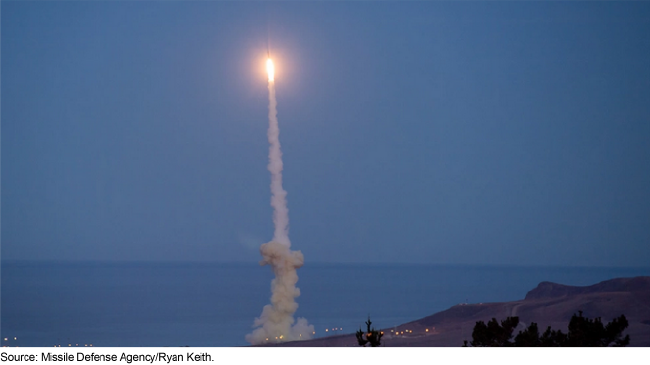
A test missile launch at Vandenberg Space Force Base, California, in December 2023
Highlights
What GAO Found
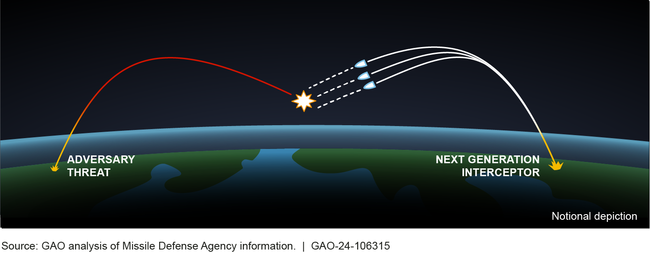
The Missile Defense Agency (MDA) is developing a new system—the Next Generation Interceptor (NGI)—to defend the U.S. against complex missile attacks (see figure). The Department of Defense (DOD) tasked MDA with expediting the system's development and fielding interceptors starting in 2028.
Next Generation Interceptor's Challenging Mission to Defend the U.S.
The NGI program is on track to start product development in 2024 but the program is planning to overlap design and production activities to accelerate flight testing. Any major design issues could disrupt this strategy. Further, the schedule for NGI is already optimistic when compared to development timeframes of similar weapon systems and MDA's history of unmet testing goals, as GAO reported in May 2023 (GAO-23-106011). NGI's costs have also increased by hundreds of millions of dollars, but the program is still within planned funding levels. MDA officials expect further increases due to supply chain issues and rising material costs.
In 2022, DOD's independent review identified multiple high-risk items and actions MDA could take to reduce technical risk. MDA disagreed with key aspects of the risk assessment and, to date, has taken limited steps to mitigate these risks. For example:
- MDA has not fully addressed directions from DOD officials regarding updating NGI's threat-related performance requirements, monitoring and reporting threat changes, and collaborating with stakeholders.
- MDA intends to make key acquisition decisions based on NGI performance simulations that do not fully represent how the warfighter intends to use the system—a necessary step to verify NGI designs are sufficiently mature and will meet performance requirements.
By not addressing these risks in a timely manner, MDA is increasing the potential for later discovering performance shortfalls that could delay the program.
MDA made some initial progress establishing a virtual environment to enable collaboration on NGI development. However, MDA encountered challenges and is not periodically assessing implementation progress, as it had planned. Doing so could help MDA identify potential efficiencies to achieve its fielding deadline.
Why GAO Did This Study
According to DOD, potential adversaries are expanding and enhancing their missile capabilities to attack the U.S., while current U.S. interceptors approach the end of their planned service life. To address this challenge, DOD has stated that it needs to begin fielding the NGI by 2028. To assist in this effort, MDA plans to use virtual tools and software to increase the program's efficiency.
Congress included a provision in statute for MDA to annually report on the status of NGI's development goals, cost, and stakeholder reviews and for GAO to assess NGI's acquisition progress. This report addresses the extent to which MDA (1) made progress in developing NGI, (2) addressed significant NGI technical risks, and (3) implemented a virtual environment to facilitate NGI development.
GAO reviewed DOD documents and independent risk, cost, and test assessments and interviewed DOD officials. GAO conducted site visits to observe construction of NGI's launch facility and key supporting radars.
Recommendations
GAO is making five recommendations to DOD, including to regularly coordinate with stakeholders regarding MDA's threat requirements, ensure performance simulations fully represent the environment NGI is expected to operate in, and periodically assess efforts to implement a virtual environment. DOD agreed with one recommendation but did not agree with the other four. GAO maintains that all of the recommendations are valid, as discussed in this report.
Recommendations for Executive Action
| Agency Affected | Recommendation | Status |
|---|---|---|
| Department of Defense | The Secretary of Defense should task the Under Secretary of Defense for Acquisition and Sustainment with ensuring the Director, MDA regularly coordinates with the intelligence community, joint staff, and combatant commands throughout NGI development to prioritize and, if necessary, update NGI's threat requirements. (Recommendation 1) |
DOD did not concur with our recommendation, stating that MDA regularly coordinates with stakeholders and provides updated threat requirements to its programs. DOD also stated that NGI's existing threat requirements are robust and cover the anticipated threat. After we issued our report, the Under Secretary of Defense (USD) for Acquisition and Sustainment (A&S) directed MDA to provide risk management approaches to address NGI's identified risks. In January 2025, MDA provided a response describing actions it planned to take, including actions associated with NGI's threat requirements. We believe USD(A&S)'s actions meet the intent of our recommendation, and USD(A&S)'s direction and oversight will help DOD stakeholders monitor NGI's development and assess interceptor performance.
|
| Department of Defense | The Secretary of Defense should task the Under Secretary of Defense for Acquisition and Sustainment with ensuring the Director, MDA promptly reports any changes in the threat that may have implications for NGI's threat requirements to appropriate senior DOD leaders, including those on the Missile Defense Executive Board and the Joint Requirements Oversight Council. (Recommendation 2) |
DOD did not concur with our recommendation. DOD stated that, when threat changes are determined by MDA and the intelligence community to be relevant to NGI and exceed the current parametric threat space, such changes already require prompt escalation to DOD senior leadership. However, after we issued our report, the Under Secretary of Defense (USD) for Acquisition and Sustainment (A&S) directed MDA to submit indicators to the intelligence community for monitoring NGI's threat-sensitive key performance requirements. MDA subsequently submitted the threat indicators in early fiscal year 2025. We believe these actions meet the intent of our recommendation and will improve awareness amongst DOD senior leaders of any future changes in the missile threat that may have a significant bearing on NGI's ability to defend the U.S., once fielded.
|
| Department of Defense | The Secretary of Defense should task the Under Secretary of Defense for Acquisition and Sustainment with ensuring the Director, MDA uses models and simulations that fully represent stressing intercept conditions for NGI performance and technology maturation assessments supporting the program's critical design review and key acquisition decisions. (Recommendation 3) |
DOD did not concur with our recommendation. DOD stated that MDA already plans to use high-fidelity models that fully represent stressing intercept conditions to support NGI's critical design review and is currently working toward increasing the fidelity of these models and simulations. After we issued our report, the Under Secretary of Defense (USD) for Acquisition and Sustainment (A&S) directed MDA to provide risk management approaches to address NGI's identified risks. In January 2025, MDA provided a response describing actions it planned to take to address the risks associated with NGI modeling and simulation development. We believe that USD(A&S)'s actions meet the intent of our recommendation and will help improve oversight of MDA's efforts to develop the models and simulations necessary to support NGI development.
|
| Department of Defense | The Director, MDA should develop a plan for budgeting for and expediting the development of all models—including models that represent stressing intercept conditions NGI is expected to encounter—and simulations necessary to support the NGI critical design review and ground testing. (Recommendation 4) |
DOD did not concur with our recommendation. DOD stated that the President's budget for fiscal year 2025 appropriately supports MDA model development, and that MDA will continue to prioritize initiatives in its budget requests in a manner that best positions the agency to carry out its mission. However, the Under Secretary of Defense (USD) for Acquisition and Sustainment (A&S) directed MDA in a September 2024 memorandum to provide various risk mitigations, including some related to models and simulations. In January 2025, MDA provided a response describing actions it planned to take to address the risks associated with NGI modeling and simulation development. Also, MDA's budget submission for fiscal year 2027 included plans for a new cloud-based digital modeling and simulation capability to support near-term NGI integration testing. In addition, MDA roughly tripled the amount of requested funding for modeling and simulation development over the next 5 years, resulting in about a $100 million increase in annual funding over current and previous levels. We believe USD(A&S)'s oversight and MDA's budgetary plan meet the intent of our recommendation and represent a reasonable approach for supporting the development of models and simulations necessary to support NGI development and ground testing.
|
| Department of Defense | The Director, MDA should conduct periodic independent organizational assessments of its efforts for implementing a digital engineering environment for the GMD program to support NGI development and incorporate lessons learned into its implementation plans, as needed. (Recommendation 5) |
DOD concurred with our recommendation and, in April 2025, MDA updated GMD's Digital Engineering Plan to include provisions for conducting annual organizational assessments and implementing lessons learned. Also in 2025, MDA completed an organizational assessment, identified lessons learned, and developed action plans that are documented and monitored by the program in a tracking system. These actions will help ensure MDA is increasing efficiency by prioritizing the most critical user needs as it continues to develop and expand its digital engineering environment. As such, we believe DOD has taken sufficient action to address our recommendation.
|