
IRS Reform: Following Leading Practices and Improving Cost Estimation Policies Could Benefit Agency Efforts
Fast Facts
After years of reductions in funding, Congress provided IRS with tens of billions of dollars to address longstanding tax administration challenges, such as outdated technology.
In 2023, IRS released its Strategic Operating Plan, which includes a high-level vision and transformation objectives. Leading agency reform practices identified in our prior work can help IRS meet its goals.
Following our best practices could help IRS better estimate and manage costs. IRS has a policy for estimating IT project costs, but needs to document a policy for other costs. Our 5 recommendations address these and other issues.
Highlights
What GAO Found
After years of significant declines in Internal Revenue Service (IRS) funding, COVID-19 relief funding in fiscal years (FY) 2020 and 2021 and the Inflation Reduction Act (IRA) of 2022 reversed this trend. Specifically, annual appropriations, adjusted for inflation, declined about 15 percent from $15.6 billion in FY 2012 to $13.2 billion in 2019. Supplemental funding for COVID-19 relief—appropriated in FYs 2020 and 2021, with portions available through FY 2023—was about $3.1 billion. IRS also experienced a 12 percent decline in staff between FY 2012 and 2022 with attrition outpacing new hires. IRS's hiring of enforcement staff has been a particular challenge during this period.
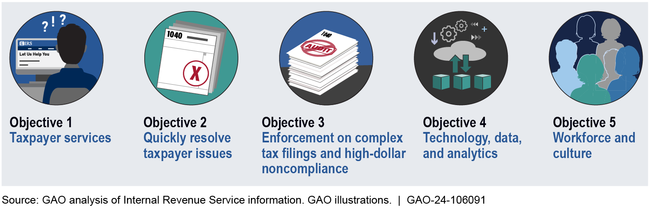
IRA provided tens of billions in funding for IRS through FY 2031. In April 2023, IRS released its IRA Strategic Operating Plan (SOP), which describes a high-level vision and leadership structure for IRA implementation. It also articulates five transformation objectives with specific initiatives and projects.
Figure: Internal Revenue Service's Inflation Reduction Act Transformation Objectives
In prior work, GAO identified leading practices for agency reforms, such as those that IRS is undertaking. IRS officials indicated they have, or plan to, implement the practices but did not provide supporting evidence. These practices can help IRS operationalize the vison outlined in the SOP and achieve its stated objectives. For example, one of the practices focuses on establishing outcomes and performance measures.
To estimate costs in its SOP and spend plans, IRS used different processes for non-IT projects, which consist primarily of labor, and IT projects. IRS does not have a comprehensive policy for non-IT cost estimation. Instead, for the SOP and spend plans, it relied on processes and tools used for annual budget estimates and an estimation template for projects. IRS used existing policies for estimating IT initiatives in the SOP. These policies met or substantially met, four of the 12 steps outlined in GAO's cost estimation best practices. For example, these policies met Step 1 by requiring that estimates define a purpose. However, these IT cost estimation policies partially or minimally met the other eight steps, for example the policies did not require sensitivity analysis. The policies are also not included in the Internal Revenue Manual, IRS's official guidance compendium. Aligning these policies with best practices can help ensure that cost estimates are reliable. Given the size of the IRA investment in IRS and the importance of an effective and efficient tax system, reliable estimates are important to the success of IRS's reform efforts.
Why GAO Did This Study
The IRA included funding for IRS to bolster taxpayer services and enforcement of the tax code, among other purposes. Enforcement of tax laws has remained on GAO's High-Risk List since 1990.
The IRA also includes a provision for GAO to oversee the distribution and use of IRA funds. In this report GAO (1) analyzes IRS's resource levels over the past 10 years; (2) describes IRS's plans for using IRA appropriations; (3) determines whether IRS had developed plans to apply agency reform practices; and (4) assesses the extent to which IRS policies for estimating the costs of IRA-funded projects and initiatives align with best practices in GAO's Cost Guide.
GAO reviewed IRS budget data from FYs 2012 through 2023 and staffing data through FY2022. GAO also reviewed IRS's SOP and GAO's prior work on practices for agency reforms. GAO compared IRS cost estimation policies with the 12 steps in GAO's Cost Guide. GAO also interviewed IRS officials about budget data, the SOP and other plans, and cost estimation.
Recommendations
GAO is making five recommendations. Specifically, IRS should demonstrate that it is following leading agency reform practices and that its policies for estimating both non-IT and IT costs should reflect GAO's cost estimating steps and be included in the Internal Revenue Manual. IRS agreed with the recommendations.
Recommendations for Executive Action
| Agency Affected | Recommendation | Status |
|---|---|---|
| Internal Revenue Service |
Priority Rec.
As IRS implements its agency reform efforts, the Commissioner of Internal Revenue should ensure that IRS can demonstrate that it is following relevant leading agency reform practices. (Recommendation 1) |
In August 2024, IRS stated it was still determining how to best demonstrate these best practices are built into its program management approach for transformation efforts. In March 2025, IRS officials said the office that had been leading this effort had been disbanded. In March 2026, IRS officials said they are working on a new Strategic Plan, expected to be released between April and August 2026. IRS officials also said they are working on a strategic workforce plan. Both the IRS Strategic Plan and the workforce planning strategy will spur new management initiatives at IRS, according to agency officials. They anticipated that IRS could provide a crosswalk of its plans and initiatives with GAO's leading agency reform practices, by February 2027. We will continue to monitor IRS's agency reform efforts.
|
| Internal Revenue Service | The Commissioner of Internal Revenue should establish a cost estimating policy for estimating costs of non-IT initiatives that addresses the 12 steps and associated best practices found in our Cost Guide. (Recommendation 2) |
In August 2025, IRS released a new Internal Revenue Manual (IRM) section on cost estimating policy, which includes discussion of labor, procurement, and non-labor cost estimates. We evaluated this policy and found that it substantially meets the majority of the 12 steps from our Cost Guide. For example, the IRM states that cost estimates should follow guidelines for a well-documented estimate and refers to GAO's Cost Guide for specific criteria for documentation (Step 10). Establishing agencywide policy can help ensure consistent application of cost estimation processes. Integrating cost estimation best practices helps reduce the risk of cost overruns or implementation delays for new programs.
|
| Internal Revenue Service | The Commissioner of Internal Revenue should include IRS's policy for estimating costs of non-IT initiatives in the IRM and issue interim guidance while the IRM section is being developed. (Recommendation 3) |
In August 2025, IRS released a new Internal Revenue Manual (IRM) section on cost estimating policy, which incorporated interim guidance from September 2024. It includes discussion of labor, procurement, and non-labor cost estimates, and refers to other internal documents on the Unit Cost Rate Calculator, and GAO's Cost Guide. Publishing policies in the IRM helps ensure that employees are using up-to-date instructions that were subject to annual and formal review and transparency standards. Also, agency policy can help ensure reliable cost estimates, as policy serves as a mechanism for providing a standard cost-estimating process and establishing roles and responsibilities for those preparing, reviewing, and updating all types of cost estimates.
|
| Internal Revenue Service | The Commissioner of Internal Revenue should incorporate all 12 steps and associated best practices found in our Cost Guide into IRS's IT cost estimation procedures. (Recommendation 4) |
As of August 2025, IRS has not provided new IT cost estimation procedures. We will continue to monitor the status of this recommendation.
|
| Internal Revenue Service | The Commissioner of Internal Revenue should include IRS's IT cost estimation procedures in the IRM and issue interim guidance while the IRM section is being developed. (Recommendation 5) |
As of April 2026, the Internal Revenue Manual (IRM) has not been updated to include IT cost estimation procedures. We will continue to monitor the status of the IRM cost estimation material.
|