
Export Promotion: Commerce Should Improve Workforce Planning and Management of Its Global Markets Unit
Fast Facts
The Global Markets unit in the Commerce Department's International Trade Administration helps small- and medium-sized U.S. businesses enter and expand into international markets.
We found that the Global Markets unit hasn't developed a comprehensive strategic workforce plan that covers all of its employees. Doing so would help focus priorities across the domestic and overseas workforces. In addition, the unit's human capital office has had vacancies that have prevented some Foreign Service Officers from doing their jobs effectively.
We recommended that Commerce develop a comprehensive workforce plan and address human capital office vacancies.

Highlights
What GAO Found
The Department of Commerce established Global Markets (GM) in 2013 by merging the International Trade Administration's (ITA) Market Access and Compliance unit with the U.S. and Foreign Commercial Service. Although GM has taken steps to consolidate its workforce, challenges remain regarding divided organizational purpose, weak brand identity, and transparency of staffing.
Between fiscal years 2014 and 2021, GM's net funding available for obligation has remained consistent, not changing annually by more than 4 percent. Although GM's payroll obligations consistently averaged 54 percent of total obligations, service costs paid to Commerce and the Department of State increased from 23 to 32 percent. Staffing levels for GM's federal employees declined about 7 percent due to the increasing service costs and vacancies created by attrition, according to GM officials.
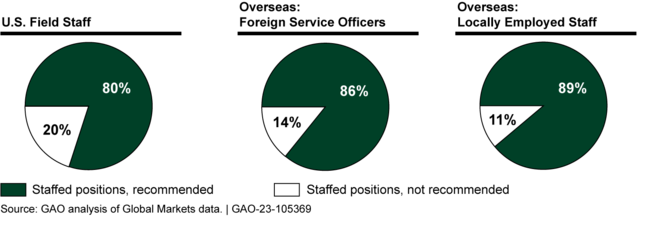
GM's actual allocation of staff differs from its quantitative staffing models, which are meant to help it align staff in its field locations with agency goals and priorities. GM justifies deviations from model recommendations, but does not regularly review the justifications later. GAO found that 156 employees are currently serving in positions that differ from model recommendations, including 20 percent in the U.S. Field (see fig.). GM primarily shifted employees from locations with smaller recommended staffing levels to ones with larger levels. Although the models recommended more, 33 U.S. offices have only one employee to carry out agency duties. GM also has not completely documented the processes to operate and change the models, which raises risks for knowledge retention and consistency in decision-making.
Percent of U.S. Field and Overseas Positions at International Trade Administration's Global Markets Staffed Above Recommended Levels, Fiscal Year 2022
GM lacks a workforce plan that covers all employees. Employees have reported issues with how GM conducts key workforce activities, such as succession planning and managing diversity, equity, inclusion, and accessibility. They also noted issues with how GM provides human resource services like recruiting, hiring, and payroll. Best practices in workforce management stress the importance of having comprehensive strategic workforce plans and core human capital services to support an agency's mission. GM's human resources office also has had chronic vacancies that reduce its ability to provide those services. Without a comprehensive strategic workforce plan and effective human resource services, GM risks not being able to carry out its mission effectively.
Why GAO Did This Study
With 1,440 employees in the U.S. and overseas as of fiscal year 2021, GM assists U.S. businesses to enter and expand international markets, advance U.S. business interests abroad, and attract investment. However, GAO previously found that GM had weaknesses in management controls and in workforce planning and hiring, and faced difficulties in conducting core mission activities.
Congress included a provision in the Joint Explanatory Statement accompanying the Consolidated Appropriations Act for fiscal year 2021 for GAO to assess GM's workforce. This report examines (1) challenges related to changes in GM's organizational structure; (2) how GM's budget affected its workforce over time; (3) the extent to which GM has aligned its resources to meet key goals and priorities; and (4) the extent to which GM has undertaken key workforce management practices.
GAO reviewed agency documents on organizational consolidation, strategic planning, and staffing procedures. GAO also collected workforce data and information on resource allocation decision making. GAO also convened focus groups of employees.
Recommendations
GAO is making four recommendations to Commerce to (1) document the processes for updating staff allocation models, (2) regularly review the need for positions that exceed model recommendations, (3) develop a comprehensive workforce plan, and (4) address human capital office vacancies. Commerce concurred with GAO's recommendations.
Recommendations for Executive Action
| Agency Affected | Recommendation | Status |
|---|---|---|
| Department of Commerce | The Secretary of Commerce should ensure that the Director General of Global Markets fully documents how to use the staffing models and the process for updating the models, including changes to the variables and weights. (Recommendation 1) |
In May 2023, we reported that the Department of Commerce's Office of Global Talent Management (OGTM) annually use staffing models to align its staff, but did not fully document the process, which raised knowledge retention risks. Furthermore, without fully documenting the process for updating its staffing models, Global Markets (GM) could not ensure consistency in how the models function and might have been unable to retain institutional knowledge of this important part of staff allocation. We recommended that the Secretary of Commerce should ensure that the Director General of Global Markets fully documents how to use the staffing models and the process for updating the models, including changes to the variables and weights. The Department of Commerce concurred with our recommendation. Officials noted that updating the staffing models began in 2021 and that, at that time, the Deputy Assistant Secretary for Global Operations conducted an internal study on how bridge human capital gaps across Global Markets. According to agency documents, as of February 2024, GM holds an annual leadership meeting that has the goals of (1) reviewing the existing models and recommending any edits so that the models reflect changes to Administration and regional organizational priorities, and (2) ensures that the models effectively process relevant data points. These edits include structural changes such as adding or removing variables, as well as editing the weight assigned to a given variable. As a result of these changes, the agency is positioned to ensure consistency in how the models function and will be better able to retain institutional knowledge of this important part of staff allocation.
|
| Department of Commerce | The Secretary of Commerce should ensure that the Director General Global Markets regularly reviews the allocation of Foreign Commercial Service Officers and U.S. Field staff, including the justifications of positions that continue to exceed modeled projections for domestic and overseas posts. (Recommendation 2) |
In May 2023, we reported that the Department of Commerce's Global Markets Office (GM) allocated staff differently than the results of its quantitative staffing model but did not regularly review the justification of these deviations. GM developed an overseas staffing model and a domestic staffing model to ensure GM's staffing decisions reflect the broader organization objectives of promoting U.S. exports and protecting U.S. business interests abroad. They developed those models in response to an August 2010 GAO report. GM officials can increase the number of positions in any given post above the models' recommended levels based on other variables such as future economic changes. We found, however, that GM does not regularly review prior staffing decisions that increased the level of staff at overseas and domestic field locations , which may lead to misalignment of staff with its strategic priorities over time. By not regularly reviewing the placement of personnel in locations above the recommendations of its staffing models, GM may not be fully aligning its resources with its stated goals and priorities. These decisions are important to revisit so that GM can keep its staff resources aligned with current priorities. Without regularly reviewing these decisions, GM cannot ensure it places the right people, in the appropriate places, at the best time. We recommended that the Secretary of Commerce should ensure that the Director General of GM regularly reviews the allocation of foreign and domestic field staff, including justifications of positions that continue to exceed modeled projections for domestic and overseas posts. The Department of Commerce concurred with our recommendation. According to Commerce, the Director General now regularly reviews the allocation of foreign and domestic field officials to best utilize personnel to implement Administration priorities. For example, in calendar year 2025, GM used the Deferred Resignation Program, Voluntary Early Retirement Authority/Voluntary Separation Incentive Payments, and normal attrition to recalibrate its domestic field staff. Additionally, GM further clarified that exceptions to the overseas staffing model projections are temporary and time-limited, with regular review by an assignments panel chaired by the Director General. As a result of these reviews, the agency can better ensure that it is fully aligning is staff resources with stated goals and priorities.
|
| Department of Commerce | The Secretary of Commerce should ensure that there is a workforce plan that comprehensively and strategically considers GM's entire overseas and domestic workforce and describes leadership action to improve diversity, equity, inclusion, and accessibility. (Recommendation 3) |
In May 2023, we reported that the Department of Commerce's Global Markets Office (GM) did not have a comprehensive workforce plan that covered all employees despite best practices that stress the importance of having comprehensive strategic workforce plans. For example, different offices within GM conduct strategic workforce planning separately for the overseas versus domestic staff. Without a comprehensive workforce plan, GM may be unable to build and manage a workforce tailored to employee and mission needs. Furthermore, we found that GM's strategic planning did not reflect the values of diversity, equity, inclusion, and accessibility (DEIA), as required in Executive Orders (EO) 14035 and 13985. In fact, different offices managed their DEIA-related efforts separately and did not put a focus on DEIA issues that made it unclear how GM could meet the expectations for federal government employers to comply with the EOs. The Department of Commerce concurred with our recommendation. According to Commerce, it has completed a comprehensive and strategic consideration of GM's entire overseas and domestic workforce. GM rebalanced staff to serve the Administration's priorities and allocating them in order to accomplish its mission. For example, each segment of GM's workforce, including its international and domestic field staff, have undergone a review that has established a plan to deploy personnel in the most effective way to support the priorities of GM and the Administration. Commerce did note, however, that it now complies with Executive Order 14151 which ended the previous EOs focused on DEIA issues. Although Commerce does not address DEIA values in its planning due to the recent EOs, the comprehensive workforce plan that aligns domestic and overseas staff with priorities improves GM's ability to provide quality services to their U.S. business clients.
|
| Department of Commerce | The Secretary of Commerce should ensure that the Director General of Global Markets takes steps to address staffing vacancies in the Office of Global Talent Management. (Recommendation 4) |
In May 2023, we reported that the Department of Commerce's Office of Global Talent Management (OGTM) had chronic vacancies that reduced its ability to provide core human capital services to its overseas Foreign Commercial Service staff . Such staff rotate frequently, and officers posted overseas require more human capital support for themselves and their families due to these changes in duty stations. By not fully staffing OGTM, GM created a high turnover rate among OGTM employees and hindered its ability to develop long-term knowledge and skills required to manage the complex needs of a global workforce. GM employees overseas experienced a level of service that can negatively affect their work. These services are critical for ensuring that GM employees can focus on their mission of providing services to U.S. based companies and promoting exports abroad. The Department of Commerce concurred with our recommendation. Officials responded that addressing staff vacancies in OGTM was a priority for the organization. According to agency documents, as of Feb 2024, Commerce has hired additional staff that decreased the number of open vacancies from 7 to 2 out of 30 positions (or 71 percent). In addition, agency officials said staff turnover in the office had decreased. As a result of this increased capacity, the agency is positioned to improve the delivery of core human capital services to its personnel working and living overseas, which will help ensure that employees can carry out their mission of export promotion as effectively as possible.
|