
Defense Logistics: DOD Can Better Manage Demilitarization Coding and Disposition Decisions
Fast Facts
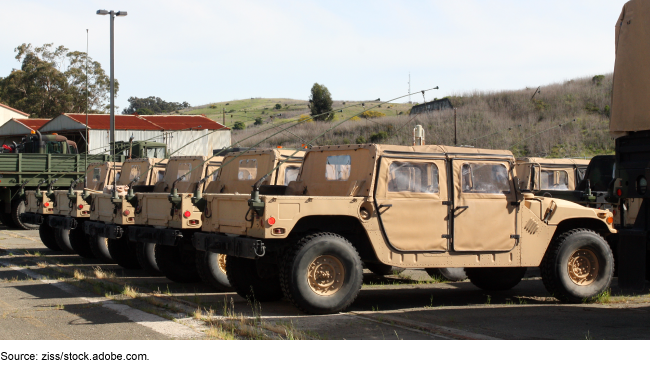
Every year DOD disposes of "major end items" such as Humvees. Some may be sold or given to other agencies after being demilitarized. Items are assigned a demilitarization code that determines the required action—the degree of disassembly, for example.
Code application was mostly consistent in the 437 categories we examined. However, in 13 cases the same items were assigned different codes and there was no process for reconciling differences.
Also, officials from 3 military services told us most of the Humvees they turned in were destroyed, because the officials lacked guidance on other options.
Our recommendations address these issues.
Highlights
What GAO Found
Each year the Department of Defense (DOD) divests itself of thousands of items of property, which includes major end items, such as High-Mobility Multipurpose Wheeled Vehicles, other tactical vehicles, and certain types of cargo trucks and trailers, through the defense materiel disposition program. DOD consistently applied demilitarization codes for most, but not all, of the major end items GAO examined for fiscal years 2019–2021. Specifically, of the codes for the 437 national stock numbers GAO examined, 413 were consistent and 24 were not. Of the 24, 13 did not have documentation explaining the rationale for the differences in codes across DOD's databases, including those maintained by the military services. The Defense Logistics Agency (DLA) is responsible for ensuring that demilitarization codes are consistent across DOD and documenting any code changes. However, DLA officials were unsure how the inconsistencies GAO identified occurred because they do not have a reconciliation process that enables DLA to identify and reconcile codes across DOD's various databases. Without fully documenting changes, including pending changes, to demilitarization codes to ensure consistent use across the department, DOD risks that major end items, including sensitive items, may be inadvertently released to the general public or that items eligible for release may be needlessly destroyed.
Air Force's High-Mobility Multipurpose Wheeled Vehicles
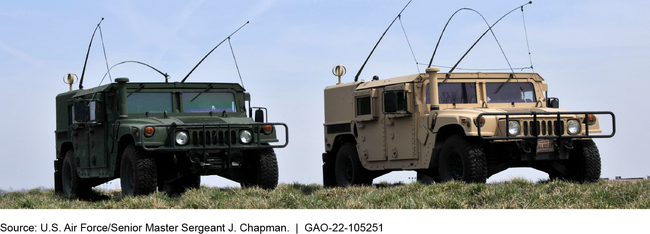
DOD guidance states that each military service is responsible for determining how to dispose of items it no longer needs. However, military service officials stated that they lacked guidance on what factors to consider when making disposition decisions for major end items, such as High-Mobility Multipurpose Wheeled Vehicles. Three military services turned in their unneeded High-Mobility Multipurpose Wheeled Vehicles to DLA, where most were eventually destroyed. According to Army officials, the Army reclaimed usable parts, such as engines, transmissions, and tires, providing DLA with little more than chassis. Military service officials stated that they opted to turn in the items because of the lack of guidance on assessing other disposal options. In the absence of such guidance, there is the risk that the expected outcomes of DOD's materiel disposition program—safeguarding national security interests, minimizing the destruction of government property, and optimizing monetary return to the U.S. government—will not be achieved.
Why GAO Did This Study
DLA manages, controls, and oversees DOD's materiel disposition program for property, including major end items, the department no longer needs. On the basis of an assigned code, many of these items must be demilitarized before being reused, transferred to other agencies, donated, sold, or destroyed.
Senate Report 116-236 (2020) included a provision for GAO to review DOD's demilitarization process and how it informs the disposal of items the military services no longer need. GAO assessed the extent to which (1) DOD consistently used the established demilitarization coding process for selected major end items and (2) the military services have established an approach for determining how to dispose of major end items they no longer need. GAO analyzed fiscal year 2019–2021 DLA and military service demilitarization codes and disposition information for major end items commonly sold to the public.
Recommendations
GAO makes two recommendations that (1) DOD establish a process to review and reconcile demilitarization codes and document changes and (2) develop guidance on how to, when disposing of major end items, assess potential risks to national security and avoid unnecessary destruction, among other things. DOD did not concur with either recommendation stating DLA's processes mitigate coding inaccuracies, the military services share responsibility for inaccuracies, and DLA lacks responsibility for assessing risk. In response, GAO clarified both recommendations and maintain they remain valid.
Recommendations for Executive Action
| Agency Affected | Recommendation | Status |
|---|---|---|
| Department of Defense | The Secretary of Defense should ensure that the Under Secretary of Defense for Acquisition and Sustainment, in coordination with the Director of the Defense Logistics Agency and the military services, establishes a process to review and reconcile inconsistent demilitarization codes and document changes, including pending changes, in the Federal Logistics Information System to ensure that major end items' demilitarization codes are up to date and consistent across DOD and the military services. (Recommendation 1) |
As of June 2026, we are closing this recommendation as implemented. In our September 2022 report, we found that the Department of Defense (DOD) did not consistently apply demilitarization codes for most of the major end items (e.g., materials ready for use like aircraft, ships, and motorized wheeled, tracked, and towed vehicles) GAO examined from fiscal years 2019-2021. The Defense Logistics Agency (DLA) is responsible for ensuring that demilitarization codes are consistent across DOD and for documenting any code changes. However, DLA officials were unsure of how the inconsistencies we identified occurred, because DLA did not have a reconciliation process that enabled them to identify and reconcile demilitarization codes across DOD's various databases. We recommended that DOD establish a process to review and reconcile demilitarization codes and document changes when disposing of major end items. DOD partially concurred with this recommendation and, as of June 2026, has taken actions to implement it. For example, in 2023 DLA established a Demilitarization Code Challenge Process, which consists of two primary ways to reconcile inconsistent demilitarization codes. The first is through their Warehouse Management System, where the DLA disposition process can identify and reconcile items directly within their internal system, and the second is through a Mailbox system where both Common Access Card and non-Common Access Card users can submit reconciliation requests for demilitarization codes in question. Additionally, in June 2026, DOD updated the Federal Logistics Information System, which facilitates the established process for approving and rejecting recommended demilitarization codes, by implementing several system upgrades that would provide the military services with more efficient means to validate demilitarization codes and expedite the collaboration process, among other things. By establishing this process and its associated systems upgrades, DOD is better positioned in mitigating potential risks to national security by preventing the inadvertent release of major end items to the public and by avoiding the unnecessary destruction of items that may be eligible for release.
|
| Department of Defense | The Secretary of Defense should ensure that the Under Secretary of Defense for Acquisition and Sustainment, in coordination with the Director of the Defense Logistics Agency, develops guidance on how the military services should assess potential risks to national security, avoid the unnecessary destruction of government property, and optimize monetary returns to the U.S. government when making disposition decisions on unneeded major end items. (Recommendation 2) |
Each year DOD divests itself of thousands of unneeded items. If properly demilitarized when required, some items may be transferred to other federal and state entities, sold, exchanged, or destroyed. The military services also play an important role in deciding how to dispose of unneeded equipment, it is essential that the military services have guidance to ensure their disposition decisions safeguard national security interests, minimize the destruction of government property, and realize optimum monetary return to the U.S. government. As such, we recommended that guidance be developed for the military services on how to, when disposing of major end items, assess potential risks to national security and avoid unnecessary destruction, among other things. DOD originally partially agreed to this recommendation, but in April 2024, DOD told us they disagreed with it. Specifically, DOD stated that DLA's role with developing guidance on assessing risk is out of their scope and is a responsibility that resides with the Military Departments. We believe the recommendation remains valid. As of June 2026, this recommendation remains open.
|