
Navy Shipbuilding: Increasing Supervisors of Shipbuilding Responsibility Could Help Improve Program Outcomes
Fast Facts
The Navy often accepts delivery of incomplete ships after significant delays in construction and considerable cost growth.
At major shipyards, the Navy has an onsite organization—the Supervisors of Shipbuilding, Conversion, and Repair—that's responsible for overseeing construction and managing shipbuilding contracts. The Supervisors' expertise provides foresight into shipbuilding problems, but we found the Navy isn't taking full advantage of it.
Among other things, we recommended ensuring that the Supervisors are consistently represented earlier in the shipbuilding process, starting before contracts are awarded.
A crane moves the lower stern into place on an aircraft carrier.

Highlights
What GAO Found
Over the past decade, GAO found that the U.S. Navy has faced significant challenges in meeting its shipbuilding goals, experiencing years of construction delays, billions of dollars in cost growth, and frequent quality and performance shortfalls. The Supervisors of Shipbuilding, Conversion and Repair (SUPSHIP) serve as the Navy's on-site technical, contractual, and business authority for the construction of Navy vessels at major private shipyards. The SUPSHIPs are responsible for evaluating the construction and business practices of Navy shipbuilders, but face challenges in improving shipbuilding results (see figure).
Factors Limiting the Ability of the Navy's Supervisors of Shipbuilding, Conversion and Repair (SUPSHIP) to Help Improve Shipbuilding Program Results
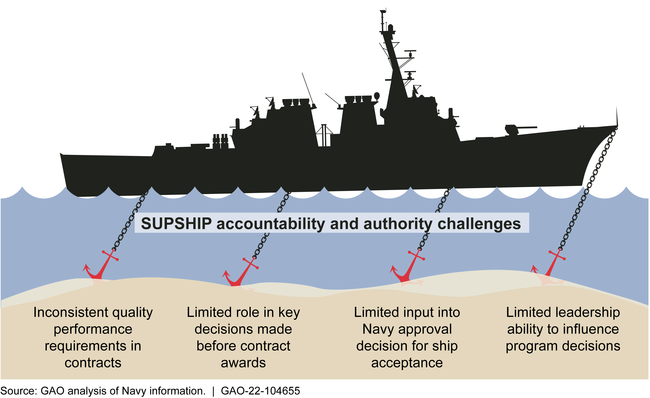
These challenges impede the SUPSHIPs' effectiveness and accountability in a number of ways:
- Variation in quality requirements across Navy shipbuilding contracts hinders the SUPSHIPs' ability to provide consistent oversight of shipbuilding quality.
- Limited input from the SUPSHIPs prior to contract awards does not leverage their expertise to support well-informed decision-making.
- Omission of SUPSHIP reporting from the Navy's process for approving acceptance of ships from the shipbuilders reduces accountability and misses opportunities to ensure that independent SUPSHIP input on ship quality and readiness informs this key decision.
- The SUPSHIPs' position within the Naval Sea Systems Command and their accountability to different technical and acquisition organizations dilutes their ability to be a distinct, authoritative voice in decision-making for Navy shipbuilding programs. Congress passed legislation in December 2021 to establish a Deputy Commander dedicated to the SUPSHIPs, which should help improve their authority and accountability.
Why GAO Did This Study
Despite the efforts of the SUPSHIPs and others to assure construction quality and contract execution, Navy shipbuilding results have regularly fallen short of program expectations. These results have raised questions about the Navy's ability to effectively oversee shipbuilder performance throughout the construction of new ships.
Congress included a provision in a Senate report for GAO to review the SUPSHIPs' oversight efforts. GAO examined, among other objectives, the SUPSHIPs' role in assuring shipbuilding quality and any challenges that limit their ability to help improve shipbuilding program results.
To do this work, GAO reviewed federal regulations as well as policy, guidance, and reporting related to the SUPSHIPs' oversight activities and results. GAO also interviewed DOD and Navy officials about shipbuilding oversight and the SUPSHIPs' role in the execution of shipbuilding programs.
Recommendations
GAO is making five recommendations to the Navy, including that it take steps to ensure regular use of its quality program standard in shipbuilding contracts; provide the SUPSHIPs with direct representation in evaluation and decision-making processes prior to contract awards; and require the SUPSHIPs to report on the quality and readiness of each ship prior to the Chief of Naval Operations' approval decisions for ship acceptance. The Navy agreed with all five recommendations.
Recommendations for Executive Action
| Agency Affected | Recommendation | Status |
|---|---|---|
| Department of the Navy | The Secretary of the Navy should determine if the Naval Sea Systems Command's Quality Program Standard for Construction of Naval Vessels requires any updates and then take steps to ensure regular use of the standard in Navy shipbuilding contracts. (Recommendation 1) |
The Department of the Navy concurred with this recommendation but, as of August 2026, has yet to demonstrate actions to implement it. In July 2026, the Navy provided its new SUPSHIP Guiding Principles document. The Navy stated that these principles shift the SUPSHIP quality oversight away from a compliance check to data-driven, risk-based framework. However, these guiding principles do not include information on how the Navy is contractually ensuring consistent quality requirements across shipbuilding programs. We will continue to monitor the Navy's actions in response to this recommendation to ensure that consistent quality requirements are included in shipbuilding contracts to support effective shipbuilding surveillance.
|
| Department of the Navy | The Secretary of the Navy should evaluate whether opportunities exist for additional targeted oversight by the SUPSHIPs of critical government-furnished equipment away from the shipyards to support improvements to overall shipbuilding results. (Recommendation 2) |
The Department of the Navy concurred with this recommendation and in July 2026 included relevant information in its new SUPSHIP Guiding Principles that covered government contract quality assurance at the source. This guidance specifies government responsibility to conduct independent oversight at the source for the most critical components along with the SUPSHIPs' responsibilities to ensure shipbuilders execute a risk-based surveillance plan. The guidance also includes expectations that, when deemed necessary and properly assessed for risk, the SUPSHIP has authority to delegate oversight and inspection responsibilities at a subcontractor's facility to appropriate government agencies. This guidance supports continued evaluation of the need for targeted oversight away from the shipyards and corresponding action to provide such oversight, consistent with the intent of this recommendation.
|
| Department of the Navy | The Secretary of the Navy should ensure that, prior to contract award decisions, the Naval Sea Systems Command evaluates the extent to which awarding a shipbuilding contract to a prime contractor that is not the shipbuilder presents additional government risk related to contractor business systems compliance and determine options, as needed, to mitigate the risk. (Recommendation 3) |
The Department of the Navy concurred with this recommendation but, as of August 2026, has yet to demonstrate actions to implement it. The Navy stated that it is working on a memo to confirm that the Program Acquisition Executives now have the responsibility to evaluate the risk of awarding a shipbuilding contract to a prime contractor that is not the shipbuilder. We will continue to monitor the Navy's actions in response to this recommendation to ensure that the Navy sufficiently accounts for any applicable risk to the government from a prime contractor not being the shipbuilder for a shipbuilding program.
|
| Department of the Navy | The Secretary of the Navy should ensure that Naval Sea Systems Command Instruction 5450.36C, Mission, Functions, and Tasks of the Supervisors of Shipbuilding, Conversion and Repair, United States Navy, is updated to provide the SUPSHIPs direct representation in the evaluation and decision-making processes for all shipbuilding programs, beginning with the pre-contract award stages of requirements development and ship design. (Recommendation 4) |
The Department of the Navy concurred with this recommendation and as of August 2026, has taken steps to implement it. In July 2026, the Navy provided its new SUPSHIP Guiding Principles document. As part of this guidance the SUPSHIPs may provide pre-award expertise. However, this guidance does not fully include the SUPSHIPs into the decision-making process. We will continue to monitor the Navy's actions in response to this recommendation to ensure direct SUPSHIP representation in decision-making processes for shipbuilding programs.
|
| Department of the Navy | The Secretary of the Navy should require that, in coordination with the Commander of Naval Sea Systems Command, the SUPSHIPs' Deputy Commander provide a report to the Chief of Naval Operations that attests to the quality and readiness of each ship prior to the approval of ship acceptance. (Recommendation 5) |
The Department of the Navy concurred with the intent of this recommendation and in July 2026 included relevant information in its new SUPSHIP Guiding Principles that supports the use of SUPSHIP input to inform Navy ship acceptance decisions. Specifically, this guidance states that the SUPSHIPs will ensure that all aspects of a vessel are ready for the next phase of its life and certify readiness when making a recommendation to the Chief of Naval Operations for delivery. Consistent with our recommendation's intent, this guidance will help improve accountability for ship delivery decisions and ensure that leadership receives relevant information to inform decisions.
|