
Telecommunications: FCC Should Enhance Performance Goals and Measures for Its Program to Support Broadband Service in High-Cost Areas
Fast Facts
The Federal Communications Commission has a program to help ensure universal access to broadband service in rural, remote, and other areas of the country that are costly to serve. The program provides billions of dollars to telecommunications companies each year to deploy broadband services.
But the FCC needs additional data on how the program is working, to help drive decisions on effective use of available funds. Also, the FCC's public reports don't address the program's performance goals as written, raising questions about just how effective the program is.
Our recommendations are to help the FCC improve its monitoring of this program.
Providing broadband to remote rural areas can be costly.

Highlights
What GAO Found
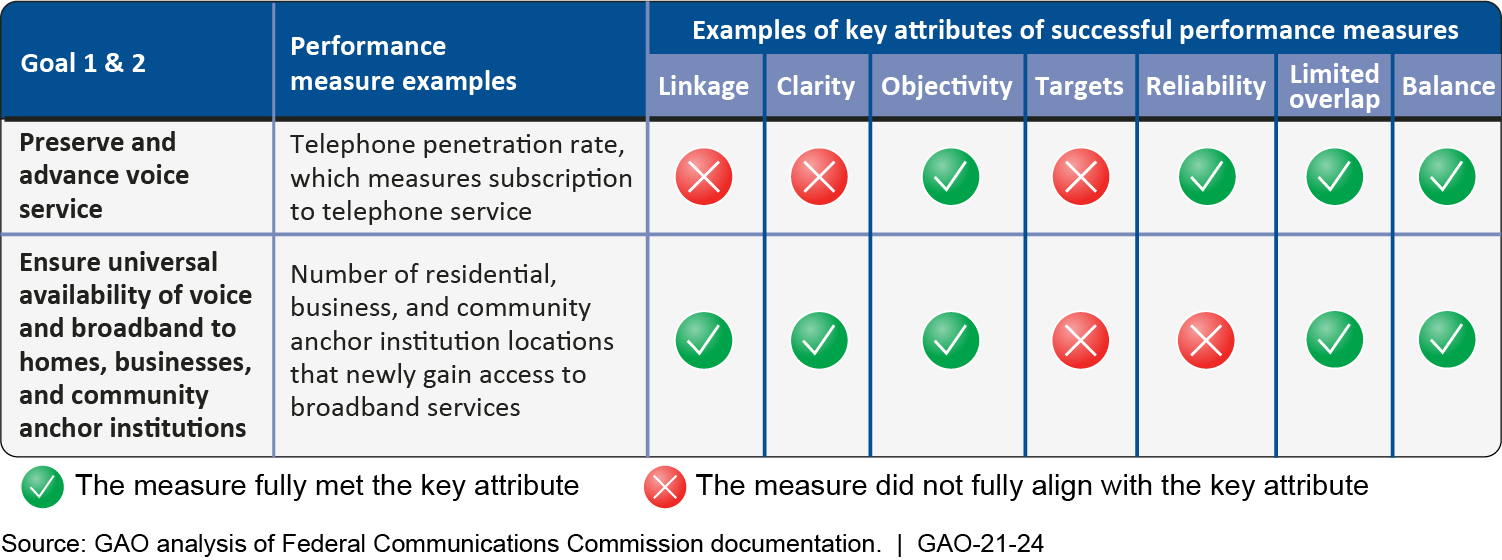
The Federal Communications Commission (FCC) has a program, known as the high-cost program, to promote broadband deployment in unserved areas. Although the performance goals for the high-cost program reflect principles in the Telecommunications Act of 1996, not all of the goals are expressed in a measurable or quantifiable manner and therefore do not align with leading practices. Furthermore, FCC's measures for its performance goals do not always align with leading practices, which call for measures to have linkage with the goal they measure and clarity, objectivity, and measurable targets, among other key attributes. For example, as shown below for two of FCC's five goals, GAO found that FCC's measures met most, but not all, of the key attributes. By establishing goals and measures that align with leading practices, FCC can improve the performance information it uses in its decision-making processes about how to allocate the program's finite resources. Leading practices also suggest that agencies publicly report on progress made toward performance goals. FCC does so, however, only in a limited fashion which may lead to stakeholder uncertainty about the program's effectiveness.
Examples of FCC’s Performance Measures Compared with a Selection of Key Attributes of Successful Performance Measures
According to stakeholders GAO interviewed, FCC faces three key challenges to accomplish its high-cost program performance goals: (1) accuracy of FCC's broadband deployment data, (2) broadband availability on tribal lands, and (3) maintaining existing fixed-voice infrastructure and attaining universal mobile service. For example, although FCC adopted a more precise method of collecting and verifying broadband availability data, stakeholders expressed concern the revised data would remain inaccurate if carriers continue to overstate broadband coverage for marketing and competitive reasons. Overstating coverage impairs FCC's efforts to promote universal voice and broadband since an area can become ineligible for high-cost support if a carrier reports that service already exists in that area. FCC has also taken actions to address the lack of broadband availability on tribal lands, such as making some spectrum available to tribes for wireless broadband in rural areas. However, tribal stakeholders told GAO that some tribes are unable to secure funding to deploy the infrastructure necessary to make use of spectrum for wireless broadband purposes.
Why GAO Did This Study
Millions of Americans do not have access to broadband. Within the Universal Service Fund, FCC's high-cost program provided about $5 billion in 2019 to telecommunications carriers to support broadband deployment in unserved areas where the cost to provide broadband service is high. In 2011, FCC established five performance goals and related measures for the high-cost program.
GAO was asked to review the high-cost program's performance goals and measures. This report examines: (1) the extent to which the program's performance goals and measures align with leading practices to enable the effective use of performance information and (2) the key challenges selected stakeholders believe FCC faces in meeting the program's goals. GAO reviewed FCC's program goals and measures and assessed them against applicable criteria, including GAO's leading practices for successful performance measures. GAO interviewed FCC officials and representatives from industry, tribal carriers, consumer advocates, and other stakeholders, to obtain a variety of non-generalizable viewpoints.
Recommendations
GAO is making four recommendations, including that FCC should ensure its high-cost program's performance goals and measures align with leading practices and publicly report on progress measured toward the goals. FCC concurred with all four recommendations.
Recommendations for Executive Action
| Agency Affected | Recommendation | Status |
|---|---|---|
| Federal Communications Commission | The Chairman of FCC should revise the high-cost performance goals so that they are measurable and quantifiable. (Recommendation 1) |
In 2011, FCC established performance goals for the high-cost program. We interviewed FCC officials and representatives from industry, tribal carriers, consumer advocates, and other stakeholders, to obtain a variety of non-generalizable viewpoints about these performance goals and compared them to leading practices. In 2020, we reported that, according to leading practices, effective organizations set performance goals that clearly define intended program outcomes, and that are objective, quantifiable, and measurable. FCC and most stakeholders we interviewed agreed that FCC's high-cost program performance goals generally reflected important and appropriate strategic objectives for the high-cost program. However, we found that FCC's performance goals did not fully align with leading practices because the goals were not always expressed in a measurable or quantifiable manner. Therefore, we recommended that FCC revise the high-cost performance goals so that they are measurable and quantifiable. In 2024, we confirmed that FCC revised its high-cost program performance goals. In particular, FCC's 2022-2026 Strategic Plan includes an overarching goal to "Pursue a 100 Percent Broadband Policy" and FCC adopted the following performance goals: universal deployment, affordability, adoption, and equitable access to broadband throughout the United States. FCC describes these goals in a 2024 report and provides more detail on how FCC intends to measure each goal. For example, with respect to adoption, FCC clarifies that "we consider our goal of universal adoption to be a universal lack of barriers to adoption other than service availability and service affordability - not 100 percent adoption." To assess broadband adoption, FCC used connection data reported by telecommunications carriers and determined that as of year-end 2022, approximately 42 percent of households subscribe to broadband at FCC's broadband speed benchmark of 100/20 megabits per second (Mbps) when it is available. By revising the high-cost performance goals to make them measurable and quantifiable, FCC is better able to demonstrate whether it is achieving desired high-cost program outcomes.
|
| Federal Communications Commission | The Chairman of FCC should ensure high-cost performance measures align with key attributes of successful performance measures, including ensuring that measures clearly link with performance goals and have specified targets. (Recommendation 2) |
As of April 2025, FCC is seeking input on how to measure whether high-cost program goals have been met and which data to use in making such determinations. As of April 2026, we are awaiting additional information from FCC. When we confirm that FCC has taken additional action, we will provide updated information.
|
| Federal Communications Commission | The Chairman of FCC should ensure the high-cost performance measure for the goal of minimizing the universal service contribution burden on consumers and businesses takes into account user-fee leading practices, such as equity and sustainability considerations. (Recommendation 3) |
As of April 2025, FCC confirmed that minimizing the universal service contribution burden on consumers and businesses is no longer a goal for the Universal Service Fund. As of April 2026, we are awaiting additional information from FCC. If FCC takes any action related to this recommendation, we will provide updated information.
|
| Federal Communications Commission | The Chairman of FCC should publicly and periodically report on the progress it has made for its high-cost program's performance goals, for example, by including relevant performance information in its Annual Broadband Deployment Report or the USF Monitoring Report. (Recommendation 4) |
In 2011, FCC established performance goals for the high-cost program. We interviewed FCC officials and representatives from industry, tribal carriers, consumer advocates, and other stakeholders, to obtain a variety of non-generalizable viewpoints about these performance goals and compared them to leading practices. In 2020, we reported that, according to leading practices, effective organizations set performance goals that clearly define intended program outcomes, and that are objective, quantifiable, and measurable. FCC and most stakeholders we interviewed agreed that FCC's high-cost program performance goals generally reflected important and appropriate strategic objectives for the high-cost program. However, we found that FCC's performance goals did not fully align with leading practices because the goals were not always expressed in a measurable or quantifiable manner. Therefore, we recommended that FCC revise the high-cost performance goals so that they are measurable and quantifiable. In 2024, we confirmed that FCC revised its high-cost program performance goals. In particular, FCC's 2022-2026 Strategic Plan includes an overarching goal to "Pursue a 100 Percent Broadband Policy" and FCC adopted the following performance goals: universal deployment, affordability, adoption, and equitable access to broadband throughout the United States. FCC describes these goals in a 2024 report and provides more detail on how FCC intends to measure each goal. For example, with respect to adoption, FCC clarifies that "we consider our goal of universal adoption to be a universal lack of barriers to adoption other than service availability and service affordability - not 100 percent adoption." To assess broadband adoption, FCC used connection data reported by telecommunications carriers and determined that as of year-end 2022, approximately 42 percent of households subscribe to broadband at FCC's broadband speed benchmark of 100/20 megabits per second (Mbps) when it is available. By revising the high-cost performance goals to make them measurable and quantifiable, FCC is better able to demonstrate whether it is achieving desired high-cost program outcomes.
|