
National Nuclear Security Administration: Information on the Fiscal Year 2021 Budget Request and Affordability of Nuclear Modernization Activities
Fast Facts
The Department of Energy's National Nuclear Security Administration is in the middle of a long-term effort to modernize the U.S. nuclear weapons stockpile.
DOE's 2021 budget estimate for nuclear modernization activities for FYs 2021-2025 is $81 billion—$15 billion more than its 2020 budget estimate for the same period.
Such an increase may require cuts in other national defense programs to keep the defense budget within spending limits.
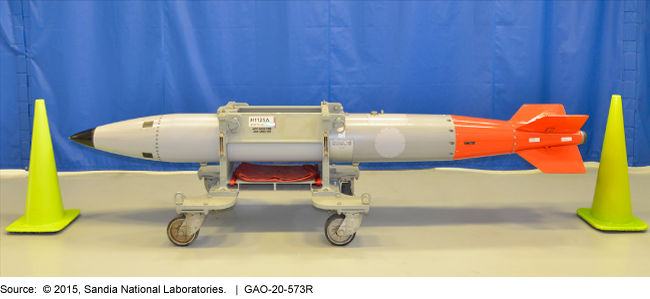
A model of the B61-12 Nuclear Bomb
Highlights
What GAO Found
The Department of Energy's (DOE) National Nuclear Security Administration (NNSA) is in the midst of a long-term effort to modernize the U.S. nuclear weapon stockpile and its supporting production infrastructure. NNSA's modernization plans and budgets are communicated to Congress on an annual basis primarily through two key documents—the Stockpile Stewardship and Management Plan (SSMP) and DOE's budget justification—together referred to as NNSA's nuclear security budget materials. GAO reviewed four areas related to the affordability of NNSA's modernization activities as described in these budget materials:
Funding for nuclear modernization activities. Congress funds NNSA's nuclear modernization activities through the Weapons Activities appropriation account, which falls under the National Defense budget function along with other NNSA, DOE, and Department of Defense (DOD) appropriations related to the common defense and security of the United States. Discretionary defense spending for fiscal year 2021 may not exceed a certain statutory limit, or else a sequestration—a cancellation of budgetary resources—would be triggered. Therefore, a proposed increase for a given program under the National Defense budget function may need to be offset by reductions in other defense programs to keep the defense budget within statutory spending limits.
Comparison of modernization activities in budget materials for fiscal year 2021 and earlier. The proposed funding in DOE's fiscal year 2021 budget justification for NNSA's nuclear modernization activities for fiscal years 2021 through 2025 is about $81 billion, which is about $15 billion more (or about 23 percent greater) compared to NNSA's estimate for the same period in its fiscal year 2020 budget materials. The main factor contributing to this large increase in proposed funding for fiscal year 2021 was NNSA's reevaluation of the funding needed to meet existing requirements, rather than costs associated with new requirements outlined in the 2018 Nuclear Posture Review.
Affordability discussion in the Fiscal Year 2020 SSMP. The Fiscal Year 2020 SSMP included a new section entitled, "Affordability Analysis." NNSA added this section in response to GAO's April 2017 recommendation that the agency include an assessment of its portfolio of modernization programs in future versions of the SSMP. The recommendation addressed a shortfall between NNSA's projected budget needs to meet program requirements and projections of the President's budget, a condition that could recur in the future. GAO found that NNSA's new section on affordability does not fully respond to its recommendation because the section does not provide information about how potential misalignment between NNSA's estimates of future modernization funding needs and projections of the President's modernization budgets may be addressed, or about the potential impacts of adjusting program schedules or cost or schedule overruns.
Implications of potential New START expiration for modernization activities. New START is a treaty between the United States and Russia for the reduction and limitation of strategic offensive arms, and it will expire in February 2021 unless both parties agree to extend it for no more than 5 years. DOD is basing its plans on the assumption that New START will be extended, and it currently has no plans to change its force structure. NNSA similarly has not considered the implications of the potential expiration of New START on the assumptions underlying its overall program of record and future-years funding projections as described in the fiscal year 2021 budget justification.
Why GAO Did This Study
GAO was asked to review issues related to the affordability of NNSA's modernization activities as reflected in its nuclear security budget materials. DOE's fiscal year 2021 budget justification for NNSA includes a proposed $3.1 billion increase for nuclear modernization activities. The budget justification states that it supports the modernization efforts and the scientific tools necessary to execute the 2018 Nuclear Posture Review. Nuclear posture reviews are issued periodically to assess the global threat environment and establish policy on U.S. nuclear forces.
For more information, contact Allison Bawden at (202) 512-3841 or bawdena@gao.gov.