
DHS Service Contracts: Increased Oversight Needed to Reduce the Risk Associated with Contractors Performing Certain Functions
Fast Facts
The Department of Homeland Security relies on contracts to support many missions. But if contractors perform certain critical functions (i.e., determining agency policy or managing budgets) without oversight from government officials, this could put the government at risk of losing control of its decisions and operations.
We looked at how DHS used and oversaw contracts in FY 2013-2018 and found that it didn’t always plan for or update the number of federal personnel needed to oversee such contracts. DHS also did not offer guidance on how to prevent contractors from performing prohibited work.
Our 6 recommendations address these issues.
Homeland Security sign and building
Highlights
What GAO Found
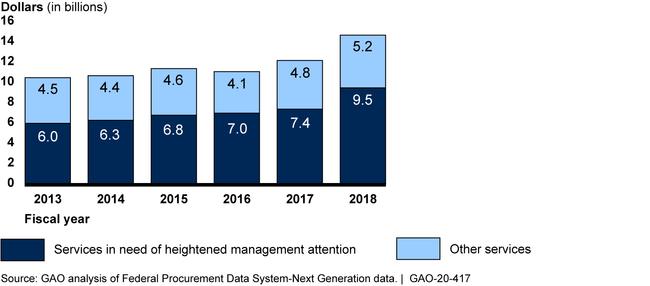
From fiscal years 2013 through 2018, the Department of Homeland Security (DHS) increased its reliance on contracts for services, particularly those in categories that may need heightened management attention, such as drafting policy documents (see figure). These services include functions that are closely associated with inherently governmental, critical, or special interest, which could put the government at risk of losing control of its mission if performed by contractors without proper oversight by government officials.
Proportion of Department of Homeland Security Contract Obligations for Services in Need of Heightened Management Attention, Fiscal Years (FY) 2013 through 2018, in FY 2018 Dollars
GAO found that DHS and selected components do not consistently plan for the level of federal oversight needed for these contracts because there is no guidance on how to document and update the number of federal personnel needed to conduct oversight. GAO also found that program and contracting officials from six of the eight contracts GAO reviewed did not identify specific oversight activities they conducted to mitigate the risk of contractors performing functions in a way that could become inherently governmental. DHS lacks guidance on what these oversight tasks could entail. Without guidance for documenting and updating the planned federal oversight personnel needed, and identifying oversight tasks, DHS cannot mitigate the risks associated with service contracts in need of heightened management attention.
Selected DHS components have information on service requirements, but budget documentation—submitted to DHS headquarters as well as to Congress—does not communicate details about most estimated or actual service contract requirements costs. Given that services account for over three-quarters of DHS's annual funding for contracts, additional insights would shed light into how much of DHS's mission is being accomplished through services, including those requiring heightened management attention. Without more visibility into this information, DHS headquarters and Congress are at risk of not having complete information for sound resource planning and decision-making, particularly as it relates to determining what proposed service contract requirements DHS should prioritize when budgeting.
Why GAO Did This Study
DHS's spending on services—such as guard services and technology support—represents over 75 percent of its annual contract obligations. The Office of Management and Budget has recognized that some service contracts require extra management attention because they pose a risk that the government could lose control of its decisions or operations.
GAO was asked to review DHS's use of and planning for service contracts. This report addresses, among other objectives, the extent to which DHS and selected components and offices use, oversee, and budget for service contracts.
GAO analyzed Federal Procurement Data System-Next Generation data from fiscal years 2013 through 2018; selected non-generalizable samples of four components with high service contract obligations and eight service contracts requiring heightened management attention; and interviewed DHS officials.
Recommendations
GAO is making six recommendations, including that DHS provide guidance for documenting and updating the federal workforce needed to oversee certain service contracts and identifying oversight tasks, and report service requirement information in budget documents to Congress. DHS agreed with two of the recommendations and did not agree with four of them. GAO continues to believe the recommendations are valid, as discussed in the report.
Recommendations for Executive Action
| Agency Affected | Recommendation | Status |
|---|---|---|
| Department of Homeland Security | The Secretary of Homeland Security should direct the DHS Chief Procurement Officer to, in coordination with the Office of Program Accountability and Risk Management, develop a risk-based approach for reviewing service requirements—through the Procurement Strategy Roadmap or other means—to ensure proposed service requirements are clearly defined and reviewed before planning how they are to be procured. (Recommendation 1) |
DHS disagreed with our recommendation, preferring to maintain the status quo in its policy and procedures. However, by doing so, DHS is missing important opportunities to prevent negative acquisition outcomes and the potential for wasted resources. In its response, DHS noted its processes for major acquisitions, however, DHS service programs and contracts did not rise to the level of being reviewed as a major service acquisition. As of May 2025, DHS has not taken additional actions to establish a risk-based headquarters approach for reviewing service requirements.
|
| Department of Homeland Security | The Secretary of Homeland Security should direct the DHS Chief Procurement Officer to document the factors the Office of the Chief Procurement Officer considers when waiving procurement actions from its Procurement Strategy Roadmap to ensure it is consistently considering potential acquisition risks in its planning—including those specific to services. (Recommendation 2) |
DHS did not concur with this recommendation, stating that the factors considered when waiving a Procurement Strategy Roadmap are not static. We have maintained that by not providing its workforce with factors to consider when identifying potential acquisition risk, DHS is missing an opportunity to improve its acquisition planning. However, effective October 3, 2022, DHS removed all requirements related to the Procurement Strategy Roadmap (see Section 3007.102-70 of Chapter 3007, Acquisition Planning, of the Homeland Security Acquisition Manual (HSAM)). The termination of the Procurement Strategy Roadmap was communicated in the HSAM Notice 2022-06 signed September 30, 2022. Given this termination, there is no longer an opportunity for DHS to implement this recommendation.
|
| Department of Homeland Security | The Secretary of Homeland Security should direct the DHS Chief Procurement Officer to update the Inherently Governmental and Critical Functions Analysis to require the identification of special interest functions. (Recommendation 3) |
DHS concurred with this recommendation and, in December 2020, issued an acquisition alert notifying its contracting officials that the Inherently Governmental and Critical Functions Analysis job aid has been revised to include a new drop down section to identify product service codes designated as a special interest function. This revision meets the intent of our recommendation and allows DHS to consistently identify all service requirements, including special interest functions, that require heightened management attention prior to contract award.
|
| Department of Homeland Security | The Secretary of Homeland Security should direct the DHS Chief Procurement Officer to update the Inherently Governmental and Critical Functions Analysis to provide guidance for analyzing, documenting, and updating the federal workforce needed to perform or oversee service contracts requiring heightened management attention. (Recommendation 4) |
DHS did not concur with this recommendation maintaining that the components are certifying that they have sufficient internal capacity or federal employees available for oversight within the Inherently Governmental and Critical Functions Analysis. We continue to believe, however, that without guidance, each component is making its own determination about which factors to consider, and DHS does not know how or whether the components are considering the federal workforce available to oversee service contracts in need of heightened management attention, or what steps, if any, the components are taking to mitigate risks if there are not enough federal personnel available to oversee the contracts after award. As of May 2025, DHS has not taken action to provide this type of guidance to its components.
|
| Department of Homeland Security | The Secretary of Homeland Security should direct the DHS Chief Procurement Officer to develop guidance identifying oversight tasks or safeguards personnel can perform, when needed, to mitigate the risk associated with contracts containing closely associated with inherently governmental functions, special interest functions, or critical functions. (Recommendation 5) |
DHS concurred with this recommendation and, in December 2020, issued an acquisition alert notifying its contracting officials that the Inherently Governmental and Critical Functions Analysis job aid has been updated to include examples of oversight tasks and safeguards. Additionally, DHS revised its Inherently Government and Critical Functions Analysis job aid to require its contracting officials document the specific oversight tasks and safeguards they will use to monitor contractor activities throughout the life of the contract. Providing this list of examples and requiring contracting officials to document the oversight tasks and safeguard they will use throughout the life of the contract, meets the intent of our recommendation and will help DHS to ensure it retains control of its mission and are providing the required heightened management attention for functions considered closely associated with inherently governmental, special interest, or critical.
|
| Department of Homeland Security | The Secretary of Homeland Security should direct the DHS Chief Financial Officer to work with Congress to identify information to include in its annual congressional budget justifications to provide greater transparency into requested and actual service requirement costs, particularly for those services requiring heightened management attention. (Recommendation 6) |
DHS did not concur with this recommendation stating that its annual Congressional Budget Justification and quarterly obligation reports already contain substantial service contract information. We maintain, however, that the service contract information currently included limits visibility for both DHS and Congress into requested and actual service requirements costs. In August 2024, DHS stated that it has reached out to Congress and will identify alternative options for providing additional information on service contracts outside of congressional budget justifications. As of July 2025 no changes have occurred, we will continue to monitor these efforts.
|